
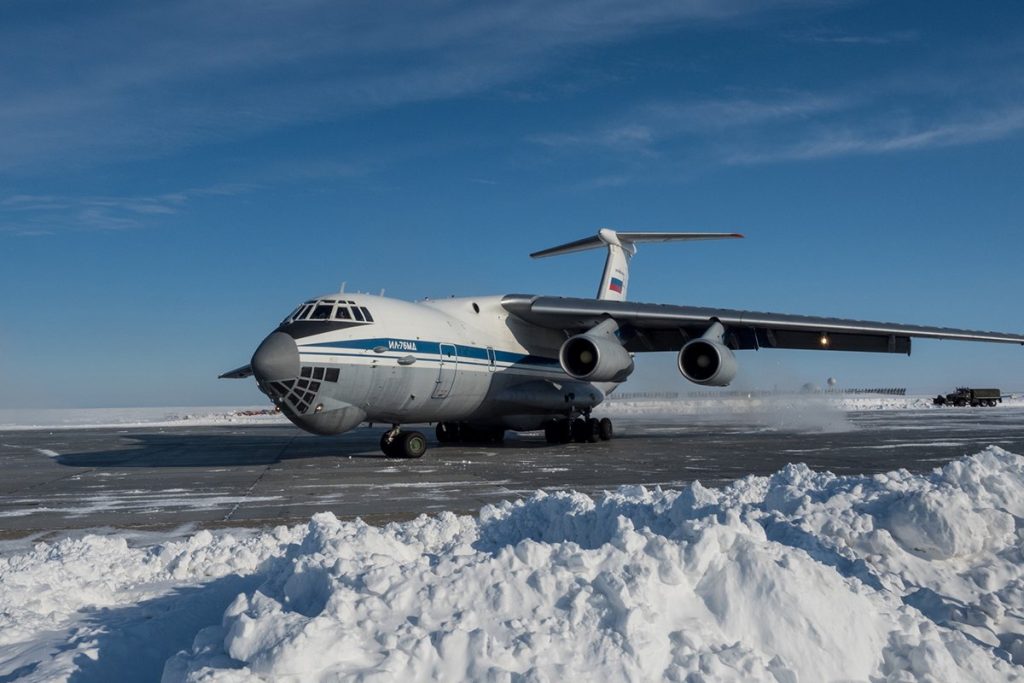
A 2.5-kilometer runway, 42 meters wide, sits on Alexandra Land in the Barents Sea. Russia finished it in 2016, and it is the most visible piece of a northern buildup that analysts at CSIS and the Center for European Policy Analysis trace back to the mid-2000s.
Bases above the Arctic Circle
The runway belongs to the Arctic Trefoil base, which CSIS calls “Russia’s northernmost military outpost.” Russia announced the airfield in April 2015. Heated hangars, radar companies, air traffic control and antiaircraft artillery battalions came with it. Defense Minister Sergei Shoigu said Su-34 or MiG-31 fighters would operate from Nagurskoye Airbase alongside Il-78 tankers, and CSIS notes the field can handle every aircraft type, strategic bombers included.
Distance matters here. A 2018 Danish intelligence assessment concluded that aircraft flying from Nagurskoye could reach the airspace over northeastern Greenland with little warning, which would put Thule Air Base in range.
The island also shields something bigger. Northern Fleet headquarters is at Severomorsk on the Kola Peninsula, home to nuclear submarines, nuclear missiles and long-range cruise missiles. CEPA describes a layered system, inherited from the Soviet “Bastion” concept, with air defense, sea denial and coastal defense placed at choke points to protect that sea-based deterrent and the energy infrastructure on the Yamal Peninsula. Beyond Alexandra Land, the Kremlin has built or modernized bases across Novaya Zemlya, Franz Josef Land, Severnaya Zemlya and the New Siberian Islands.
Exercises and pressure on NATO
In August 2019 the Northern Fleet ran a naval aviation exercise in the Barents and Norwegian Seas with more than 50 aircraft, 30 vessels and nearly 2,000 ground personnel. Norway’s chief of defense, Haakon Bruun-Hanssen, read it as practice for cutting off NATO access to the Baltic, North and Norwegian Seas and slowing reinforcements to Norway.
CEPA’s December 5, 2024 report adds the lower-intensity side: dangerous air maneuvers, electronic warfare and GPS jamming “in Lapland and Finnmark,” with Norwegian aviation disrupted “practically every day.” It also points to the legal front. Moscow treats the Northern Sea Route as “internal waters” under Article 234 of UNCLOS, and a December 2022 law obliges foreign military vessels to give “90 days in advance” notice before passing certain choke points.
What NATO has done
Finland and Sweden joining the alliance changed the northern map. In 2024 the United States signed Defense Cooperation Agreements with Norway, Finland and Sweden, opening access to over 40 military locations, 15 of them in the northern parts of each country. NATO has activated Joint Force Command Norfolk for Arctic operations and set up the Multi Corps Land Component Command in Finland. The US Army brought back its 11th Airborne Division in 2022 as an “Arctic-capable force by design.”
CSIS added a caution in 2020: satellite imagery then did not confirm that Russia had put coastal defense missiles on Alexandra Land.
Sources
- Ice Curtain: Hunting for Russia's Newest Military 'Treasures in the Far North'
- Up North: Confronting Arctic Insecurity (Implications for the United States and NATO)




