
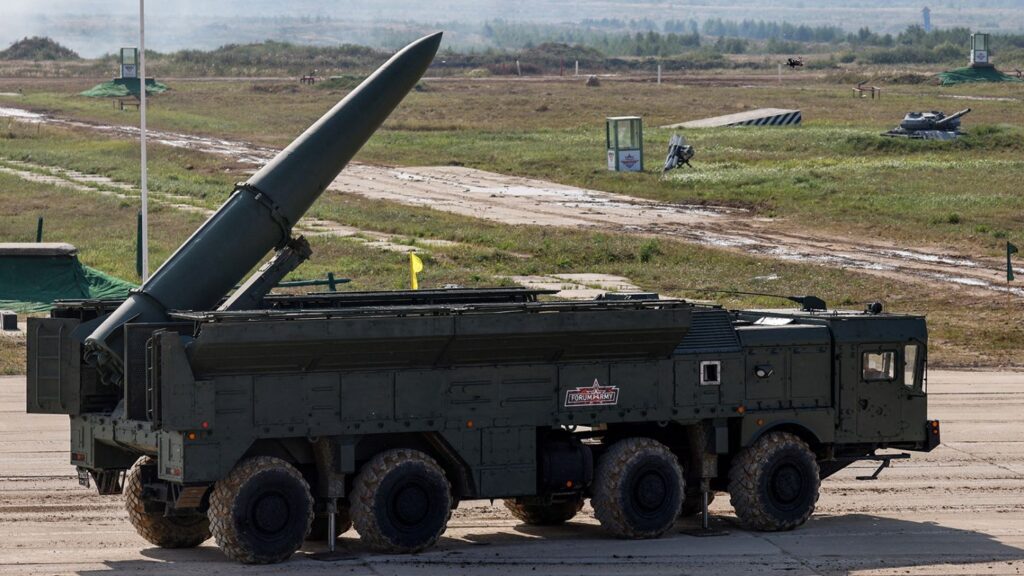
The Soviet Oka missile had an estimated circular error probable of around 50-100 m. For a big, fixed target on well-mapped ground, fine. For anything small, hidden or moving, useless. The Iskander, the 9K720 system that NATO calls the SS-26 Stone, exists largely because Russian designers spent decades fixing that one number.
The analysts at the Royal United Services Institute trace the family tree plainly. The direct technological predecessor of the 9M723 missile was the Oka, not the Tochka, as is often assumed. Work on it probably went on quietly through the 1990s at the Kolomna Machine Bureau, even after Gorbachev traded the Oka away under the Intermediate-Range Nuclear Forces Treaty. The 9M723 entered service in 2006 and has been refined through several iterations since.
What the launcher actually does
The mechanics here start with the truck. Each 9P78-1 launcher rides on an 8×8 MZKT-7930 chassis from the Minsk Tractor Plant in Belarus, weighs 42.3 tonnes and manages 70 km/h on roads. It carries two missiles and a crew of three. Ready to fire within 16 minutes of travelling, or five if it is already parked. A reload takes 16 minutes.
An Iskander-M brigade fields three battalions of four launchers each, so 12 in total. Both missiles on one launcher can go within a minute of each other, and RUSI notes a single truck might carry two different types, say a 9M728 cruise missile and a 9M723 ballistic one, timed to arrive together. That is the part air defence planners dislike.
Brigades sit apart from the strategic rocket forces. At least one is assigned to each of Russia’s military districts.
Range, warheads and the catch
The missile body takes warheads of between 480 kg and 700 kg: cluster munitions, unitary high explosive, or a tactical nuclear payload. With the heavy 700 kg warhead the range is roughly 500 km. But the catch is that this figure is a ceiling for one configuration, not a fixed property. Colonel General Vladimir Zaritsky, then commander of the Artillery and Missile Forces, tacitly admitted in 2007 that range can be doubled depending on warhead size and trajectory.
The cruise missiles in the family, the 9M727 and 9M728, carry a 480 kg warhead over 500 km, which earned them the designation R-500.
Where the precision comes from
An electro-optical seeker that the Soviets once planned for the Oka cut the 9M723’s miss distance by an order of magnitude, to 5-10 m. An onboard computer called the Baget 62-04 processes the images in the final seconds, letting the missile classify mobile targets older systems could not touch. RUSI points to an Iskander strike on a Buk-M1 air defence vehicle in Ukraine, and to the Russian Ministry of Defence’s 2018 report of the first use against ships.
Not every round gets the seeker. Cluster-munition versions fly without one and land within 30 m of the aim point, close enough for the submunitions to do their work. Seeker-equipped rounds may hit within 7 m, and the cruise missiles can reach 1-3 m.
Interception is hard. The 9M723 flies a quasi-ballistic path, so it spends longer under the horizon of air defence radar. At altitudes of 40 km it passes above the engagement envelope of systems such as the PAC-3 but below that of ballistic missile defence interceptors. Some variants also carry the 9B999, a possible penetration aid that fits into six canisters at the base of the warhead.
A guidance upgrade, unconfirmed
In July 2026, Ukrainian military-linked channels circulated photos of an antenna said to have been recovered from inside a 9M723. Army Recognition’s analyst described a protected 12-element digital array, labelled Kometa-M12R-VT, meant to keep GLONASS navigation steady under jamming and spoofing. The Russian Ministry of Defence has not confirmed it. Army Recognition itself says the claim should be treated with caution until someone independent verifies it.
The weak point, according to RUSI, is supply. Parts of the guidance chain rely on Western components, and the same processing system turns up in the Kh-101 and the Kalibr. Strict export controls could starve Russia of the electronics that make the Iskander so much better than the Oka.
Sources
- The Iskander-M and Iskander-K: A Technical Profile (Royal United Services Institute, Sam Cranny-Evans and Dr Sidharth Kaushal)
- Russia's Iskander-M Upgrade Reveals Push to Preserve Missile Accuracy Under Electronic Attack (Army Recognition, Teoman S. Nicanci)




