
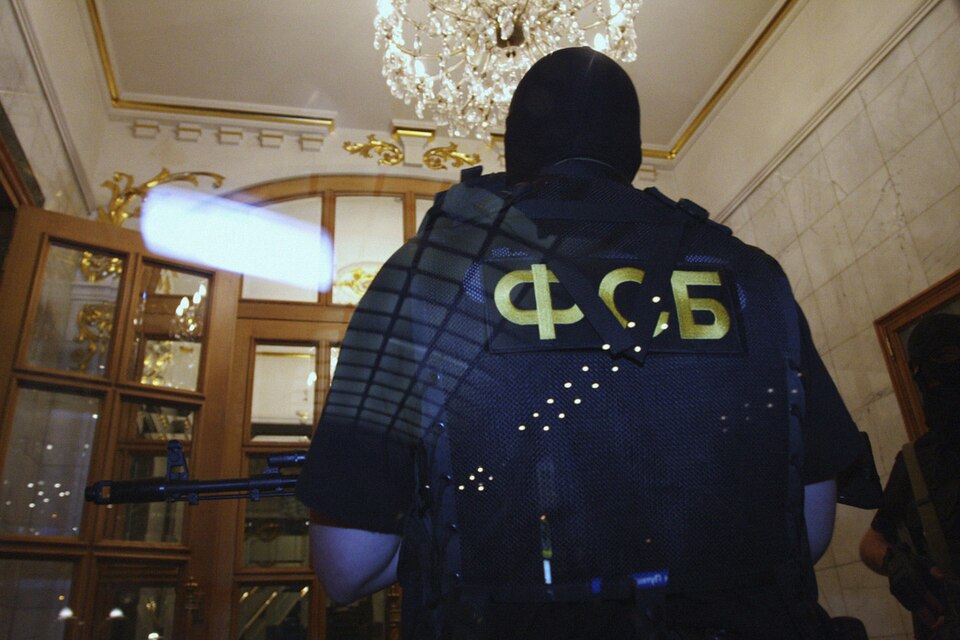
Nobody outside the service knows how many people work for the FSB. Its budget is not published, and the headcount is not disclosed. Cautious estimates quoted in Foreign Affairs put the number at more than 200,000.
Russia’s Federal Security Service is the main inheritor of the Soviet KGB at home. It handles internal and border security, counterintelligence, counterterrorism and surveillance. Spying abroad belongs, formally, to two others: the SVR, the foreign intelligence agency, and the GRU, military intelligence. The Russian government describes the FSB as a federal body that carries out state policy on national security, guards the state border and coordinates counterintelligence work across other agencies. The president oversees it, and the current director is Alexander Bortnikov.
Splitting up the KGB
With the Soviet state gone, Boris Yeltsin did not want one security giant left standing. He feared that hard-liners inside it might try the kind of coup that had failed against Gorbachev that August in 1991. His answer was to cut the KGB into pieces with clearly separated duties, as Andrei Soldatov and Irina Borogan describe it in Foreign Affairs.
The biggest piece went through several names. It began as a Ministry of Security, became the FSK (Federal Counterintelligence Service), and from 1995 was the FSB. Foreign intelligence became the SVR. Eavesdropping and cryptography went to a separate communications agency, FAPSI, formed in September 1991 from two KGB directorates. The units that had guarded Soviet leaders and the frontier became independent services too.
Putin’s years
In the last stretch of Yeltsin’s rule, Vladimir Putin, a former KGB officer who had served in East Germany, was named FSB director. A financial crash and a wave of public anxiety followed. In September 1999, 216 people died in bombings of two Moscow apartment buildings. Putin, by then prime minister, blamed the Chechens and launched a new offensive in Chechnya, which made him popular almost overnight.
The agency grew once he reached the presidency. In March 2003 he signed a decree that put the border guards under the FSB and carved up FAPSI, the communications agency, handing one share to the FSB and another to the Federal Protective Service. The Crypto Museum’s profile notes that the frontier force was the old KGB border troops directorate, and that FAPSI was Russia’s counterpart to the American NSA and British GCHQ. FSB counterintelligence officers also took key posts in the Interior Ministry, and Putin later installed an FSB officer, Rashid Nurgaliev, as interior minister.
The FSB also moved into territory that was not formally its own. When it could not absorb the SVR, according to the Foreign Affairs account, it built a department of its own to collect intelligence and operate abroad.
A different animal from the KGB
The Soviet KGB, Soldatov and Borogan argue, answered to the Communist Party, which kept a branch in every KGB division. Today’s FSB has no such overseer. They write that it is impenetrable to outsiders, and that it now supplies much of the staff for senior jobs in government and in companies the state controls. In their view the Kremlin handed it a further job: protecting the stability of the rulers and, by extension, of the country.
Not everyone accepts that the old KGB has simply been rebuilt. The authors themselves call the reality more complicated than that.
Sources
- Russia's New Nobility (Foreign Affairs, Andrei Soldatov and Irina Borogan)
- FSB (Crypto Museum)
- Federal Security Service of the Russian Federation (The Russian Government)




