
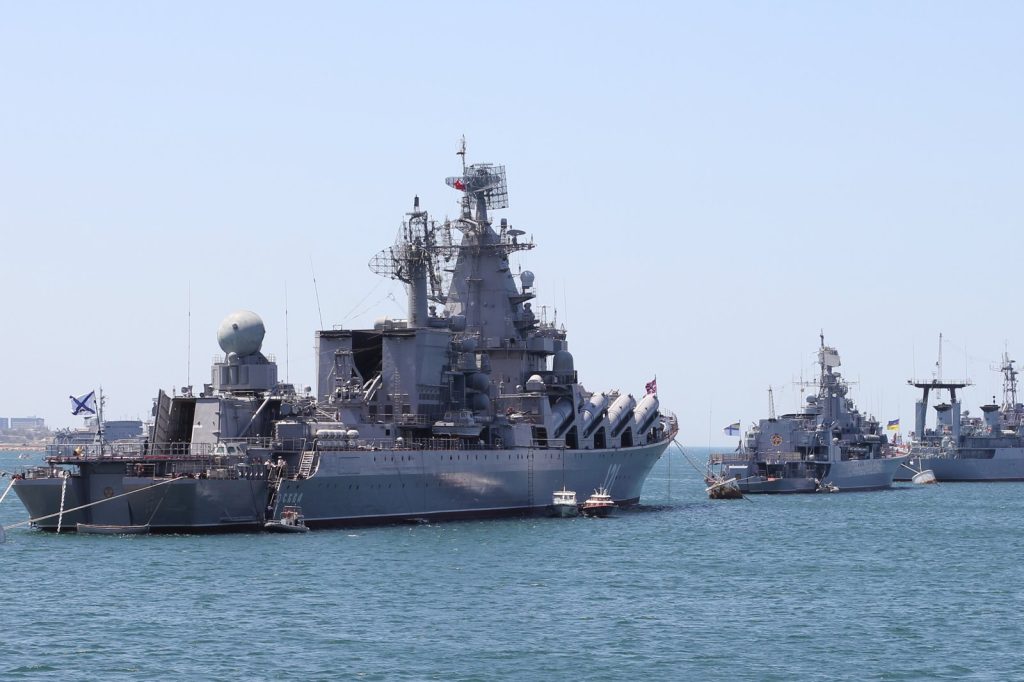
The fleet headquarters is no longer in Sevastopol. Russia moved it to Novorossiysk after Ukrainian drones and missiles kept finding targets in Crimea, Business Insider reported, citing NATO military leaders who said Ukraine’s campaign had “damaged or destroyed dozens of Russian warships.”
That is the end point of a decline that started with one ship. On April 14, 2022, two Neptune missiles struck the cruiser Moskva, flagship of the Black Sea Fleet, which carried a crew of 500 and was valued at “$750 million.” No Russian flagship had been sunk since the Russo-Japanese War of 1904-1905, according to the Kyiv Independent.
A list that kept growing
The Moskva was not alone. Landing ships went one after another, and by February 14, 2024, when naval drones hit the Caesar Kunikov off Alupka, it was the fourth landing ship destroyed since 2022.
Sevastopol itself offered no shelter. On September 13, 2023, a strike in dry dock at the Sevmorzavod shipyard damaged the landing vessel Minsk and the submarine Rostov-on-Don. The submarine suffered “catastrophic damage” and would need years of repair.
Newer hulls fared no better. The stealth corvette Askold was destroyed at the Kerch shipyard on November 4, 2023, before it entered service. The patrol ship Sergey Kotov, commissioned in July 2022, was sunk by five Magura V5 drones in the Kerch Strait on March 5, 2024.
Command and basing
Admiral Viktor Sokolov lost his job as fleet commander after the Kotov attack. British Defense Ministry assessments, cited by Newsweek, pointed to the losses as the likely reason. “This is the third Russian Black Sea Fleet vessel sunk in the past five weeks,” the UK government said. Ukrainian officials put the Kotov toll at seven Russian sailors killed and 27 injured.
The attacks also pushed Russian assets east. Newsweek reported the move to Novorossiysk, along with talk of a new facility in Abkhazia.
Stretched thin
Trouble at home compounds the trouble in the Black Sea. Business Insider’s NATO sources describe a Russian navy already limited by “limits in shipbuilding, maintenance, and modernization, redeployment challenges, and operational overstretch.” Then the Assad regime fell in late 2024 and put Russia’s access to the Tartus naval facility in Syria in doubt.
“Losing a port there means losing logistical support,” Commodore Arjen Warnaar said, “and that stretches the capabilities they have.” To keep a presence in the Mediterranean, NATO officials say, Moscow has to pull ships and submarines from other regions. They add that NATO has enough assets to deal with whatever that brings.
Sources
- Russian ships destroyed by Ukraine: the most important losses
- Russian Black Sea Fleet Commander Dismissed Over Mounting Losses
- Russia's navy looks to be stretched thin after getting battered by Ukraine (Business Insider, via Yahoo News)




