
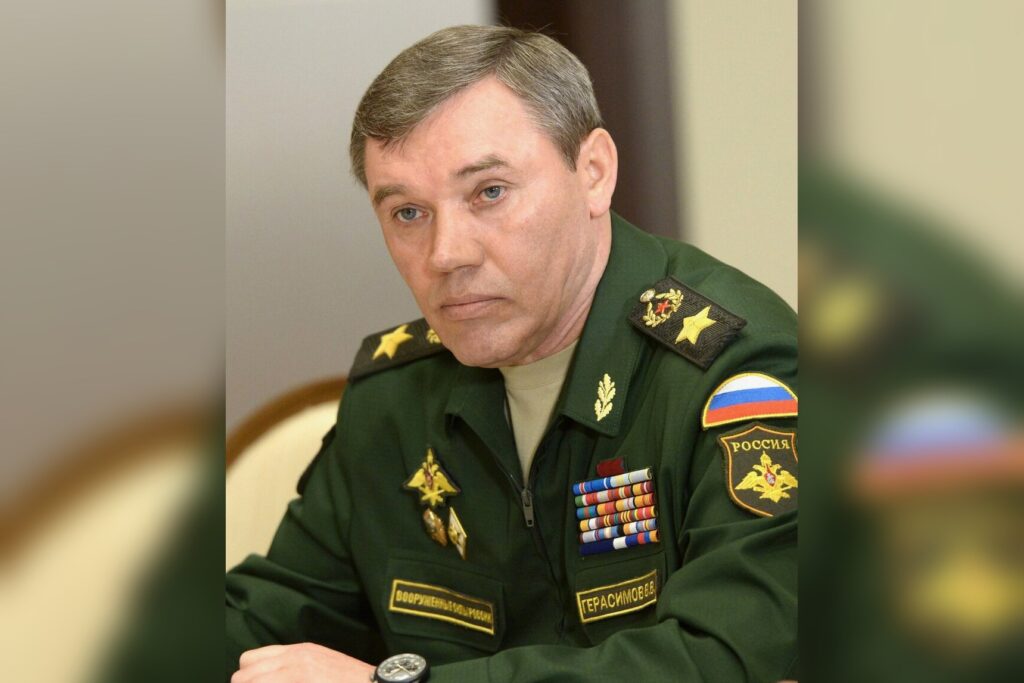
The helicopter was marked with a “Z.” Valery Gerasimov, Russia’s Chief of the General Staff, looked tense in the video the defence ministry released in September 2025 as he flew over occupied Ukrainian territory. The Barents Observer noted he had reason to be: over more than three and a half years of full-scale war, Ukrainian forces have shot down a large number of Russian helicopters.
On the ground, in what appeared to be an underground bunker, he told commanders of Group Centre: “Our forces are advancing in practically all directions.” The Barents Observer reported that not everyone in the room looked convinced, and that there had been no major advance by Russian forces.
That is the job Gerasimov has held since November 2012, and in Ukraine it has grown well beyond the staff desk.
From Kazan to the General Staff
BBC Monitoring profiled him when Vladimir Putin named him armed forces chief of staff in 2012. He was 57, born in Kazan, the Volga city that is the capital of Russia’s ethnic Tatars. He started his military career in 1977 with the Northern Group of Forces, then served in the Far Eastern and Baltic Military Districts. By 1999 he was chief of staff of the 58th Army in the North Caucasus, shortly before the second Chechen war broke out. In 2001 he took command of that army.
The record was not spotless. While chief of staff of the Far Eastern Military District in 2003-2005, he was reprimanded over mass outbreaks of illness among conscripts. The BBC called it seemingly the only black mark on his file. He went on to command the districts covering St Petersburg and Moscow, became deputy chief of the general staff, and in April 2012 took over the Central Military District. Speculation at the time linked that move to a strained relationship with his boss, Gen Nikolai Makarov, whom he then replaced. Shoigu, the new defence minister, called him “a military man to the roots of his hair.” Igor Korotchenko, editor of National Defence magazine, called him “a very competent person, a true patriot.”
He had run Moscow’s Victory Day parades since 2009.
Running the war
On January 11, 2023, the Defense Ministry named Gerasimov commander of the combined forces in Ukraine, replacing Sergey Surovikin, who had held the post only since October. Surovikin stayed on as his deputy. Gerasimov was the fourth commander of the Ukraine campaign in barely 11 months, and DW read the churn as the Kremlin’s frustration with battlefield setbacks. The ministry said the change reflected “the expansion of the scale of the tasks at hand.”
Russian pro-war bloggers had already criticised him, along with Shoigu, for the lack of success. The European Union, the US, Switzerland and Australia have all placed him on sanctions lists over Russian interference in Ukraine since 2014.
The war has pulled in forces from far afield. The Barents Observer reported that the 61st Naval Infantry Brigade and the 80th Motorised Rifle Brigade, based in the Pechenga area near the Norwegian and Finnish borders, were fighting in occupied parts of the Kherson region, including the Dnepr delta. Group Dnepr, the formation that includes forces from the Kola Peninsula, had commanders at that meeting.
On August 27, 2026, the Moscow Times reported Gerasimov inspecting troops of Russia’s “South” grouping at an undisclosed location. He said Russian units stood 4 kilometers from the eastern outskirts of Slovyansk, in the Donetsk region, with operations advancing along a 160-kilometer front.
Sources
- Profile: Russia's new military chief Valery Gerasimov – BBC News
- Russia appoints Gerasimov as overall commander in Ukraine – DW
- Commander of Arctic marines in the room as General Staff Chief Gerasimov pays visit to war zone – The Barents Observer (Atle Staalesen)
- Russian Forces Inching Closer to Slovyansk in Eastern Ukraine's Donetsk Region, Gerasimov Says – The Moscow Times




