
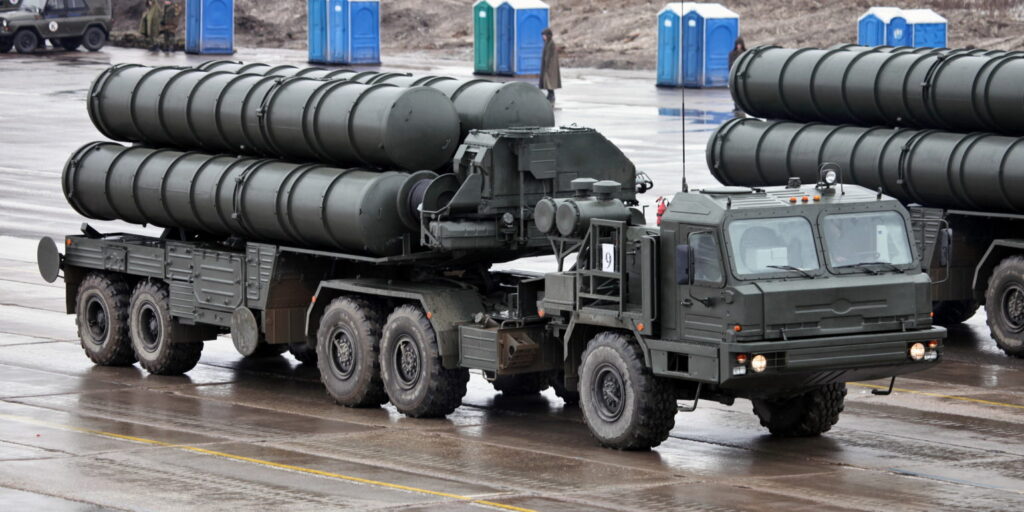
A Pantsir air defense unit sat on the roof of Russia’s Defense Ministry in Moscow, and the drones flew in anyway. That, per Ukrainian Air Force spokesperson Yuriy Ihnat, is what the system’s design predicts. “The Pantsir systems are only capable of firing at objects above its level, rather than below,” he told reporters, leaving “a vulnerability” in the capital’s central defenses.
Newsweek reported the episode after a Monday drone raid that hit an area near the ministry headquarters and some nonresidential buildings. Moscow Mayor Sergei Sobyanin said nobody was hurt. Ihnat put it bluntly: “if there are tanks on the hill, I’m just curious how they will shoot when the drone…will fly lower.”
Short-range shield, long-range umbrella
Russia had mounted Pantsir batteries on government buildings in January, after earlier Ukrainian air attacks. The system pairs guns with missiles and is meant for close defense: it can engage high-speed air-to-ground missiles within 7 kilometers and tactical aircraft up to 20 kilometers away. Newsweek notes that the S-400 carries more firepower, but the Pantsir fits a city better. Units have also been placed near Vladimir Putin’s residence.
The S-400 does a different job. Euromaidan Press, citing Ukrainian military sources, describes it as the main danger to Ukrainian aircraft, with reported engagement ranges up to 400 kilometers and a more typical effective reach of 200 kilometers.
Layers coming apart
The catch for Moscow is that layers only work when every layer exists. A company commander in Ukraine’s 413th Unmanned Systems Regiment, callsign Churchill, told Euromaidan Press that in some front-line sectors the Russians are “losing the concept of layered air defense.”
The numbers behind that claim come from Tochnyi.info. Between June 2025 and early March 2026, Ukraine carried out 492 strikes on air-defense infrastructure, plus 433 more on anti-access assets. In March and May alone, Ukraine’s General Staff counted 24 radar systems damaged in Crimea. April brought 25 air-defense targets, among them Tor, Buk, Osa and Pantsir systems and parts of S-400 and S-300V batteries.
Russia is shuffling what it has left. After recent strikes on Moscow, S-300 and S-400 installations were positioned in the capital, the Moscow Times reported, which thins coverage over occupied Ukrainian territory and Crimea.
Kostiantyn Kryvolap, a former aviation test engineer at the Antonov Design Bureau, drew the operational conclusion. With the Russians having “significantly reduced the number of S-400 and S-300 systems,” he said, Ukraine can now use systems that warn pilots of incoming missiles early enough to maneuver. Ukraine’s Vyrivniuvach guided glide bomb, a domestic design, entered serial production in the same month.
Moscow, for its part, calls the drone attacks terrorism. Ukrainian military intelligence spokesperson Andriy Yusov has said they will “continue and increase in scale.”
Sources
- Ukraine Exposes Critical Flaw in Russia's Defenses
- Russia built its air defense in layers. A Ukrainian commander says the drones are peeling them off one by one




