
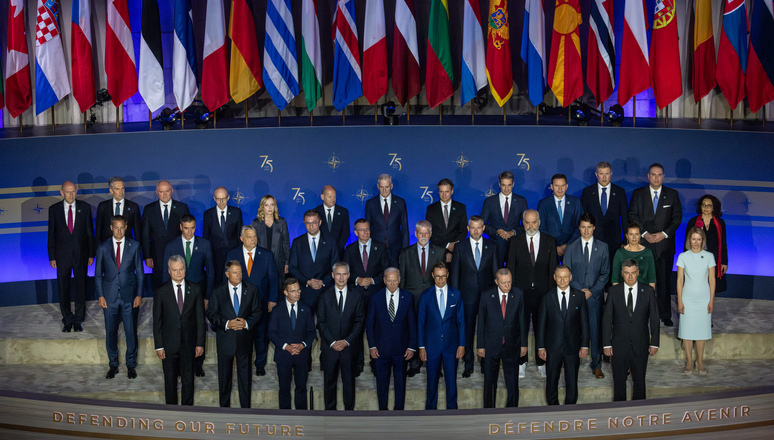
“More than two-thirds of Allies” now meet the 2% of GDP spending target, the Washington Summit Declaration of July 10, 2024 said. Ten years earlier, the Wilson Center notes, only three nations did.
That arithmetic sat at the centre of NATO’s 75th anniversary summit in Washington. Leaders marked the signing of the North Atlantic Treaty on April 4, 1949, by 12 countries. They also welcomed Sweden as the thirty-second member; it had formally joined on March 7, 2024, after Russia’s 2022 invasion pushed Sweden and Finland out of their long non-alignment.
Money and hardware
The Wilson Center counted 23 of 32 members projected to reach the benchmark, and put the rise in European defence spending since February 2022 at over $80 billion. The declaration itself concedes that “expenditure beyond 2% of GDP will be needed in order to remedy existing shortfalls.” A polite way of saying the 2% figure was always a floor.
Industry was the other worry. NATO announced an “Industrial Capacity Expansion Pledge” to close a manufacturing gap, noting that “Russia is spending between 7-9% of its GDP on its military.” The summit text also named China “a decisive enabler of Russia’s war” and promised closer ties with Australia, New Zealand, Japan and South Korea.
Ukraine at the table
Ukraine took the most space. NATO set up a mechanism called NATO Security Assistance and Training for Ukraine, or NSATU, with a minimum of EUR 40 billion in annual funding. President Joe Biden pledged five more air defense systems and said F-16 fighters donated by the Netherlands and Denmark would be operational by summer 2024.
The declaration calls Ukraine’s route to membership “irreversible”, though it sets no date. Its wording is conditional: “We will be in a position to extend an invitation to Ukraine to join the Alliance when Allies agree and conditions are met.”
On July 11, Secretary General Jens Stoltenberg welcomed Volodymyr Zelenskyy to a NATO-Ukraine Council meeting in Washington. He pointed to the support package agreed a day earlier, “including a pledge of long-term security assistance,” and said NATO’s backing “is built to last.” His line for the cameras: “Ukraine’s future is in NATO.”
The summit also reaffirmed Article 5, which the declaration calls “iron-clad,” and closed a chapter for Stoltenberg. Biden awarded him the Presidential Medal of Freedom after a decade as Secretary General.
Sources
- NATO's 75th Anniversary Summit: Standing the Test of Time (Wilson Center, Jason C. Moyer)
- Washington Summit Declaration (NATO)
- NATO Secretary General welcomes President Zelenskyy to the Washington Summit




