
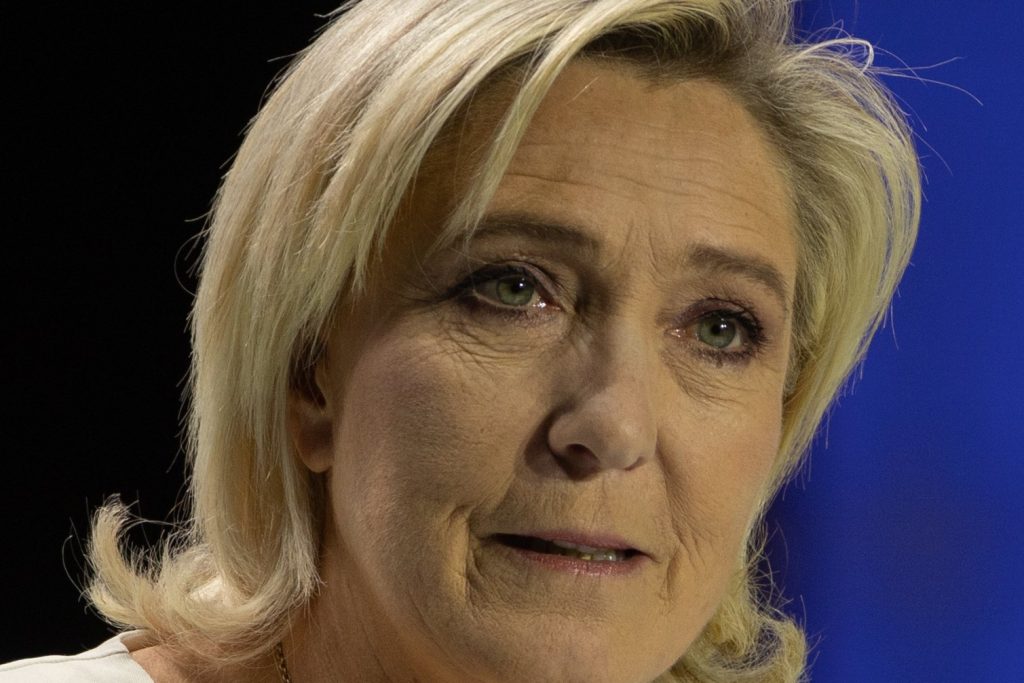
The campaign posters for Marine Le Pen’s National Rally (RN) were easy to miss in Normandy last week. They hung behind the flags of Britain, the United States and Canada, put up for the 80th anniversary of the D-Day landings. Days later, the party had won the European Parliament vote in France.
The RN took 31.4 per cent. President Emmanuel Macron’s pro-Europe centrist coalition took 14.6 per cent, less than half as many votes. In Germany, the far-right Alternative for Germany came second with 16 per cent, ahead of Chancellor Olaf Scholz’s Social Democrats.
Macron answered with a surprise. He dissolved the National Assembly and called snap parliamentary elections, with a final ballot set for July 7. In a televised address on Sunday he cited “the rise of nationalists and demagogues” as a danger to France’s place in Europe and the world. Two days later he told Le Figaro: “Dissolution is the clearest, most radical and strongest gesture. A gesture of great confidence in the French people.”
A bet on voter fear
The thinking is plain enough. Voters tend to give the European Parliament little attention, since the European Commission and national governments set policy. A national vote is different, and Macron is hoping the prospect of a far-right government will make people think twice.
Critics say he has misread the mood. Newspaper reports put his approval rating around 22 per cent. In Le Monde, journalist Solenn de Royer wrote that a “weaker than ever” Macron was reaching for the formula that first brought him power, casting the contest as populists against progressives, “essentially ‘me or chaos.’” Le Monde’s director, Jérôme Fenoglio, wrote that “nothing less than the future of our democracy will be decided, in a hurry.”
The Guardian’s editorial board in the U.K. offered a warning from history. David Cameron, it noted, pledged a Brexit referendum after strong 2014 European results for Nigel Farage’s Ukip, and found that “bold gambits can deliver very nasty surprises.”
Cracks on the right, pacts on the left
Éric Ciotti, head of the conservative Republicans, called for an alliance with the National Rally. No mainstream party had proposed that before. His own party was outraged and moved to dismiss him.
On the left, the Greens and Jean-Luc Melenchon’s far-left France Unbowed reportedly pledged to act together. Macron urged moderates on both sides to find common ground against the RN.
Le Pen confirmed that if the RN wins a majority, party president Jordan Bardella, 28, would become prime minister. Bardella has more than one million TikTok followers and is seen as a rising star among RN supporters. An RN win would force Macron into “cohabitation,” sharing power with opponents until his term ends in 2027. With the far right, that would be unprecedented.
Some fear France could follow Hungary, where Viktor Orban’s increasingly authoritarian policies have worn down the independent judiciary and a free press. Le Pen, who is positioning herself to run for president in 2027, no longer says she wants to take France out of the European Union. Critics say the aim of weakening the bloc from within remains.
Oxford historian Timothy Garton Ash pointed to the party’s stance on Russia. “They say we want peace, by which they mean ‘make a deal with [Russia’s Vladimir] Putin,’” he said.




