
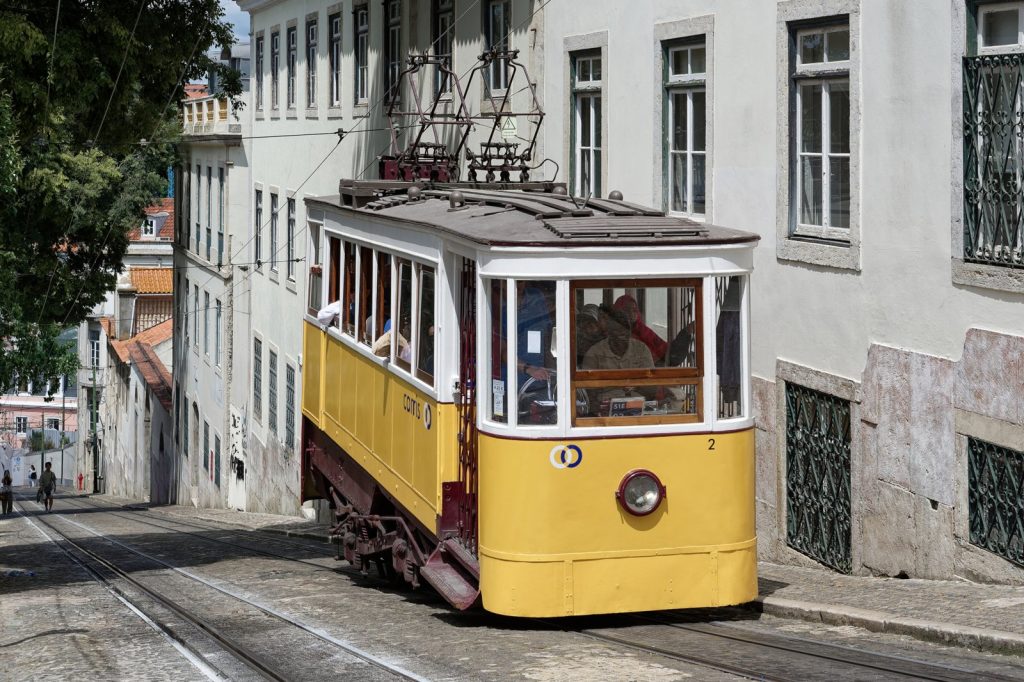
The Glória funicular in Lisbon came off its rails at 18:04 on 3 September 2025, at the start of the evening rush. Sixteen people died. The car at the top of the hill ran away downhill and hit a building near the bottom of the line.
The funicular links Bairro Alto with Restauradores Square and was popular with tourists. Most of the casualties were foreigners.
Who died
Police said five of the dead were Portuguese. The others were three Britons, two South Koreans, two Canadians, an American, a Ukrainian, a Swiss and a French national.
One Portuguese victim was André Marques, the brake guard on the funicular. His employer, Carris, which runs the line, called him a “dedicated, kind and happy professional, always willing to contribute to the greater good.” Four other Portuguese victims worked for the charity Santa Casa da Misericórdia, whose headquarters sit on the hill. One of its employees, Valdemar Bastos, told the BBC that staff often rode the funicular, along with tourists and elderly people, rather than climb the steep slope on foot.
Alvaro Santos Almeida, head of Portugal’s health service, said 23 people were injured, six of them in intensive care.
What investigators found
Portugal’s rail and aviation accident investigator, the GPIAAF, issued a preliminary report on 6 September. The cable joining the two cabins had snapped where it attached to the upper car, after the vehicle had moved only about 6 m. The brakeman applied the pneumatic and hand brakes at once, but once the cable’s balancing force was gone, the car could not be slowed.
A visual check of the cable on the morning of the crash had shown nothing wrong. The investigators noted that the failure point could not be seen without taking the cable apart. The section had been in use for roughly 337 days of an expected 600-day service life.
The investigator’s first results on 20 October went further. The cable, it found, “did not comply with the specifications in force at the CCFL [Lisbon’s transport operator] to be used for the Gloria tram,” and Carris had run no testing or oversight on it before installation. The braking system had failed to stop the car. The report also flagged five places where the maintenance program cited “non-existent, inapplicable or outdated standards.” The GPIAAF recommended that Lisbon’s funiculars stay shut until they can be declared fully safe.
Maintenance questions
Lisbon has outsourced upkeep of its funiculars since 2011. After a tender in 2022, Carris signed a €1 million contract with MAIN – Maintenance Engineering covering the Glória, Bica and Lavra funiculars and the Santa Justa Lift. The Carris workers’ union said staff had repeatedly reported poor work by MAIN.
Carris chief executive Pedro de Brito Bogas told the press within hours of the crash that “the maintenance protocol was scrupulously followed,” with monthly, weekly and daily inspections. The Glória had its last general overhaul, due every four years, in 2022, and its two-year maintenance ran from 26 August to 30 September 2024. A daily visual inspection took place nine hours before the derailment. One of the line’s cars had also left the track in May 2018 because its wheels were poorly maintained. Nobody was hurt then.
Mourning and response
Portugal observed a national day of mourning on 4 September, and Lisbon declared three days of its own. President Marcelo Rebelo de Sousa, Prime Minister Luís Montenegro and Lisbon mayor Carlos Moedas attended a Mass that afternoon at the Igreja de São Domingos. The city suspended all funicular services and ordered inspections of the other lines, and formed a technical team of Carris engineers and university and national laboratory experts to design a new safety device and decide when the Glória can reopen.




