
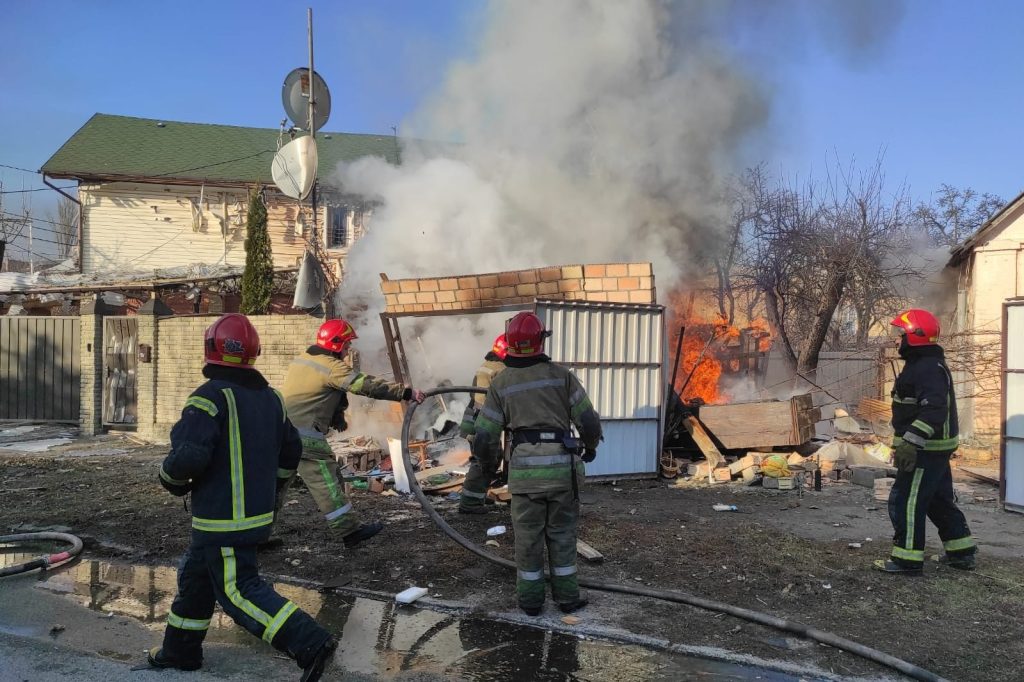
Five healthcare workers are in hospital this morning — one of them fighting for his life — after what Kyiv officials describe as a precision strike on a medical facility in the Shevchenkivskyi district. The attack, part of a broader Russian missile and drone barrage on the Ukrainian capital early Thursday, has reignited debate in Kyiv about the adequacy of existing protections for medical personnel under the laws of war. The Geneva Conventions explicitly prohibit targeting medical units and personnel.
They carry special protected status. Yet here, in the fourth year of Europe’s deadliest conflict since World War II, that status appears to have been ignored.
Mayor Vitali Klitschko confirmed the casualties on Telegram. Tymur Tkachenko, head of Kyiv’s military administration, reported a destroyed residential building and a damaged medical facility. This is not the first such incident.
It follows a pattern. Russian strikes have repeatedly hit hospitals, clinics, and ambulances across Ukraine.
But the scale of the wounding — five medical workers in a single district — raises questions the Ukrainian government is now quietly examining. What more can be done? How do you enforce rules a belligerent has already decided to break?
The mechanics of the attack were familiar. Ballistic missiles and unmanned aerial vehicles. Air-raid sirens.
Civilians with children and pets rushing into metro stations. AFP journalists counted more than a dozen explosions.
Fires broke out. But the targeting of a medical facility changes the legal calculus. Under international humanitarian law, such attacks can constitute war crimes.
The International Criminal Court has already issued arrest warrants for Russian officials over alleged war crimes in Ukraine. Thursday’s strike adds fresh evidence to the pile.
President Volodymyr Zelenskyy had warned of an impending “massive attack.” He cut short a visit to Dublin on Wednesday based on intelligence reports. The attack came hours later. The timing suggests foreknowledge, but not the kind that prevents — only the kind that braces.
Ukrainian officials now face a policy question. Do they escalate their diplomatic campaign to isolate Russia further? Do they push harder for specific war-crimes prosecutions targeting medical-strike cases?
Do they reassess how they protect medical infrastructure — moving field hospitals, hardening facilities, changing operational security protocols? Kyiv has already documented thousands of potential war crimes since the invasion began.
The evidence is voluminous. But prosecutions are slow. International tribunals move at a pace that offers little deterrence to commanders ordering strikes today.
The policy gap is real: the laws exist, the institutions exist, but the enforcement does not match the speed of the war. Mayor Klitschko’s Telegram updates offered raw, real-time confirmation.
“The enemy continues to launch missiles at the capital,” he wrote. Around 50 minutes after the first explosion, a second blast hit near the same site. Firefighters and ambulances arrived both times.
The wounded healthcare workers are a specific category of casualty. They are not civilians caught in the crossfire. They were on duty.
They were protected. The attack on them is a direct challenge to the rules of war that every state has signed.
How Ukraine responds — through courts, through diplomacy, through operational changes — will shape the next phase of this conflict. The policy choices are being made now, in real time, as the fires are still being put out.




