
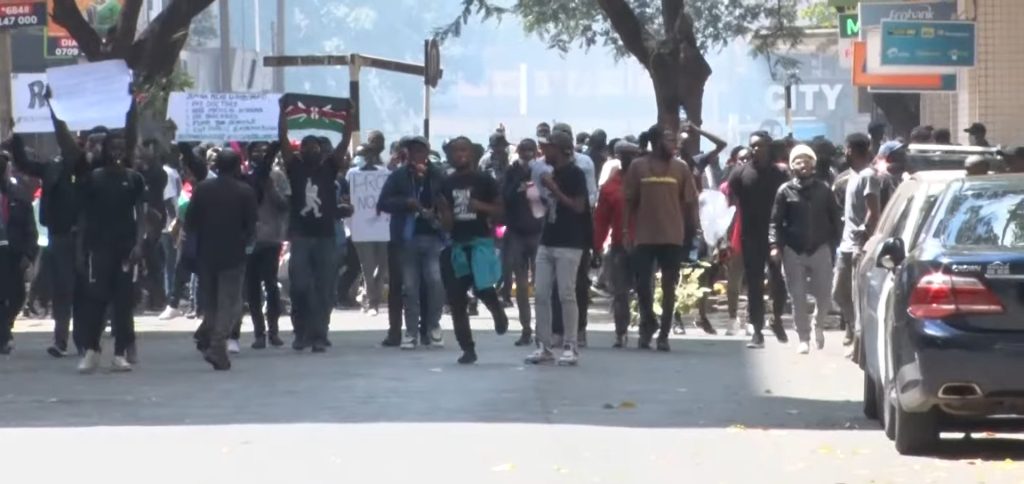
“We are coming with flowers. So your government should prepare to give us security.” That was youth activist Brian Otieno, speaking ahead of Thursday’s anniversary of the day Gen Z protesters broke into the grounds of Kenya’s parliament during demonstrations against a 2024 finance bill. Anti-riot police were out in strength in Nairobi.
For many young Kenyans, June 25 has become more than a protest date. It stands for resistance to police brutality and economic hardship, and to what activists see as a widening gap between leaders and ordinary people. Many say little has changed. Youth unemployment, the rising cost of living and worries over governance still weigh on the generation that first organized online.
“June 25th is a reminder of what this regime is all about,” Faith Njeri, a university student in Nairobi, told DW. “It is a reminder of when you guys lost legitimacy to the people of Kenya… because of just simply saying no to the finance bill.”
Remembering the dead
Rex Masai, a 29-year-old activist, was the first person killed in the June 2024 protests. The government-mandated Kenya National Commission on Human Rights recorded at least 60 deaths overall.
Businessman Kevin Mwangi read out names he did not want forgotten: Rex Masai, Denzel Omondi, Eric Shieni, David Chege, Erickson Mutisya, “and the many who disappeared.” Online, students like Mercy Wanjiru urged people to swap their profile pictures for images of Masai and the other dead. “You cannot kill us and lead us,” she said.
A movement without a figurehead
Earlier waves of protest in Kenya tended to revolve around parties or established civil society groups. This one did not. Organizing ran through social media and loose local networks, and it drew students, young professionals, gig workers and first-time demonstrators.
Beatrice Waithera, national leader of the Red Vest Movement, told DW the secrecy was partly a response to scrutiny of public gatherings. Organizers worked so discreetly, she said, that President William Ruto “had to come into one of the spaces on X, formerly Twitter, to try and speak to us.”
Some politicians have tried to tie the protests to opposition figures or well-known activists. Waithera rejects that. “What happened in 2024, what happened in 2025, was larger than life, was larger than Boniface Mwangi, was larger than me,” she said. Mwangi, a human rights and anti-corruption campaigner who has announced a run for president, was not present when parliament was occupied, she noted.
Having no single leader made the movement harder to co-opt or suppress. Arrests, intimidation and alleged abductions were reported, yet turnout did not collapse. “The fear is gone,” Waithera said, though she added that organizers have had to reinvent their methods. The movement now works online and offline on governance, police accountability and economic reform as well as taxes.
Accountability still missing
Families of victims and human rights groups have repeatedly asked for investigations into alleged excessive force. Waithera has little faith in the institutions. “The courts are apathetic to our issues,” she said. “The judiciary is captured, the executive is captured and the National Police Service is captured.”
Ruto has recently promised to compensate the families of those killed, but he has not apologised. Money does not settle it for them. “There is no amount of money that will ever pay for the lives we lost,” Waithera said, adding that she sees Rex Masai’s mother in court all the time.
She wants a national conversation like the kind that follows a war, and asked why Ruto has not issued a national apology. As for where the anger goes next, she pointed to Kenya’s 2027 general election. “We are angry and we are going to the ballot with it,” she said.




