
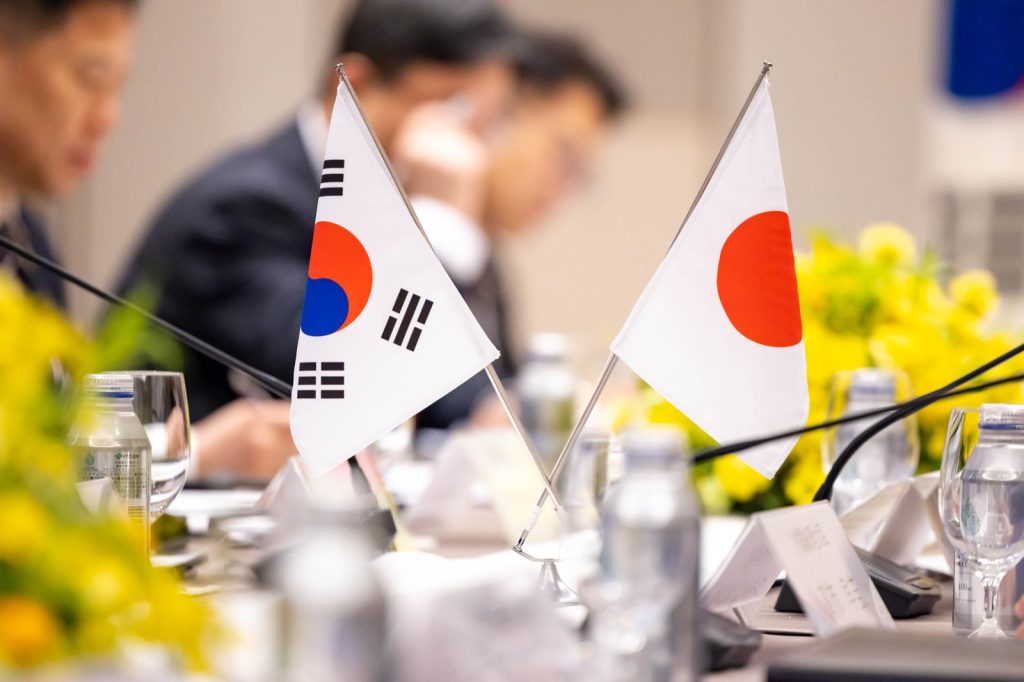
Tokyo, March 17, 2020 — cybernewschronicle.com — Sixteen hours. That is how long Japan and South Korea’s trade negotiators sat in video conference on March 17, 2020. The second round of senior-level talks between the two countries did not end the dispute.
It did not produce a deal. What it produced was an agreement to keep talking.
The session was a marathon, forced online by the COVID-19 pandemic. Both sides came to the virtual table carrying the same baggage they have carried since July 2019. That is when Japan restricted exports of three materials — fluorinated polyimides, photoresists, and hydrogen fluoride — that South Korea needs to make semiconductors and display panels.
Tokyo says the controls are about national security. Seoul says they are economic retaliation for a 2018 South Korean Supreme Court ruling that ordered Japanese companies to compensate Korean workers forced into labor during World War II.
The March 17 talks were the second round of what is officially a dialogue on export controls. The first round happened in January 2020.
Japan’s Yoichi Iida, head of the trade control department at the Ministry of Economy, Trade and Industry, said the two sides “exchanged information and welcomed the progress each side has made.” South Korea’s Ministry of Trade, Industry and Energy issued its own statement: “The two countries gave positive feedback on each other’s plan to bolster export control capabilities in terms of rules and policies.” Read those statements closely. They are about process, not outcome. The substance was information exchange.
The progress was on export control systems — the rules and policies each country uses to manage sensitive technology flows. Neither side said the other had changed its position on the core conflict.
Japan still restricts the materials. South Korea still says the restrictions are unjustified. That matters because the dispute has real weight.
South Korean companies like Samsung and SK Hynix dominate the global market for semiconductors and display panels. The materials Japan restricted are essential inputs.
When Tokyo tightened controls, it threatened supply chains that stretch across the electronics industry worldwide. A prolonged disruption would hit manufacturers in multiple countries, not just South Korea. The legal dispute over forced labor sits underneath the trade conflict, unresolved.
Japan argues the issue was settled by a 1965 treaty. South Korea’s Supreme Court disagreed in 2018. The two governments have not bridged that gap.
The March 17 talks did not try to bridge it. They focused narrowly on export control systems.
Both sides presented their plans. Both sides listened. Both sides said the other was making progress on rules and policies.
That is diplomatic language for: we still disagree, but we are willing to keep talking. The video format added a layer of difficulty.
Sixteen hours on a screen is a long time. Negotiators cannot read a room the same way. They cannot break for informal side conversations in hallways.
But the pandemic left no choice. The talks went ahead anyway. Japan and South Korea are neighbors.
They are both democracies. They are both major economies.
They are both allies of the United States. And they have been locked in this dispute for eight months. The March 17 meeting did not break the lock.
It kept the door open for a third round at some future date. That is the only concrete result: an agreement to continue discussions.
Neither side announced any change to the export restrictions. Neither side announced any change to the legal dispute. The conflict remains where it was.
The only difference is that both governments now have a clearer picture of the other’s export control systems. That may matter later. For now, it is just information.




