
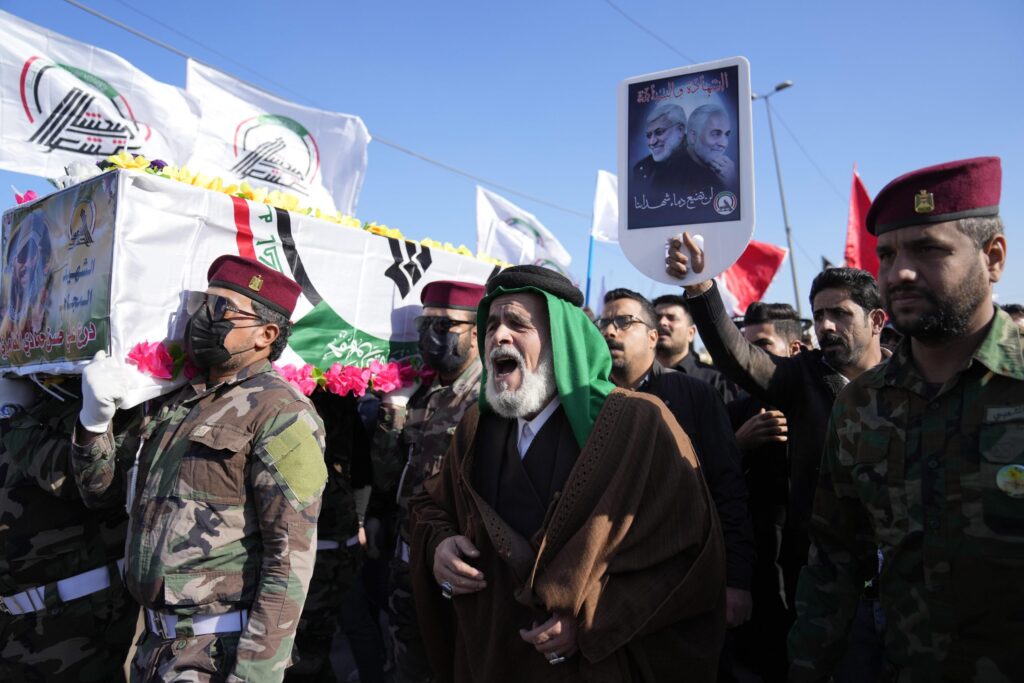
About 50,000 fighters. That is the size Reuters put on the militias that march under the banner of the “Islamic Resistance in Iraq,” along with long-range missiles, anti-aircraft systems and stakes in construction, real estate and currency exchange.
The name covers a loose alliance, not a single army. RFE/RL describes it as “an umbrella organization of Shi’ite, Iran-backed armed groups,” and several of its militias also sit inside the Popular Mobilization Forces, which has nominally been part of the Iraqi army since 2016. TRT World, writing in January 2024, noted that the groups “never officially acknowledged” ties to Tehran.
Who is in it
Kataib Hezbollah is the heavyweight. Founded in 2003, it was run by Abu Mahdi al Muhandis until his killing in January 2020, and RFE/RL puts its strength at roughly 10,000 fighters. Asaib Ahl al Haq, the League of the Righteous, appeared in January 2006 under Qais al Khazali; estimates of its membership range from 3,000 to 10,000. The Nujaba Organization came later, in 2013, founded by Ekrem al Kaabi. Kataib Seyyed al-Shuhada and the Badr Organization are named among the other armed groups in the wider mix, and RFE/RL says some factions have as few as 100 members.
Plenty of Iran’s other regional partners work in parallel. CBS News counted approximately 40 Iranian-backed militant groups across the Middle East, the Houthis in Yemen and Hezbollah in Lebanon among them.
The Iran link
Whether Tehran gives the orders is disputed. Iranian Foreign Ministry spokesperson Nasser Kanaani said the resistance forces do not take orders from Tehran and make their own decisions. CBS News reported the opposite from the groups’ side: the Islamic Resistance in Iraq has openly said it answers to Supreme Leader Ayatollah Ali Khamenei.
Security expert Baraa Shiban told CBS that “The IRGC is the most important piece in that web and is able to influence the overall strategy.” Support runs from funding and small arms to drones. One of the most important things Iran supplies, Shiban said, is weapons “like these drones that they use to attack the U.S. base.”
The attacks
In January 2024 a senior official of the group told the Iranian press it had carried out 178 drone and missile attacks over 100 days. Its representatives said that as long as the US supported Israel the attacks would intensify, and they called all US assets in the region legitimate targets. The Tower 22 attack in Jordan killed three American service members, according to CBS.
The same pattern returned in 2026. After the US-Israeli air campaign began on February 28, RFE/RL reported, the coalition mounted regular drone and rocket attacks on the US Embassy compound in Baghdad and hit American installations in Iraq’s Kurdish region. On March 16 Kataib Hezbollah said its senior commander and spokesman Abu Ali al-Askari had been killed in Baghdad. One analyst quoted by RFE/RL called the proxies “a tripwire it can use to increase or decrease pressure.”
Baghdad’s problem
Iraqi Prime Minister Ali al-Zaidi promised President Donald Trump in July that he would disarm the militias by September 30, 2026, the date set for the withdrawal of US-led coalition forces. Five Iran-aligned groups rejected the deadline outright. In August Kataib Hezbollah demanded guarantees that American forces would never return and that Washington would stop shaping Iraq’s political and economic decisions.
Zaidi also arrested militia members on terrorism-related charges in August. Threats of retaliation followed, and senior politicians had to step in to calm the situation. Some of those politicians warned that “tough measures against the militias will make disarmament impossible and could lead to instability.”
Sources
- What are the Iran-backed groups operating in the Middle East? (CBS News)
- Iraq Pulled Into Iran War As Tehran Expands The Battlefield (RFE/RL)
- In Gaza tinderbox, US and Iran-backed militias are… (TRT World)
- Explainer: Why is US ally Iraq unable to disarm Iran's militia allies? (Reuters via Al-Monitor)




