
About 20,000 sailors. That is the size of the Revolutionary Guards’ naval wing, according to the Council on Foreign Relations, and their beat includes the Strait of Hormuz. For crews and families who depend on that waterway, the force behind the fast boats is worth understanding.
A second army, with its own chain of command
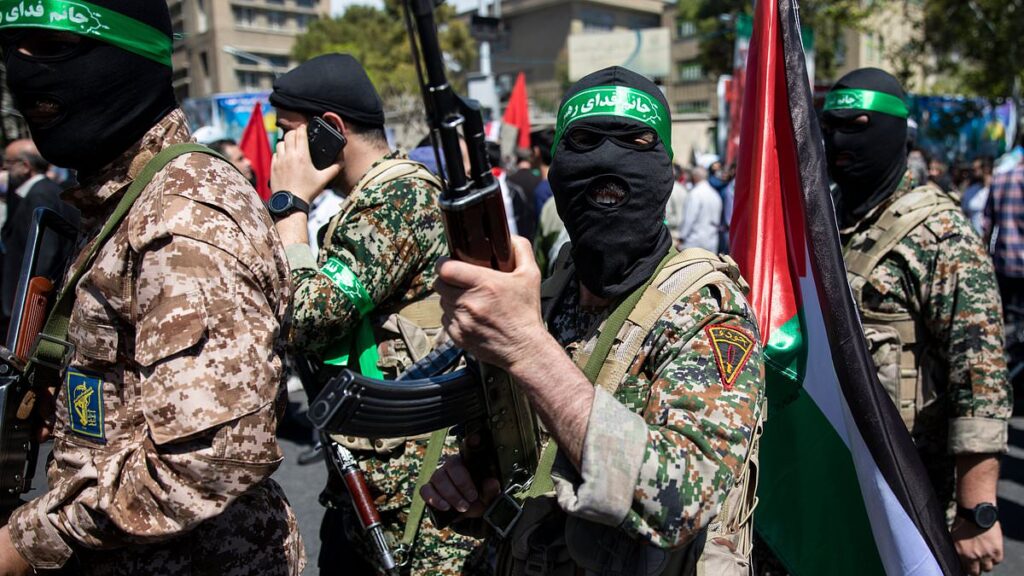
Iran’s Islamic Revolutionary Guard Corps was created in the wake of the 1979 revolution. Ayatollah Khomeini set it up to protect the new Islamic Republic from enemies at home and abroad, and the Council on Foreign Relations says it was meant as a counterweight to the regular armed forces, a “people’s army.” The Middle East Forum traces its roots to the units that guarded senior clerics.
It does not report to the elected president. It answers to the Supreme Leader. Scholars quoted by the Middle East Forum observe that the group “has seldom engaged in activities not sanctioned by the Iranian leadership.”
The Iran-Iraq War of 1980-88 changed it from a revolutionary militia into a conventional force. Today the Council on Foreign Relations puts it at roughly 190,000 troops spread across ground forces, a navy, an air force, a cyber command and the Basij paramilitary. The ground forces number over 150,000. The Basij claims it could mobilize around 600,000 volunteers. The air force runs Iran’s ballistic missile program.
Reach beyond Iran’s borders
The Quds Force handles the Guards’ foreign work. It cultivates armed groups in Iraq, Lebanon, the Palestinian territories, Syria and Yemen, supplying training, weapons and money, and Tehran calls the network an “axis of resistance.” The Middle East Forum credits the Guards with founding Hezbollah in Lebanon and the Badr Organization in Iraq, and says they armed the Houthis, who seized Yemen’s capital in 2015.
Its own arsenal includes ballistic missiles, fast-attack boats, air defense systems and drone units. In 2019 the Guards sabotaged commercial ships in May, seized tankers in July and shot down an American RQ-4 Global Hawk drone valued at $130 million, the Middle East Forum reported. The United States designated the IRGC a foreign terrorist organization in April 2019.
Power at home
Inside Iran, the Guards reach into politics and business. Former commanders hold senior government posts; the Middle East Forum noted that nearly half of Mahmoud Ahmadinejad’s cabinet ministers came from the force. The organization also controls enterprises in banking, shipping, manufacturing and infrastructure, and the Council on Foreign Relations says it has smuggled oil, mostly to China, to get around sanctions.
Ordinary Iranians have felt it most. The Council on Foreign Relations says the Basij was accused of beating, shooting, sexually assaulting and torturing people during the 2022-2023 “Women, Life, Freedom” protests. In January 2026 the Guards met nationwide demonstrations with extreme force, and the European Union responded by designating the IRGC a terrorist organization.
The force has also lost leaders. Major General Hossein Salami, its top commander, was killed in Israel’s June 2025 strikes on Iran’s nuclear program along with several other commanders.
Sources
- The Islamic Revolutionary Guard Corps (IRGC) (Council on Foreign Relations Backgrounder)
- Backgrounder: The Islamic Revolutionary Guard Corps (IRGC) (Middle East Forum, Gary C. Gambill)




