
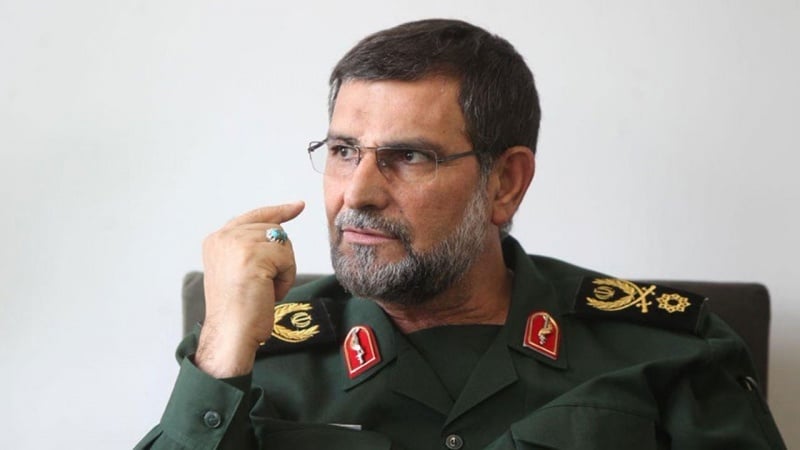
TEHRAN, July 12 — The commander of the Islamic Revolutionary Guard Corps Navy, Rear Admiral Alireza Tangsiri, has emerged as the central figure in Iran’s most aggressive challenge to global shipping in decades. On April 30, 2025, Tangsiri announced the indefinite closure of the Strait of Hormuz via state media, citing “security concerns” related to U.S. naval exercises. The record shows Tangsiri was appointed to his post in 2018 by Supreme Leader Ali Khamenei.
Born in 1960 in Tangestan, Iran, he joined the IRGC during the Iran-Iraq War, which lasted from 1980 to 1988, serving in naval operations throughout that conflict. His career has included command of the IRGC Navy’s first naval zone in the Persian Gulf.
Tangsiri reports directly to IRGC commander-in-chief Major General Hossein Salami and holds a seat on the IRGC’s senior leadership council. According to the source, his actions are seen as a key factor in Iran’s asymmetric naval strategy.
Hardline posture and the 2019 drone incident
Tangsiri is known for his hardline stance against the United States and Israel, frequently threatening to close the Strait of Hormuz in response to sanctions. The record shows that in 2019, he oversaw the downing of a U.S. RQ-4A Global Hawk drone, which Iran claimed had violated its airspace. The incident escalated tensions in the Persian Gulf and underscored the IRGC Navy’s willingness to confront American assets directly.
The Strait of Hormuz is a critical chokepoint for global oil shipments. Tangsiri’s threats to close it have been a recurring feature of his public statements since assuming command.
The April 2025 closure announcement
On April 30, 2025, Tangsiri went on state media to declare the indefinite closure of the strait. He cited “security concerns” related to U.S. naval exercises as the justification. The announcement marked a dramatic escalation from previous rhetorical threats to an operational directive.
Sources familiar with the timeline note that the closure order came during a period of heightened U.S. naval activity in the region. The IRGC Navy, under Tangsiri’s command, has positioned itself as the primary instrument for enforcing such a blockade.
Strategic implications and chain of command
Tangsiri’s position within the IRGC’s senior leadership council gives him direct influence over the organization’s broader strategic decisions. His reporting line to Major General Hossein Salami places him at the center of Iran’s military hierarchy. The record shows that Tangsiri’s career trajectory—from a junior officer during the Iran-Iraq War to commander of the IRGC Navy—reflects the regime’s preference for battle-tested commanders with ideological reliability.
His actions are seen as a key factor in Iran’s asymmetric naval strategy, which relies on small, fast attack craft, mines, and anti-ship missiles rather than a conventional blue-water fleet.
What to watch next
The indefinite closure of the Strait of Hormuz, announced by Tangsiri in April 2025, remains in effect as of this writing. The international community, including the Trump administration, has not publicly accepted the closure as legitimate. Naval forces in the region continue to operate under heightened alert.
Tangsiri’s next moves will likely determine whether the strait remains effectively closed or whether a confrontation with U.S. and allied naval forces becomes unavoidable. The commander’s history of direct action—including the 2019 drone shootdown—suggests he is prepared to enforce his orders.




