
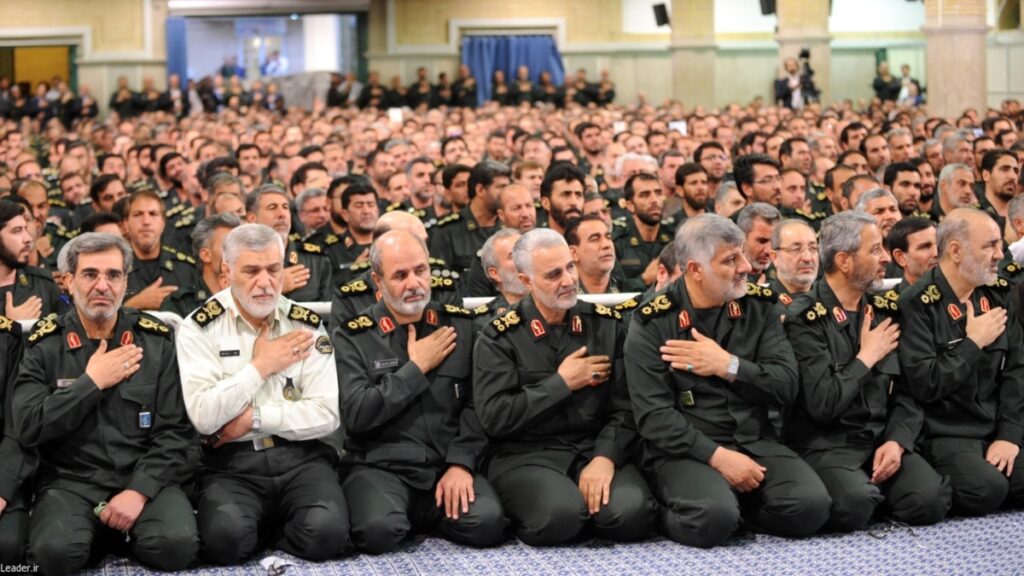
WASHINGTON, July 9 — When the United States designated Iran’s Quds Force a terrorist organization in April 2019, it codified what intelligence agencies had long understood: this was no ordinary military unit. The Quds Force, a special operations arm of Iran’s Islamic Revolutionary Guard Corps, operates as the regime’s primary instrument for projecting power beyond its borders, running intelligence operations and paramilitary campaigns across the Middle East and further afield.
The technical reality of the Quds Force is that it functions as a state-sponsored expeditionary capability, designed to operate in the shadows. Established in 1990, it has spent decades building networks of proxies and sleeper cells — assets that can be activated for assassinations, bombings, or political subversion.
Under the hood, its structure mirrors that of Western special operations commands, but its legal framework is fundamentally different: it answers directly to Iran’s supreme leader, not to the country’s conventional military chain of command. For much of its modern history, the Quds Force was synonymous with one man. Qasem Soleimani commanded the unit from 1998 until his assassination in January 2020, building it into the most capable Iranian force for extraterritorial operations.
His successor, Esmail Ghaani, inherited an organisation that had already been implicated in a string of high-profile attacks against American and Israeli targets. The detail that matters here is the unit’s track record.
The Quds Force has been tied to the 1996 Khobar Towers bombing in Saudi Arabia, which killed 19 U.S. airmen. It was also linked to the 2011 plot to assassinate the Saudi ambassador to the United States — a scheme that involved a would-be bomber and a Washington restaurant, and which was disrupted before it could be carried out. These operations share a pattern: they target American personnel or interests, often on foreign soil, and they rely on deniable proxies.
As ever, the unit’s designation as a foreign terrorist organisation by the U.S. since April 2019 has not halted its activities. The alleged plot to assassinate former President Donald Trump, reported in July 2024, would fit squarely within the Quds Force’s operational history. Targeting a former U.S. official — particularly one who ordered Soleimani’s killing — is consistent with the unit’s doctrine of retaliation and its long memory for perceived slights.
The Quds Force does not operate in isolation. It is the expeditionary spear of the IRGC, which itself controls vast economic interests inside Iran and reports directly to the supreme leader of Iran.
The unit’s budget, training, and recruitment are opaque, but its footprint is visible from Syria to Yemen, from Iraq to Lebanon, where it has armed and advised Hezbollah for decades. What comes next depends on the political calculus in Tehran. Ghaani has maintained continuity since Soleimani’s death, but the unit faces increasing pressure from Israeli strikes on Iranian assets in Syria and from U.S. sanctions that have squeezed the IRGC’s financial networks.
The alleged Trump assassination plot, if confirmed, would represent a significant escalation — a direct attempt to kill a former American head of state, rather than a serving diplomat or military officer. For now, the Quds Force remains what it has been since 1990: a specialised tool for Iranian power projection, one that has proven willing to strike at American targets across decades and continents.
The technical details of its operations may shift, but the strategic logic — asymmetric retaliation through deniable proxies — has remained remarkably consistent.




