
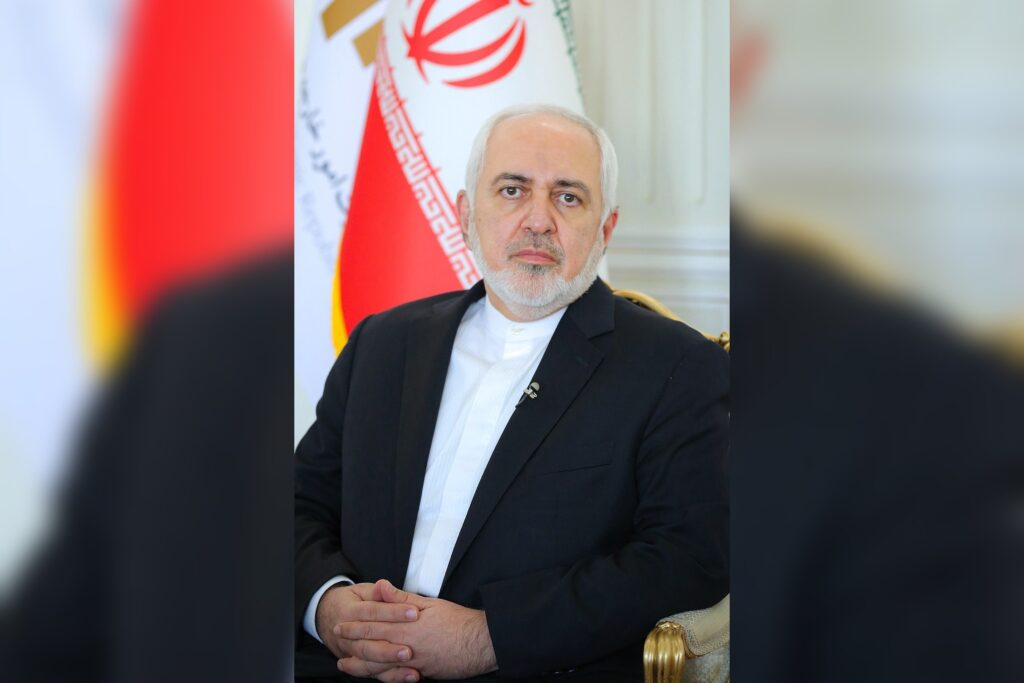
On July 8, President Donald Trump looked at the remains of the agreement his negotiators had struck with Iran a month earlier in Switzerland and delivered a verdict: “I think it’s over,” he said, adding that he no longer wanted to deal with Tehran. Twelve days later, one of the most recognizable Iranian diplomats of the past two decades wrote back. Mohammad Javad Zarif, who served as Iran’s foreign minister, vice president and permanent representative at the United Nations and now teaches global studies at the University of Tehran, published a new essay in Foreign Affairs laying out, once more, how he thinks the war should end. Here’s what it means: the argument is no longer about whether to talk, but about who controls the water the whole world ships through.
The war began on February 28, when the United States and Israel struck Iran, and Tehran answered by attacking its neighbors and squeezing the Strait of Hormuz, the waterway that normally carries one-fifth of the world’s crude oil and natural gas. Zarif’s first bid to stop it came in April, a roadmap published in the same magazine that he said would go “beyond a temporary ceasefire”: Iran would “place limits on its nuclear program” under international monitoring, blending down the roughly 440kg (970lb) of uranium inspectors estimate it holds at 60 percent enrichment to below 3.67 percent, and would “reopen the Strait of Hormuz in exchange for an end to all sanctions”. He called Trump’s demand for zero enrichment “fanciful”, offered a mutual nonaggression pact, and pitched the whole package to the American president as a “well-timed off-ramp”. “Emotions may be high, and each side is boasting about its war-front victories. But history best remembers those who make peace,” he wrote.
The June memorandum in Switzerland was supposed to be that off-ramp, and its collapse shows why the diplomacy keeps failing. In plain terms, the two sides read the same document differently. Iran believed it had promised only to “make arrangements using its best efforts for the safe passage of commercial vessels with no charge, for 60 days only”, and that it and Oman would “define the future administration and maritime services in the Strait of Hormuz” with the other Gulf states. Washington believed it had bought unconditional free passage. A text that each party understands to mean opposite things, Zarif writes, could never hold.
The new essay’s core claim is that the strait has become existential for Iran. Sanctions, in his telling, had long closed the waterway to Iranian commerce while leaving it open to everyone else; once the war started, weapons and components that struck Iranian cities had traveled through it, so Tehran now treats the passage of any traffic as a wartime question rather than a commercial one. Think of it like a homeowner who controls the only road into town and, mid-feud, stops distinguishing between delivery vans and armor. Yet Zarif concedes the leverage is fragile: a sustained closure could turn world opinion against Iran and accelerate the pipelines, ports and land corridors being built to bypass the waterway altogether.
His proposed bargain is sweeping. The United States would recognize Iran’s territorial integrity, remove terrorism designations, permanently lift sanctions and honor the memorandum’s promise of a $300 billion investment fund; Iran would ratify the IAEA Additional Protocol giving inspectors wider access and legally codify the late supreme leader Ayatollah Ali Khamenei’s fatwa against nuclear weapons. A mutual nonaggression framework would sit underneath, and the two countries could then cooperate on Afghanistan, drug trafficking and the management of migration. For Washington, he frames the payoff in its own language, the long-promised “pivot to Asia”: a region that polices its own security would finally let the United States turn elsewhere.
The neighbours, for their part, have heard him out and pushed back. Anwar Gargash, diplomatic adviser to the UAE president, wrote on X that Zarif’s earlier article ignored “aggression against its Gulf Arab neighbors”: “Thousands of missiles & drones targeting infrastructure, civilians, even mediators, is not strength; it is hubris & strategic failure. The Arab world has seen this before: destruction peddled as victory,” he continued. Qatar’s Hamad bin Jassim Al Thani, once the country’s prime minister, called the April roadmap clever and agreed with much of it, but said the war had cost Iran “the loss of an important part of your friends in the region, and the erosion of the trust that was built over years”. “Today, we need a voice like yours [Zarif’s] merging from within Iran to propose solutions to this war,” he added.
The practical upshot for everyone else is that the diplomat keeps writing while the shooting continues. Zarif’s case, in both installments, is that Iran cannot be bombed into collapse and the strait cannot be declared open by press release; his critics’ case is that Iran spent its trust firing at the very neighbors whose cooperation any security framework requires. Both can be true, which is precisely the trap the essay keeps circling. The war’s next chapter will show whether anyone in Washington or Tehran is still reading.
Sources
- Iran’s ex-FM Zarif proposes peace roadmap; Gulf points at erosion of trust | US-Israel war on Iran News | Al Jazeera
- Mohammad Javad Zarif: An Iranian Vision of the New Middle East




