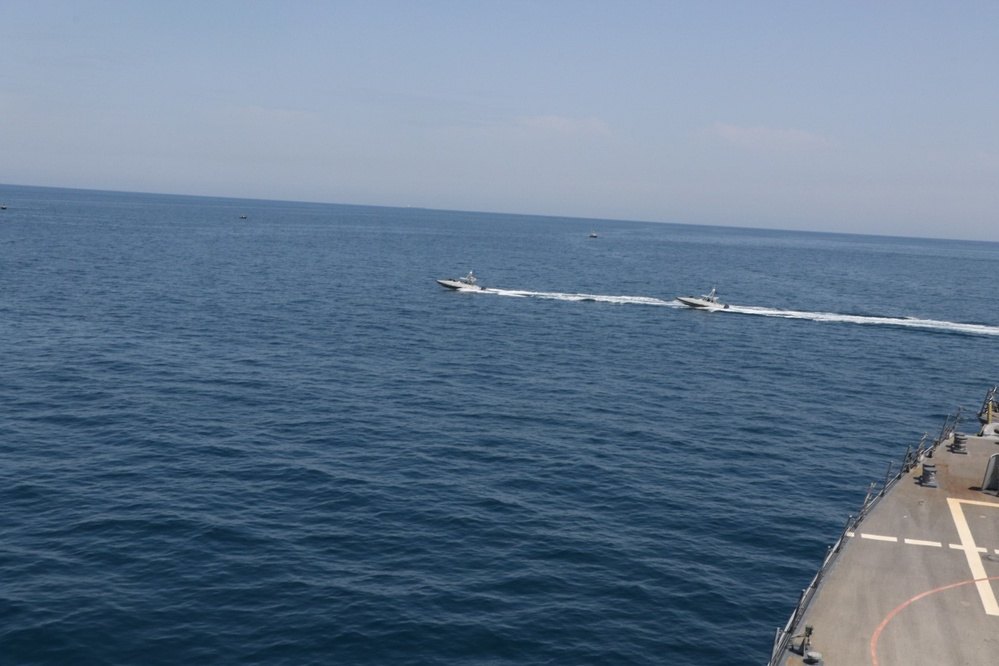
Smoke hung over the Lebanese city of Nabatieh as Israeli warplanes struck again, just hours after Washington announced a renewed ceasefire. Iran’s response came fast. Its central military command said “the Strait of Hormuz will be closed to vessel traffic.”
The command blamed a US “breach of contract” and “the Zionist regime’s continuous and relentless violation of the ceasefire in southern Lebanon.” Tehran called Israel’s attacks a violation of its deal with the United States to end the Middle East war.
A deal under strain
Iran blockaded the strait, a key route for oil and gas shipments, for much of the war, sending shockwaves through global energy markets. Under the preliminary agreement signed this week by US President Donald Trump and Iranian counterpart Masoud Pezeshkian, it agreed to reopen. Traffic had begun to pick up in recent days.
The deal was meant to halt the wider regional war on all fronts, Lebanon included, a key Iranian demand. Fighting there had already strained it.
Follow-up talks planned in Switzerland were postponed indefinitely the day before, after Israel launched a wave of deadly strikes in Lebanon when four of its soldiers were killed in combat. A US official then announced a new Israel-Hezbollah ceasefire brokered by US and Qatari mediators. Israel’s ambassador to Washington, Yechiel Leiter, said Israel would respect it if Hezbollah did.
Strikes in the south
It did not hold. An Israeli military official said Hezbollah had “launched more than 50 projectiles at Israeli forces in southern Lebanon” overnight, and that Israel was carrying out fresh attacks. Hezbollah said Israel had attempted “an infiltration attempt towards the Ali Taher hills,” which overlook Nabatieh, “under the cover of the ceasefire,” and that its fighters “confronted them with appropriate weapons.”
Lebanese state media reported Israeli air raids on about 20 locations. Civil defence said 16 people were killed in the Nabatieh area. Lebanon’s health ministry reported seven more dead and 13 wounded in a strike on a village near Sidon. An AFP journalist on the Israeli side of the border saw smoke behind Beaufort Castle, a strategic position Israel captured last month.
Hezbollah lawmaker Hassan Fadlallah said the group “has the full right to confront this enemy when it attacks us.” An Israeli military official told the public broadcaster Kan that Israel’s approach to the truce was “on the basis of fire being answered with fire.” Leiter insisted Hezbollah broke the truce: “Israel is honouring the ceasefire while defending itself against terrorist attacks, as any self-respecting country would.”
Fadi Zayat, 53, who had fled the southern town of Tayr Debba, told AFP he and his family returned a few days ago. “Our bags are ready to flee again,” he said. “We’re waiting for a serious decision to end the war.”
Diplomacy on several tracks
Hezbollah pulled Lebanon into the wider conflict in early March, firing rockets at Israel after the killing of Iran’s supreme leader in US-Israeli strikes. A ceasefire meant to take effect in April was never honoured.
In a call with Secretary of State Marco Rubio, Lebanese President Joseph Aoun stressed that Israeli attacks on Lebanese territory must stop, his office said. Rubio, per the State Department, insisted Lebanon follow through on efforts to disarm Hezbollah and re-establish control over all its territory. Israel and Lebanon have held several rounds of US-mediated talks in Washington, with another due next week.
The Switzerland talks were meant to start two months of negotiations on matters the first deal left open, notably Iran’s nuclear programme. Vice President JD Vance, who was expected to lead the American side, put off his trip. US media reported that envoy Steve Witkoff was heading there instead, with Jared Kushner also expected. Pakistan’s interior minister, Mohsin Naqvi, arrived in Iran for meetings, Iranian media said. Switzerland’s foreign ministry said envoys present were “continuing their efforts to maintain the dialogue.”