
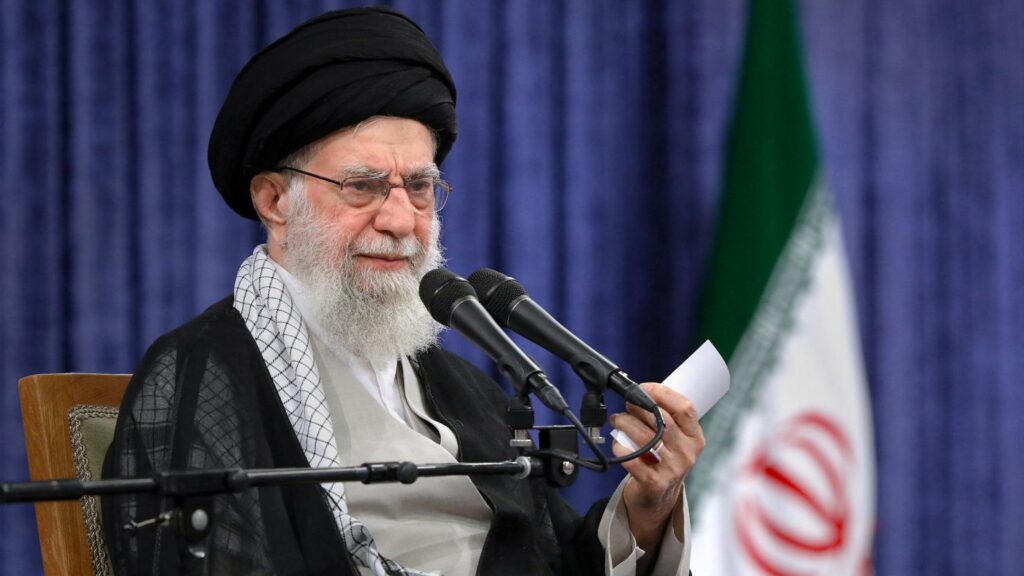
Israel’s official Persian-language social media account on X openly derided the state funeral for late Supreme Leader Ayatollah Ali Khamenei as Iranian officials and international delegations gathered in the capital on Friday. The online mockery coincided with the viewing of the former leader’s coffin inside the Grand Mosalla religious venue, a central site for the weeklong memorial proceedings.
Provocation Amid Solemn Rites
Israel’s government-run Persian-language profile posted an inquiry targeting the proceedings: “Seriously, what did they put in that coffin?” Hours later, the same account published a second message aimed at the crowd size, reading, “Many people come too – not to mourn, but to make sure he’s really dead.” The posts came on the same Friday that dignitaries viewed Khamenei’s heavily draped casket, covered in the national flag of the Islamic Republic, inside the expansive Grand Mosalla venue. AFP news agency photographs captured mourners holding the casket during the viewing.
The late leader was eliminated on February 28 during a coordinated military strike executed by the United States and Israel, according to source material. The juxtaposition of Israel’s public mockery with Iran’s solemn state ceremonies underscores the deep hostility between the two nations.
Memorials Draw Leadership, Mourners
Iran’s highest-ranking administrative figures initiated a weeklong sequence of memorial ceremonies on Friday. Global allies and local mourners entered Tehran, where Khamenei’s body is currently lying in state. Domestic authorities anticipate that the public processions and viewing cycles will draw millions of participants before the final interment takes place next week. State-run television broadcasted images of Iranian President Masoud Pezeshkian paying respects before the casket on Friday afternoon.
He was accompanied by Parliament Speaker and chief diplomatic negotiator Mohammad Bagher Ghalibaf, who was filmed weeping at the scene. For now, the focus in Tehran remains on the weeklong memorial proceedings, with authorities preparing for what they expect to be massive crowds before Khamenei’s burial next week.
Background: The Khamenei Legacy and the Supreme Leadership
Ali Khamenei succeeded Ruhollah Khomeini as Supreme Leader after Khomeini’s death in 1989, becoming the second person to hold the position. Khomeini had led the 1979 revolution that overthrew the monarchy and established the Islamic Republic. Khamenei’s leadership spanned more than three decades, during which he consolidated control over Iran’s political, military, and religious institutions.
His tenure was marked by efforts to maintain Iran’s revolutionary ideology amid domestic challenges and regional conflicts. The Khamenei family’s influence extended beyond governance.
Ali Khamenei’s son, Mojtaba, was widely seen as a potential successor, continuing a pattern of dynastic consolidation within Iran’s clerical leadership. The family traces its lineage to Shia religious figures, claiming descent from the fourth Imam, Ali al-Sajjad, a tradition that has reinforced their authority in Iran’s theocratic system. Supreme Leadership in Iran is an unelected position that wields ultimate authority over the state, combining religious and political power.
The office was created under the Islamic Republic’s constitution to ensure clerical oversight of government, military, and society. The Supreme Leader appoints key officials, controls the armed forces, and sets the broad direction of state policy.
This structure has made the position one of the most consequential in Iranian governance, with its occupant serving as both a spiritual guide and a head of state. Khamenei’s death in February 2026 prompted a period of transition, with Iran’s leadership organizing extensive mourning rituals to reinforce continuity. The scale of the ceremonies, broadcast to millions, reflects the regime’s reliance on symbolic displays of unity to legitimize its authority.
For Iran’s government, these rituals are not merely commemorations but demonstrations of strength, intended to project stability during a moment of vulnerability. For outside observers, the proceedings offer a window into the regime’s resilience—or fragility—amid shifting power dynamics.




