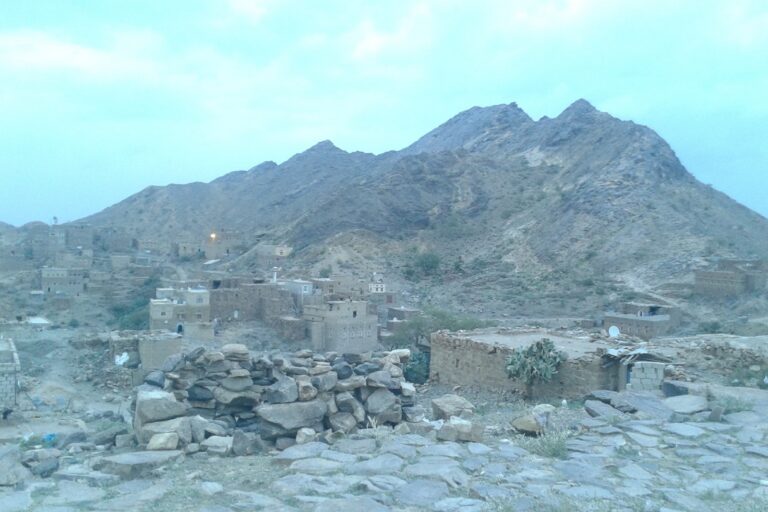
On 25 October 2026, a landmine planted by Houthi forces killed two civilians and injured several others in the Nateh district of Al-Bayda province, Yemen. The victims were in a Hilux transport truck traveling from the Houthi-controlled capital, Sanaa, toward the Al-Abr region in Hadhramaut province. One of the dead was identified as Saleh Ali Jaber Al-Harnakash. The blast occurred on a secondary route, a rugged and unpaved road that travelers are forced to use after the closure of primary roads connecting governorates. This shift in transit has significantly increased exposure to the vast network of landmines and improvised explosive devices indiscriminately planted by Houthi forces.
The Roadblock on Secondary Routes
The closure of primary roads connecting Yemeni governorates has forced travelers and motorists onto unpaved secondary routes. Local sources reported that this shift in transit has significantly increased exposure to the vast network of landmines and improvised explosive devices planted by Houthi forces. The Nateh district of Al-Bayda province, near the border with the Bayhan district of Shabwa, has become a focal point for these dangers. Civilians navigating these routes to move between provinces face a persistent threat from explosive ordinance deliberately placed along transit corridors. The recurrent nature of these attacks continues to endanger the lives of travelers and has led to a rising toll of civilian casualties.
U.S. Embassy Warns of Escalating Risks
The U.S. Embassy in Beirut updated its travel warning for American citizens, citing Iran’s efforts to target American officials and the escalating possibility of a militant attack by the Houthis in the region. The embassy classified southern Lebanon, the Syrian border, the southern suburb of Beirut, and refugee camps as highly dangerous areas, urging American citizens located there to leave quickly. The U.S. State Department kept Lebanon at Level 4, the highest level, meaning Americans are advised not to travel there for any reason. The warning tied its Lebanon risk assessment to Houthi attacks against Saudi Arabia, including strikes targeting civilian airports and other critical infrastructure. The embassy warned that hostilities could disrupt commercial flights and access to Beirut’s airport, and that drone and missile strikes could occur throughout Lebanon.
Indiscriminate Planting and Civilian Toll
At least two civilians were killed and several others sustained varying injuries following a landmine explosion planted by Houthi militias in the Nateh district of Al-Bayda province. The blast occurred when a civilian vehicle struck a landmine while traveling from the Houthi-controlled capital, Sanaa, toward the Al-Abr region in Hadhramaut province. The victims were transported for medical treatment as local authorities assessed the scene. Sources noted that the closure of primary roads has forced travelers onto rugged, unpaved secondary routes, significantly increasing exposure to the vast network of landmines and improvised explosive devices indiscriminately planted by Houthi forces, leading to a rising toll of civilian casualties. The incident underscores the persistent threat posed by the deliberate targeting of secondary roads and transit corridors with explosive ordinance.
Regional Implications
The U.S. intelligence chief Jay Clayton stated that Iran had “significantly stepped up” efforts to target Americans in the Middle East and beyond, and he told Secretary of State Marco Rubio that “Iranian plots for lethal attacks against American citizens have reached an advanced stage.” The U.S. Embassy in Beirut warned of a risk of terrorist attacks without prior notice, which could target tourist sites, transportation hubs, markets, and facilities run by local authorities. The National reported that a State Department official said the advisories were “not indicative of new capabilities from the Houthis, but reflect the strikes we have seen over recent days.” The U.S. Embassy in Beirut urged Americans to enroll in the Smart Traveler Enrollment Program (STEP) to receive security alerts, to follow local media, to avoid protests and gatherings, and to have emergency departure plans that do not rely on U.S. government assistance. The closure of primary infrastructure and the planting of landmines on secondary routes have altered the calculus of movement for both Yemeni civilians and international travelers, with the U.S. warning that the situation could escalate further.
Humanitarian Access And Agricultural Devastation
The widespread planting of landmines on secondary routes has crippled humanitarian access across Yemen, aid agencies report. The United Nations Office for the Coordination of Humanitarian Affairs (OCHA) documented that blocked corridors have forced relief convoys to reroute through mined areas, delaying life-saving aid to famine-stricken regions. A local aid worker in Al-Bayda province stated, “Every trip into the countryside is a gamble; we lose fuel and time avoiding explosions that should not be there.” The Food and Agriculture Organization (FAO) noted that farmers are unable to reach their terraced fields, resulting in widespread crop abandonment and exacerbating food insecurity in a country already facing the world’s largest humanitarian crisis. The deliberate mining of agricultural pathways has transformed vital farmland into no-go zones, stripping civilians of both shelter and sustenance.
Economic analysts warn that the landmine contamination is reversing years of development progress in Yemen’s rural heartland. The World Bank estimates that damage to infrastructure and agricultural land from explosive hazards costs the Yemeni economy millions of dollars monthly in lost productivity. Residents of the Nateh district reported that entire valleys once used for grazing and cultivation are now too dangerous to enter, forcing families to abandon ancestral lands. One displaced farmer from the Al-Saqiya area explained, “We fled the fighting, only to lose our livelihoods to hidden mines. We have no way to plow our soil or feed our livestock.” The combination of closed primary routes and mined secondary paths has created a web of exclusion that traps both aid and population in a cycle of vulnerability.
Sources
- U.S. Embassy In Beirut Warns Americans Not To Travel, Citing Houthi Attack Risk: 5 outlets compared | NewsCord
- Seoul ‘fabricated’ landmine blast, North Korea tells UN in letter
- Two Civilians Killed by Houthi Landmine Blast Between Al-Bayda and Shabwa Provinces | وكالة خبر للأنباء
Photo: Ibrahem Qasim (CC BY-SA 3.0)