
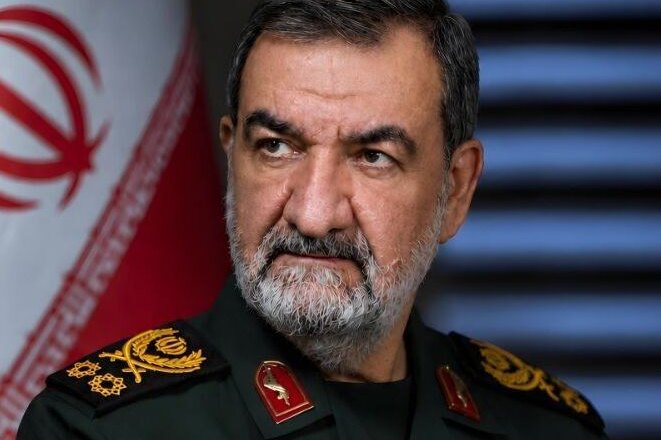
The scene, as Iranian state media framed it in January 2025: a cavernous underground complex, ranks of soldiers, and a commander in a green military uniform and with a short beard taking their salute. The man walking across US and Israeli flags laid on the floor was Major General Hossein Salami, who ran the Islamic Revolutionary Guard Corps, the secretive and heavily armed force the world knows as the IRGC, and the site, the reports added, was now turning out “new special missiles,” as the semi-official Mehr outlet put it. It was peak Salami choreography, the theatrical swagger of an officer entering his sixth year atop Iran’s most powerful security force. Five months later he was dead, killed alongside much of the country’s top brass in a single Israeli operation.
By then Salami had led the Guards since 2019, one of the most powerful men in the Islamic Republic, reporting directly to Supreme Leader Ali Khamenei. A US sanctions docket puts his birth year at 1960. He commanded the state’s most potent military arm, the force analysts credit with crushing dissent at home and projecting Iranian power abroad, bankrolling a vast network of regional militias used against US personnel and others across the Middle East. The Guards were also believed to arm and assist Yemen’s Houthis, enabling attacks on international shipping in the Red Sea. Under Salami, Iran fired hundreds of drones and missiles at Israel across April and October 2024, the first direct strikes on Israeli territory from Iranian soil. His tenure also owned a dark chapter: the shootdown of a Ukrainian passenger jet that had just left Tehran’s international airport, which killed all 176 people on board. An unnamed commander of the Tor M1 air-defense battery that fired was later sentenced to 13 years in prison.
The European chapter of his story had opened four years earlier, on April 12, 2021, when the EU blacklisted Salami, seven other militia commanders and police chiefs and three Iranian prisons, imposing travel bans and asset freezes over the deadly November 2019 crackdown. It was the first EU rights sanctions on Iran since 2013. The bloc’s official journal was unsparing: Salami “took part in the sessions” where the orders to use lethal force were issued, and therefore “bears responsibility for serious human rights violations in Iran,” the EU said.
The protests themselves began on November 15, 2019, when a surprise hike in fuel prices sent people into the streets across Iran, before the movement was crushed amid a near-total internet blackout. About 1,500 people were killed in less than two weeks, by a toll three Iranian interior ministry officials gave Reuters at the time; the United Nations counted at least 304. Iran called that count “fake news”. A March 9 report by UN Special Rapporteur Javaid Rehman found Tehran had used lethal force and faulted it for failing to investigate properly or hold anyone accountable. Tehran’s answer to the sanctions was fury. The foreign ministry said it strongly rejects them and would suspend its human-rights talks with the EU and all cooperation flowing from them, including on terrorism, illicit drugs and refugees. Spokesman Saeed Khatibzadeh accused the bloc of political motives, saying it stayed silent on the “anti-human and illegal” sanctions unilaterally imposed by Washington since it walked away from the 2015 nuclear deal in May 2018. “The Islamic Republic of Iran is considering reciprocal sanctions in reaction to the European Union’s move, which will be announced subsequently,” he said.
The timing was awkward by design. The sanctions landed as negotiators in Vienna worked to bring Washington back into the 2015 nuclear deal, and the EU had described those talks as “constructive”. A European diplomat told AFP the blacklist had been in the pipeline a long time and was pressed ahead anyway. The EU’s Iran rights list dated to 2011 and now held 89 names and four entities, separate from the nuclear-programme sanctions Brussels dropped under the deal.
Then came June 13, 2025, and Israel’s Operation Rising Lion. Salami was killed alongside Mohammad Bagheri, who had run Iran’s armed forces as chief of staff since 2016, commanding a body a US Treasury document called “the most senior military body in Iran, which implements policy and monitors and coordinates activities within the armed forces”; Ali Shamkhani, the former national security chief who represented Tehran in the China-brokered talks that restored diplomatic ties with Saudi Arabia before his abrupt replacement in mid-2023; and Amir Ali Hajizadeh, commander of the IRGC’s Air Force and head of the missile program, the mastermind behind the April 2024 attack on Israel and the 2020 missile strike on a US base in Iraq. The Israeli military said Hajizadeh died with other senior air force leaders when a strike caught them gathered at an underground command center. CNN security analyst Beth Sanner compared removing Salami to the US losing its chairman of the joint chiefs: “You can imagine what Americans would do,” she said.
Salami’s end carried its own grim symmetry: the commander who took a salute in one underground complex in January 2025, walking across the flags of the United States and Israel, was killed in another underground site barely five months later, with his fellow generals gathered around him. The EU had spent four years trying to hold him accountable with travel bans and asset freezes. Israel closed the file from the air.
Sources
- EU sanctions elite Iran commander over 2019 protests | European Union News | Al Jazeera
- Hossein Salami, Mohammad Bagheri, Ali Shamkhani killed as Israel targets Iranian military and nuclear leadership | CNN




