
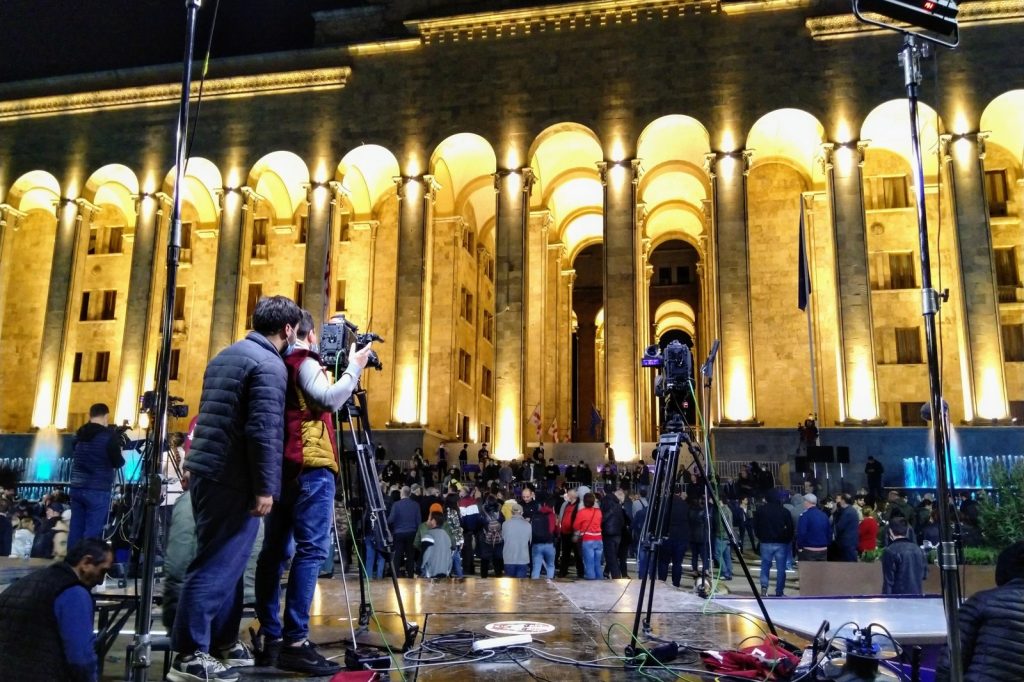
Davit Tamazashvili was fixing his camera outside the parliament building in Tbilisi when the shooting began. The freelance reporter says three bullets struck his legs.
“I was wearing thick jeans, which saved me. Some people who were hit on the hand bled immediately…but my thick jeans protected me,” he told RFE/RL the next day, showing his injuries.
Tamazashvili had been at the vehicle gate of the building, where demonstrators were trying to block the entrance. Pepper spray and water cannon hit the crowd there, along with what looked like rubber bullets. He also said a tear gas canister was thrown at protesters, and that surveillance cameras nearby should show who fired and who threw it.
Police deny it, evidence points the other way
The clash came on May 1. Fifteen people with assorted injuries went to hospitals afterwards, and in at least eight cases the victims said rubber bullets had hit them. RFE/RL collected eyewitness accounts and photographs of wounds, interviewed two of the injured and filmed rubber bullets at the place where they were reportedly fired. Its reporters found the injuries consistent with rubber bullet impacts.
Deputy Interior Minister Aleksandre Darakhvelidze rejected that. Speaking to reporters in the early hours of May 2, he said law enforcement officers used “no rubber bullets” even though there were “sufficient legal reasons for their use.” Georgia’s Special Investigation Service said it was looking into excessive force against the demonstrators.
UN human rights chief Volker Turk said he was worried by what he called “unnecessary and disproportionate use of force by law enforcement personnel against demonstrators and media workers” in Tbilisi. He asked the government to withdraw the law and to talk with civil society and journalists, who stand to be affected by it.
The bill behind the protests
Parliament had moved the legislation through a second-reading vote just before the May 1 demonstration, which was one of the largest Georgia has seen. A third and final vote is expected on May 17. Under the bill, any organization taking more than 20 percent of its funding from abroad would have to register as an agent of foreign influence.
Critics call it “the Russian law”, after the measure Moscow has used to silence its own critics. They also say it could put Georgia’s bid for European Union membership at risk. The ruling Georgian Dream party had to back away from an earlier version last year after protests, and brought back a slightly modified text this spring. President Salome Zurabishvili, who has put distance between herself and the party, has promised to veto it if it passes the third reading.
On May 2, tens of thousands of people returned to the streets. They gathered in front of parliament and on Heroes’ Square, where they blocked a major intersection. Police arrested some demonstrators there while trying to clear the road, but the square filled up again once the crowd from the parliament building marched over.
Washington and Brussels weigh in
The Foreign Ministry in Tbilisi turned down an invitation from the United States to hold direct talks with American officials, according to U.S. Ambassador Robin Dunnigan. She said Georgian leaders were invited to speak with the most senior U.S. figures about the partnership and any concerns over American assistance. The ministry said the offer came with a condition that parliament pause debate on the draft law, which it said “does not correspond to the spirit of partnership.” Dunnigan’s statement did not mention any such condition.
The U.S. State Department said Georgian actions and statements were “incompatible with the democratic values that underpin membership in the EU and NATO.” European Commission President Ursula von der Leyen wrote on X that she condemned “the violence on the streets of Tbilisi” and added that “the Georgian people want a European future for their country.”
The hacking collective Anonymous also claimed responsibility on May 2 for taking down the websites of the Georgian Dream party and the pro-government channel PosTV, both unreachable since late on May 1. It described the attack as a reply to police violence and warned that more government sites would follow.




