
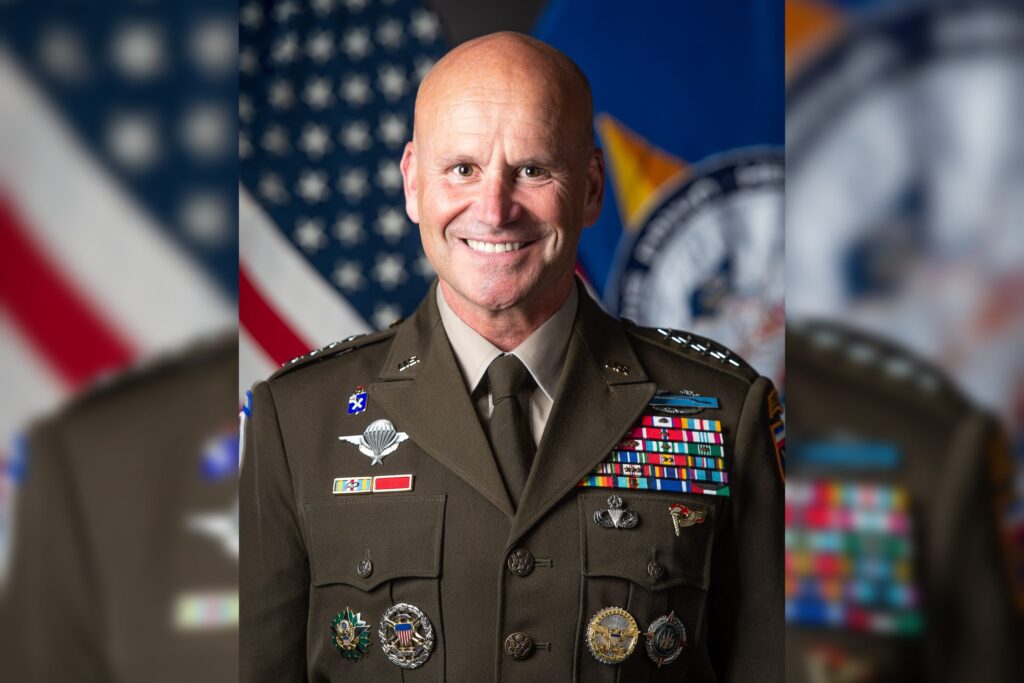
A New York stage, August 2024, and the moderator is admiring the business card: “What a fantastic title.” The man who holds it, General Christopher G. Cavoli, offers his deadpan reply, “Not very supreme”, and the room laughs. In the corridors of the alliance, the joke lands differently. The Supreme Allied Commander Europe, in post since July 4, 2022, with U.S. European Command added on July 1, is four years into the alliance’s top military job, held through the most consequential period since the Cold War.
The wider picture of the man: commissioned into the Infantry in 1987, near forty years in uniform, with commands spanning the 25th Infantry Division, the 7th Army Training Command and the 1st Battalion, 32nd Infantry Regiment. He ran U.S. Army Europe from January 2018 to June 2022, folding Africa operations into its portfolio, after staff work as Director for Russia on the Joint Staff and a deputy posting in Herat, Afghanistan. A Foreign Area Officer concentrated on Eurasia, he speaks Italian, Russian and French, holds degrees from Princeton and Yale, and wears the Ranger Tab, Combat Infantryman’s Badge and Master Parachutist’s Wings.
Against this backdrop, what he took over in July 2022 was a war he had watched from its first hours. As Army Europe’s commander he had helped build the structures that aided Ukraine, seeded by the 82nd Airborne and the 18th Airborne Corps, and years earlier, as a one-star, assembled the American training mission at Yavoriv in western Ukraine. The aid machinery he now oversaw ran through the Ramstein process of the Ukraine Donors Coordination Group, drawing in, by his count, maybe fifty nations. His caution to the New York audience was soldierly: war is unpredictable, “Otherwise, it wouldn’t be war.”
His reading of the fight is unsentimental. Ukraine’s burdens are unmovable ones, he says, size, population, industrial base, a country already partially occupied for ten years before the full invasion, yet these are not insuperable; he has been “astounded by some of the innovation that has come out of Ukraine under pressure”, military, technical and tactical, the Kursk operation among them. Of the allies he notes many have “turned around decades of pacifistic tendency”, rearming even as they help; as he puts it, “five years ago we wouldn’t have predicted a NATO like the one we see today.”
What is at stake, in his telling, extends to the adversary. Russia complicated its own invasion plan with multiple axes on exterior lines, bungling basic operational art, and what struck him most was corruption’s toll on the readiness of its forces, petty rot in the sustainment of equipment. The record shows a linguist-scholar of Russia now commanding the very alliance Russia’s war remade. Europe could ask for little more apt an arrangement.
Sources
- General Christopher G. Cavoli – Euro-Atlantic Network | Atlantic Treaty Association
- A Conversation With Supreme Allied Commander Europe (SACEUR) Christopher G. Cavoli | Council on Foreign Relations




