
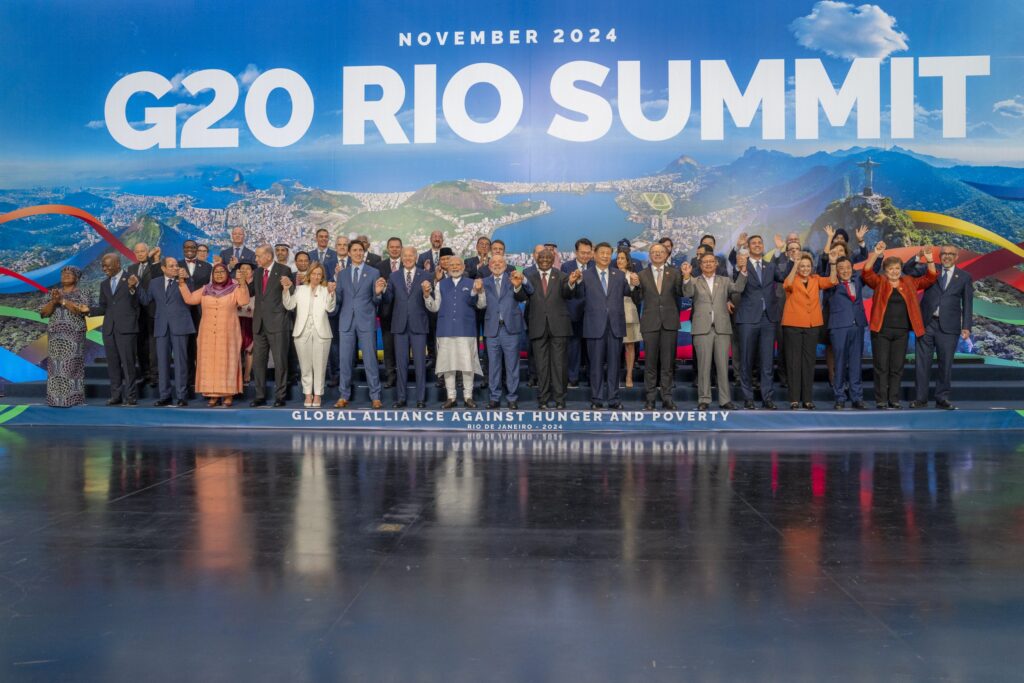
The African Union (AU) came out of its first G20 as a full member with most of what it wanted on paper. The Institute for Security Studies in Africa put it plainly: the 86-point Rio de Janeiro Leaders’ Declaration “ticked most of the boxes” of the AU’s key priorities.
Until this year the bloc had held only the status of “invited international organization.” The G20 now has 19 countries and two regional unions, the European Union and the AU, and together they account for 85% of the global economy, 75% of world trade and 67% of the global population, the Wilson Center noted.
Who sat at the table
Mauritanian President Mohamed Ould Ghazouani, the AU Chairperson, spoke for the continent in Rio, with Moussa Faki Mahamat, chairperson of the AU Commission, assisting. The pairing came out of a February 2024 decision at the AU summit in Addis Ababa, a compromise after a dispute over who should lead the delegation. The Wilson Center cautioned it may not suit future summits.
Neither man was highly visible in Rio, ISS said. It still read the result as a sign that months of meetings with Brazil and South Africa beforehand had paid off.
Ghazouani devoted his speech to the Global Alliance against Hunger and Poverty, which Brazil launched during the summit. He thanked Brazil and offered Africa’s support, saying one in five Africans suffers from malnutrition and that over 300 million could be chronically undernourished by 2030 without action.
What the declaration said
The text commits leaders to work toward low-cost financing for developing countries moving to low-carbon economies. It endorsed principles for just and inclusive energy transitions. It also welcomed a 25th chair on the International Monetary Fund’s Executive Board, meant to give sub-Saharan Africa more voice.
Leaders called for a larger UN Security Council that would give more say to “underrepresented and unrepresented” regions, Africa among them. They stopped short of explicitly backing permanent seats. They also acknowledged the need to deal better with debt vulnerabilities in low- and middle-income countries.
Peace was the gap. Sanusha Naidu of the Institute for Global Dialogue told ISS Today: “You cannot achieve stability, economic development and equality without having peace and security and stability on the agenda.” She called it one of the “missing pieces” and said South Africa should give it more attention once its presidency starts on December 1.
A friendly room
ISS suggested the AU had some luck. Brazil’s Luiz Inácio Lula da Silva chaired, and the organising troika was Brazil, India and South Africa. Argentina’s Javier Milei dissented on several points, including a 2% tax on global billionaires, but agreed not to block the overall declaration and only registered his disagreement.
ISS expects next year’s summit in South Africa to be similar. The year after, when Donald Trump chairs the G20, could be a real test of how effective the AU is.
Sources
- The African Union Becomes a Full Member of the G20
- G20 Summit ticks most of the African Union’s boxes | ISS Africa
Sources
- The African Union Becomes a Full Member of the G20
- G20 Summit ticks most of the African Union’s boxes




