
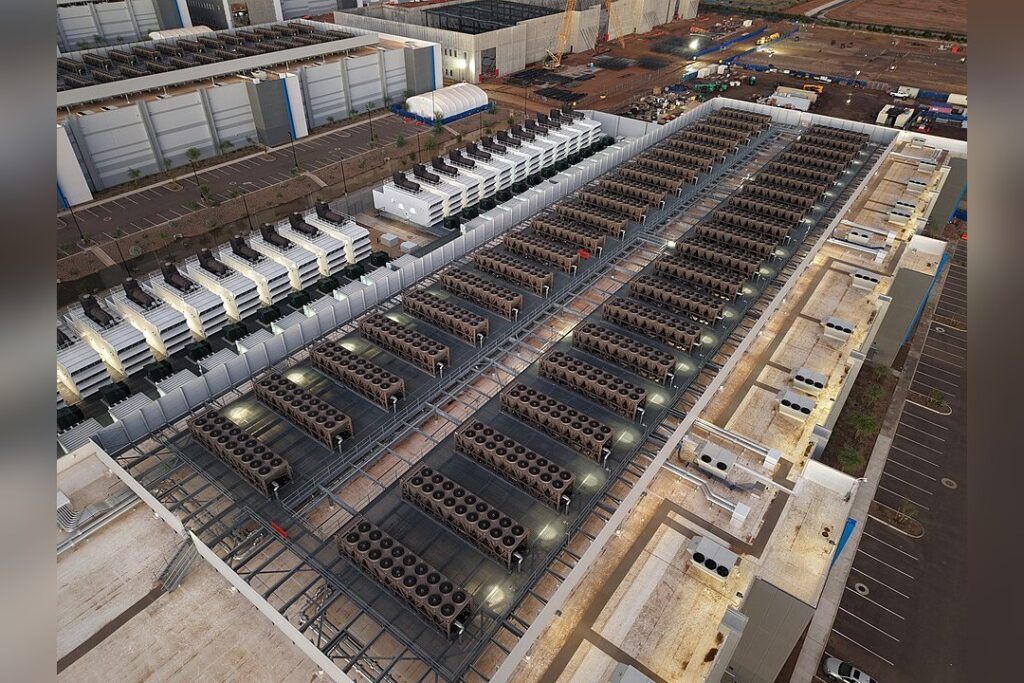
Copper thieves are targeting the sprawling data centers that power modern artificial intelligence, turning the same infrastructure that made the AI revolution possible into a magnet for an age-old crime. The phenomenon follows directly from the work of Fei-Fei Li, the Stanford computer scientist whose creation of ImageNet in 2009 helped launch the deep-learning boom now driving demand for massive computing facilities. Li, who immigrated from China at age 16 and graduated from Princeton University with a bachelor’s degree in physics in 1999, launched ImageNet as a visual database containing over 14 million labeled images.
That dataset became a standard benchmark for computer-vision algorithms and was instrumental in advancing deep learning, the technique that underpins today’s generative AI systems. Her research has been cited in more than 100,000 academic papers, and the market for AI data centers built to host such models is projected to reach $45.2 billion by 2028.
An Unlikely Target for an Old Crime
The link between Li’s academic breakthroughs and the physical infrastructure being built today is direct. Training large AI models requires immense computing power, which generates significant heat. That heat must be managed by cooling systems that rely on copper wiring and components. Copper is valuable, easy to resell, and now sits inside remote, sprawling facilities that are difficult to secure fully.
Thieves have taken notice, and copper theft from construction sites and industrial facilities, while not new, has become a growing concern for data center operators as the scale and value of these installations rise. Li served as chief scientist at Google Cloud from 2017 to 2018 and co-founded AI4ALL in 2017, a nonprofit focused on promoting diversity in artificial intelligence.
In 2022 she received the ACM Prize in Computing, one of the field’s highest honors. Her election to the National Academy of Engineering and the National Academy of Medicine further underscores her influence. She has also spoken publicly about the need to develop artificial intelligence responsibly, a theme that runs through her career and now takes on a physical dimension as the very infrastructure required to sustain AI advances becomes a target.
From ImageNet to Infrastructure
The tension between building powerful technology and ensuring its responsible use has long defined Li’s career. Now that tension has a concrete manifestation: the data centers being built to support AI research are energy-intensive, filled with valuable metal, and increasingly difficult to protect.
AI is not just software; it requires physical plants that cost enormous amounts to build and operate, and those plants are now drawing attention from thieves. The encouraging note is that the research community Li helped build is aware of the problem. Security measures at data centers are being upgraded, and copper theft is being treated as a serious operational risk.
Yet the fundamental challenge remains: the demand for computing power is growing faster than the industry’s ability to secure the infrastructure that provides it. Li’s work on ImageNet fundamentally changed what computers could see and understand, and that work now drives an industry worth tens of billions of dollars.
That industry is learning in real time that building powerful technology also means protecting the physical systems that make it possible. For Li, whose path from an immigrant teenager working weekends at her family’s dry-cleaning shop to a leading computer scientist shaped her approach to both research and public service, the present moment illustrates the chain of consequence linking academic work to global supply chains and local crime. She co-directs the Institute for Human-Centered Artificial Intelligence at Stanford and has repeatedly emphasized the need for ethical guardrails.
That dual commitment is now essential not only for algorithmic development but for securing the concrete, steel, copper, and electricity that sustain modern AI. The future of AI depends on more than algorithms; it depends on secure, reliable infrastructure.
Li helped create the algorithms. The rest of the industry is still catching up on the infrastructure. For now, the message is clear: the technology is powerful, the demand is real, the infrastructure is being built, and it needs to be protected.




