
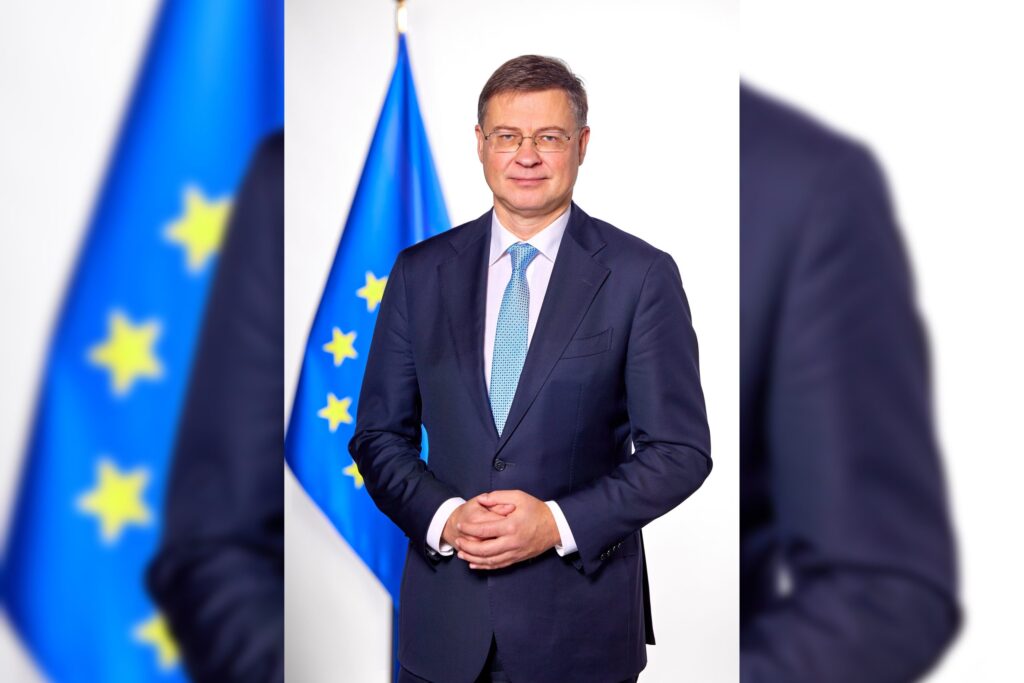
BRUSSELS, July 7 — For Indian exporters and manufacturers tracking the European Union’s hardening stance on Chinese trade practices, one name has become central to the conversation: Valdis Dombrovskis. The European Commissioner for Trade, in office since 2020, is the architect behind a regulatory push that is reshaping how the world’s largest trading bloc deals with Beijing’s industrial output. The stakes for Asia are immediate.
India, which has its own trade disputes with the EU over steel and textiles, watches closely as Brussels builds legal tools that could eventually apply to any nation found to be distorting markets. Dombrovskis has been the driving force behind the EU’s Foreign Subsidies Regulation, announced in 2023, a mechanism designed to counter state-backed advantages that undercut European companies.
His previous role as Prime Minister of Latvia from 2009 to 2014 gives him a distinct perspective. Analysts in New Delhi note that experience likely informs his insistence on “a level playing field” — a phrase he has used when discussing Chinese electric vehicles and other goods that benefit from state support. ## The Anti-Subsidy Offensive Dombrovskis has launched anti-subsidy investigations into Chinese electric vehicles and other goods. These probes are not abstract trade actions for Indian automakers.
Tata Motors and Mahindra & Mahindra, both of which have ambitions to export EVs to Europe, face a market where Chinese competitors are already under scrutiny. If the EU imposes countervailing duties on Chinese EVs, it could open a price window for Indian exports — but only if New Delhi can assure Brussels that its own production incentives do not cross the same line.
The commissioner has coordinated with the United States on trade policy toward China. That transatlantic alignment, according to trade officials in Mumbai, creates a unified front that makes it harder for Beijing to play one Western market against another.
For India, which maintains its own strategic autonomy, the EU-US coordination on Chinese overcapacity is a reminder that the rules-based trading order is being rewritten, often without New Delhi at the table. ## A Career Forged in Crisis Born August 5, 1971, Dombrovskis entered politics in the aftermath of Latvia’s independence from the Soviet Union. He led his country through the global financial meltdown, making tough choices that stabilized the economy but cost his government popularity.
That record earned him respect in Brussels, eventually leading to his appointment as European Commissioner for Trade. His current role places him at the center of the EU’s response to what officials describe as Chinese industrial overcapacity.
The term refers to a situation where China produces far more steel, aluminum, solar panels, and EVs than its domestic market can absorb, then exports the surplus at prices that undercut local manufacturers. Dombrovskis has made addressing this dynamic a signature issue. ## What to Watch Next For Indian readers, the key question is whether the EU’s anti-subsidy tools remain targeted at China or become a broader template.
The Foreign Subsidies Regulation, as the European Commission has framed it, applies to any company receiving foreign financial contributions that distort the internal market. That language is neutral on its face, but its enforcement will reveal Brussels’ priorities.
Dombrovskis is expected to continue coordinating with Washington on trade enforcement. Indian trade negotiators, meanwhile, are watching the EU’s ongoing free trade agreement talks with New Delhi — discussions that could determine whether India benefits from the rebalancing of global supply chains or gets caught in the crossfire. The commissioner’s next moves will signal whether the EU intends to deepen its partnership with like-minded democracies or pursue a more protectionist path.
For now, the direction is clear: the era of unchecked state-subsidized exports to Europe is ending, and Valdis Dombrovskis is the official drawing the new boundaries.




