
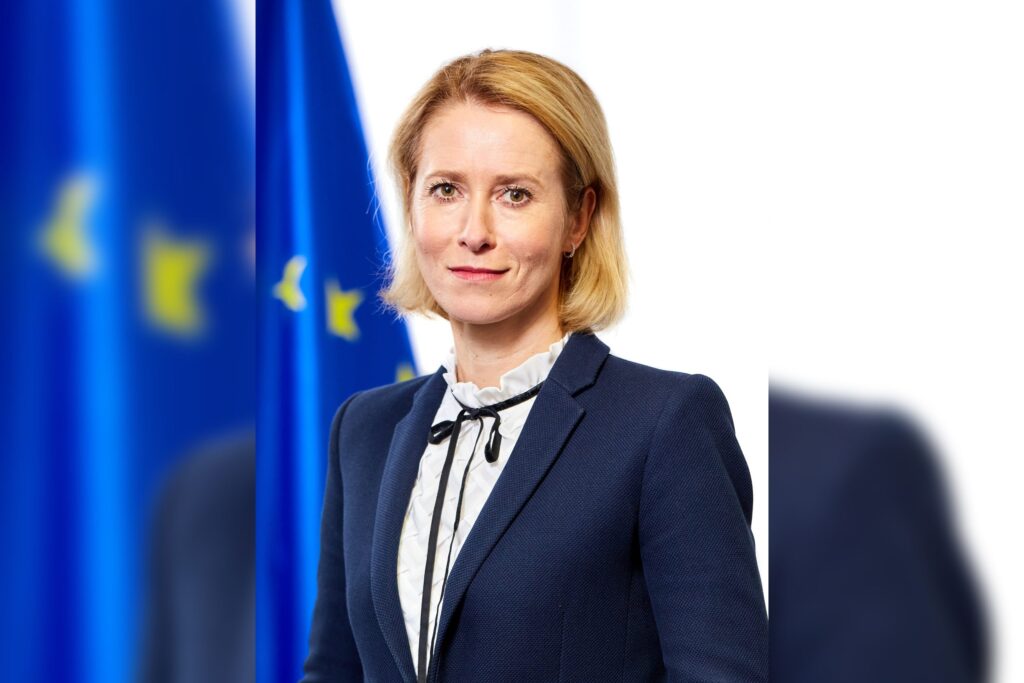
“Weakness provokes Russia. Strength doesn’t.” Kaja Kallas said that to the Kyiv Independent in January 2024, when she was still Estonia’s prime minister and Ukraine’s aid from the West was under strain. It is the shortest summary of the line she held through most of her time in office, and she carried it with her when she left for Brussels.
Kallas took the premiership in January 2021, after the previous cabinet collapsed in a corruption scandal. The Associated Press reported that she was 43, a lawyer and former member of the European Parliament, and the first woman to head an Estonian government. Politics ran in the family: her father, Siim Kallas, helped create the Reform Party and later served as prime minister and as an EU commissioner. Kaja had taken over the party herself in 2018, again a first for a woman. Her first job was not Russia at all. Her coalition with the Center Party was formed to keep Estonia on course through the COVID-19 crisis. Looking back, she told Estonian public radio it was a very hard time: she started at the peak of the pandemic, and decisions had to be made at her first cabinet session.
A small state, a large share of the aid
Russia’s full-scale invasion in February 2022 changed the job. The Kyiv Independent noted that Estonia, a country of 1.3 million people bordering Russia, had committed aid to Ukraine of nearly 500 million euros, over 1.4% of its GDP, which put it among the leading supporters measured against the size of its economy. When Volodymyr Zelensky visited Tallinn on Jan. 11, 2024, the government pledged 1.2 billion euros for Kyiv over the next four years.
Kallas pushed the same message at EU and NATO tables. DW wrote that, relative to GDP, Estonia had become one of the largest military suppliers to Kyiv, while she kept pressing allies to follow. In the interview she argued that long-range weapons mattered because Moscow had to calculate that it could be hurt in return. She also told the paper that worrying about Russia’s humiliation was beside the point. One country had attacked another, she said: “There are no gray areas in this.”
She was equally direct on practical questions. Estonia was then hosting around 36,000 Ukrainian refugees, and Zelensky had raised whether men of mobilization age might be sent home. Kallas said Estonia would do nothing to hand anyone over, since they held temporary protection from the EU, and that it was up to Ukraine to ask them to return. On the 50 billion euro EU package blocked by Hungary, she said 26 countries stood firmly behind it and she expected a deal.
Out of Tallinn
In July 2024 she submitted her resignation to the president, Alar Karis, stayed on as caretaker until early August and gave up the Reform Party leadership. EU leaders had picked her to succeed Josep Borrell as foreign policy chief. DW reported that Climate Minister Kristen Michal was tipped to take over in Tallinn.
In Brussels the audience grew from 1.3 million Estonians to some 450 million people in 27 countries, but the focus did not. In February 2025 she told DW that “sabotage is on the rise in Europe”, pointing to the latest suspected hybrid attack, on undersea cables in Sweden’s economic zone in the Baltic, and said such incidents should be read together rather than in isolation. Russia’s intentions toward European security, she added, had not changed.
The same interview dealt with the new Trump administration. Kallas called the United States an ally and a friend, said she had spoken that week with Marco Rubio, the secretary of state, and that it went well, and argued that the turbulence in Washington made the EU look like the stable, predictable partner.
Sources
- Estonian PM: Our taxpayers shouldn't pay for damages caused by Russia (Kyiv Independent)
- EU top diplomat: Sabotage is on the rise in Europe (DW)
- Estonia: Premier Kallas resigns to become top EU diplomat (DW)
- Kaja Kallas to become Estonia's 1st female prime minister (AP via Daily Sabah)




