
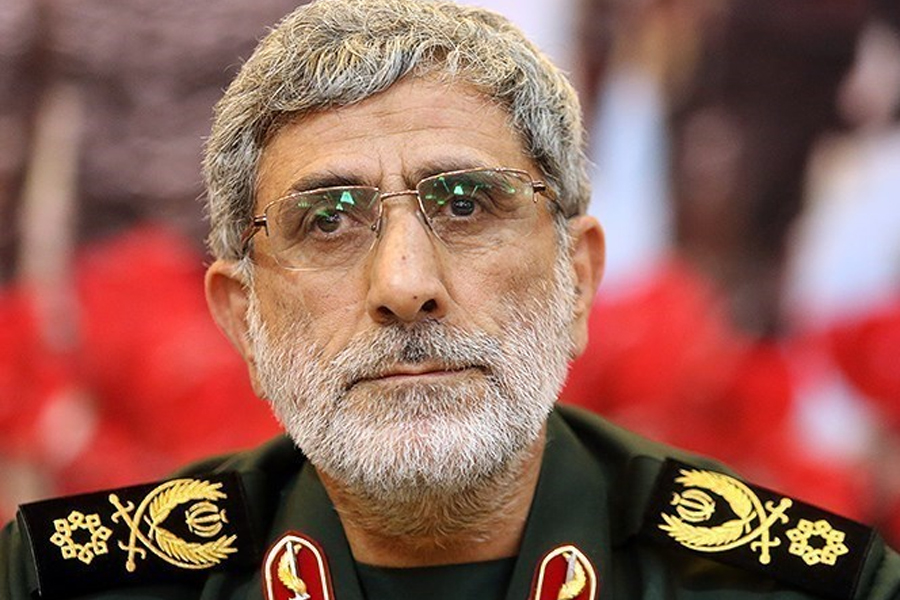
Hours after Qassem Soleimani died in a US strike near Baghdad airport in January 2020, Iran’s supreme leader reached for his deputy. Ayatollah Ali Khamenei named Esmail Qaani, then 62, to run the Quds Force, and sent a message with the appointment: the work “goes on as usual”, as planned by the man he called a martyr.
Most people outside the region had never heard of Qaani. That was partly the point.
A quieter man than his boss
Soleimani had cultivated a celebrity profile. According to Asia Times, he had a social media team and kept appearing at fronts in both Syria and Iraq. Qaani’s first press conference was different in one respect. He stood flanked by banners of the Shiite militias Tehran has cultivated, from Hezbollah in Lebanon to Afghanistan’s Fatimeyoun Brigade. “That was something even Soleimani didn’t do,” military analyst Kamal Alam told the outlet.
Still, analysts expected a lower profile. Iran analyst Will Fulton predicted far thinner coverage of Qaani, with his reputation resting on the mystique of activities that stay out of view. In plain terms: a manager, not a showman.
Where he came from
Qaani was born in Mashhad, in Khorasan province, a place where the Guards prepare Shiite Afghans to fight abroad. He is a veteran of the Iran-Iraq war, in which he led two brigades, the Nasr-5 and the Imam Reza-21; the latter later became a division. Radio Farda reported that he had belonged to the Quds Force since its founding in 1988 and spent the past two decades as an intelligence official and Soleimani’s deputy.
Alam said Qaani had mostly worked on Afghanistan and on Central and South Asia, courting Shia communities that had been passive and pulling them toward Tehran. That meant, he said, “indoctrination, and then actual mobilization and finally deployment into the battlefield”, as happened in the war against the Islamic State. An official in the supreme leader’s bureau added that Qaani had built contacts as far afield as groups in Africa.
The United States had marked him years earlier. On March 27, 2012, the Treasury Department listed him as a Specially Designated National over his part in supervising payments and weapons shipments to Hezbollah and to Quds Force elements in the Middle East and Africa.
The network he inherited
The Council on Foreign Relations describes the Quds Force as the Guards’ de facto external affairs branch, with links to armed groups from Afghanistan to Yemen. Its help runs to training, arms, cash and advice on tactics. In Yemen the Guards gave the Houthis intelligence, training and weapons in their fight against the government and its Saudi backers. In Syria, the force fought on the front lines beside Syrian government troops and Lebanese Hezbollah.
Khamenei praised Qaani as “one of the most distinguished Islamic Revolution Guard commanders”. Asia Times noted that he began the job under a cloud: the Guards had mistakenly shot down a Ukrainian passenger jet carrying Iranians, spoiling the national unity that followed Soleimani’s killing.
Sources
- Three Decades Of Iran's Qods Force And Its New Commander (RFE/RL Radio Farda)
- Esmail Qaani: Soleimani's discreet successor (Asia Times)
- Iran's Revolutionary Guards (Council on Foreign Relations backgrounder)




