
Advanced Patriot interceptors cost about $4 million apiece. The Shahed drone they are fired at costs $35,000. That gap is the heart of a problem the United States and its Gulf partners have been working through since the war with Iran began, according to Michael C. Horowitz of the Council on Foreign Relations and Lauren Kahn of Georgetown’s Center for Security and Emerging Technology.
Writing in March, as Operation Epic Fury entered its second week, the two analysts argued that Iran’s response to U.S. and Israeli attacks proves the world has entered “the era of precise mass in war”: high-volume use of low-cost, increasingly autonomous systems with accurate guidance. The lessons of Ukraine’s war, now more than four years old, are visibly shaping how Washington, Tehran and Jerusalem fight.
The cost curve
The Shahed-136 costs between $20,000 and $50,000 per unit, has a range of up to 2,000 kilometers and hits what it is aimed at unless shot down. Iran has fired thousands of one-way attack drones, plus a shrinking number of ballistic missiles, at Israel, U.S. bases and countries across the region. One drone attack killed six U.S. service members. Most of Iran’s drones were intercepted, but the steady stream drained defenders’ resources and destroyed critical equipment, including U.S. radar systems.
Ukraine’s experience suggests defenders can often down up to 80 percent of a drone barrage. Even so, 20 percent getting through can mean many damaging hits. Using air defenses often costs five to one hundred times more than launching the weapon being shot at. Even a Coyote interceptor runs $125,000 per shot.
Interceptors are also scarce. Within two days of the war’s start, U.S. media were reporting possible shortages. The United Arab Emirates said on March 2 that it had already faced 174 Iranian ballistic missiles, 8 cruise missiles and 689 drones. Lockheed built only about six hundred Patriot interceptors in 2025 and wants to reach two thousand by 2027.
Washington asked Ukraine for help, since Ukrainian forces have shot down tens of thousands of Shaheds. Ukrainian President Volodymyr Zelenskyy said on March 5 that his country was ready to supply drone interceptors. He also pointed out that more Patriot missiles had been used in the Middle East in three days than Ukraine had used since Russia invaded in 2022.
What counts as a drone
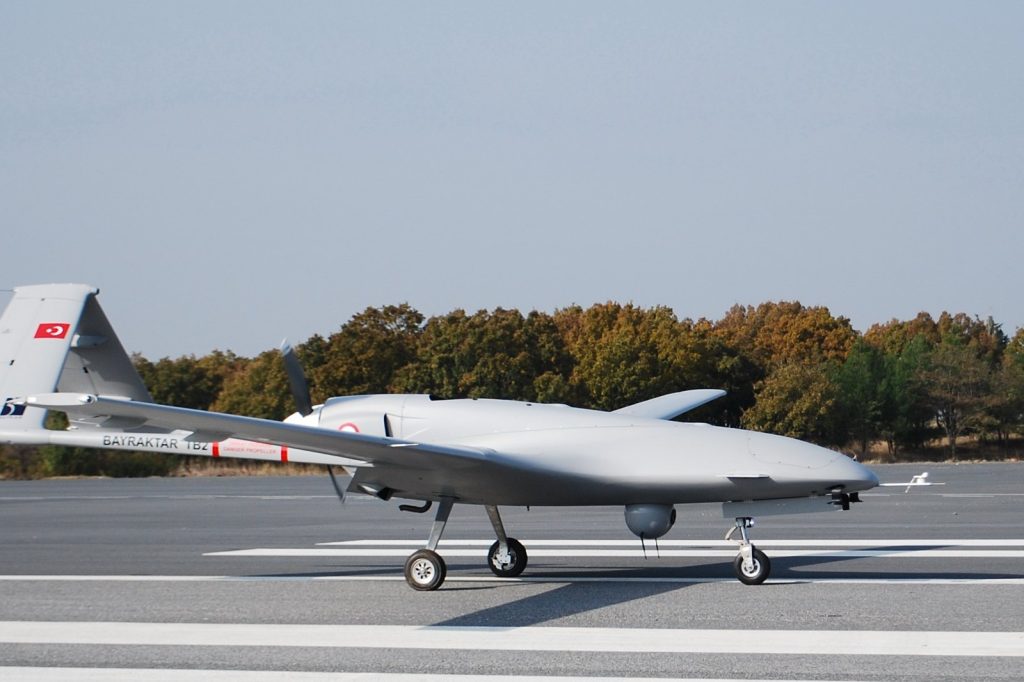
Horowitz and Kahn say the word “drones” now covers too much ground. They separate tactical surveillance drones, high- and medium-altitude long-endurance models like Turkey’s TB2 Bayraktar, one-way attack drones like the Shahed-136, first-person-view drones such as Ukraine’s Vampire, and collaborative combat aircraft that work alongside fighters as “loyal wingmen.” Lumping them together, they argue, makes it harder to judge what each does on the battlefield.
The United States has borrowed from the other side. LUCAS, a low-cost one-way attack system reverse-engineered from the Shahed-136, went through the Pentagon’s acquisition pipeline in eighteen months and was embedded in U.S. Central Command in December 2025. Its first operational use came in the opening U.S. attacks of Epic Fury.
Their conclusion is blunt: precise mass will become a regular feature of warfare, like machine guns or tanks before it. The United States, they note, spends less than 0.5 percent of its defense budget on fielding such capabilities.
Australia puts money behind the lesson
Canberra has already acted. The Australian government announced in April that at least $2 billion in new or redirected funds would go into drones and counter-drone measures, lifting total drone spending over the next decade to at least $12 billion. At least $2.2 billion is earmarked for smaller, lower-cost drones. Money will also flow to large uncrewed systems such as the Ghost Bat and Ghost Shark.
Defence Minister Richard Marles said conflicts overseas “have shown just how important drones and uncrewed systems are for our defence force.” He described the Ukraine and Middle East wars as underscoring “the ability for these systems to generate significant asymmetric advantage against larger, more expensive platforms.”
The Ghost Bat, developed by Boeing Australia, is designed to fly alongside crewed aircraft such as F-35 fighters and fired at an aerial target in testing late last year. Germany has expressed strong interest in buying it.
Sources
- First Ukraine, Now Iran: A New Era of Drone Warfare Takes Hold | Council on Foreign Relations
- Government announces billions in spending on military drones




