
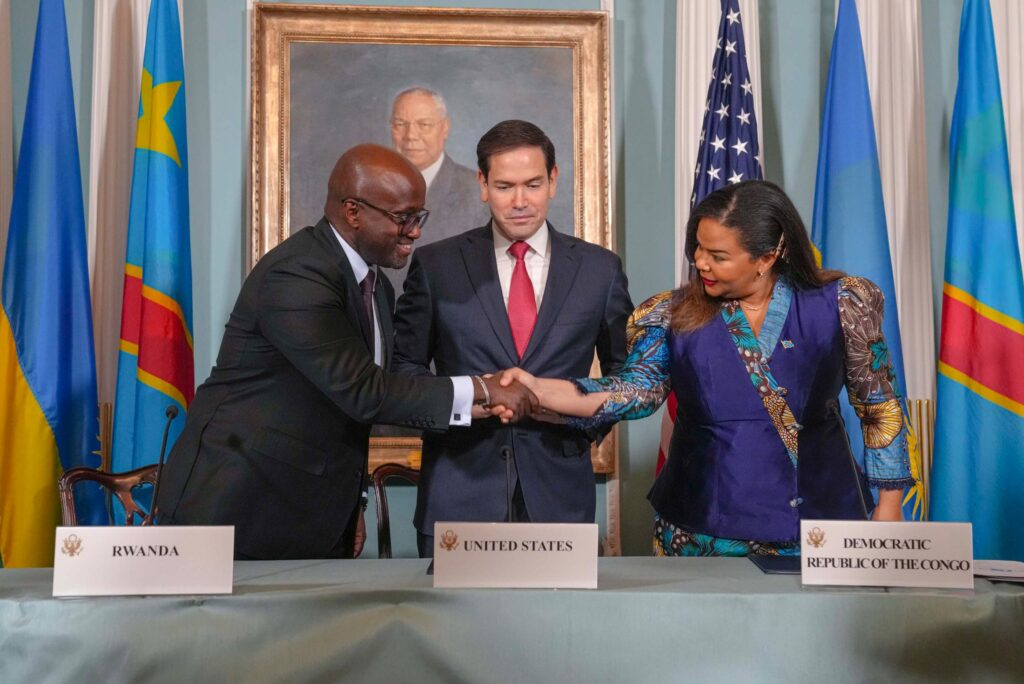
“This conflict and efforts have lasted for 30 years, but none have succeeded in resolving the underlying issues,” Rwandan President Paul Kagame said in Washington on Thursday, as he and Congolese President Felix Tshisekedi put their names to a U.S.-brokered peace deal.
Several African leaders stood beside them at the ceremony: Kenya’s William Ruto, Angola’s Joao Lourenco, Burundi’s Evariste Ndayishimiye and Faure Gnassingbe of Togo. The White House called the accord “historic” and described the war it addresses as “one of the worst conflicts on Earth,” Xinhua reported.
The presidents were in effect confirming a text that the two countries’ foreign ministers had first signed on June 27. In between came a series of bilateral and trilateral meetings that drew in the Congolese, Rwandan and U.S. presidents.
Tshisekedi called it “not just another document” and “a real turning point” after years of armed tension and humanitarian crises.
What the deal says
DRC presidential spokesperson Tina Salama listed three aims. The first is to stop the violence in the east. The second is to restore the country’s sovereignty and territorial integrity, and the third is to break up the illicit mineral supply lines that pay for the fighting.
The two capitals also signed the Regional Economic Integration Framework, meant to turn peace into development. Its terms apply only after “satisfactory execution” of two military instruments in the accord. Salama said the framework involves no joint management or merger, and “in no way a loss of sovereignty”. Her summary: “Peace first, then the economy.”
The disputes underneath
Eastern DRC has seen repeated bouts of violence, driven partly by the March 23 Movement, or M23. Kinshasa says Kigali backs the group. Rwanda denies it, and accuses the DRC of working with the Democratic Forces for the Liberation of Rwanda, a group tied to the 1994 genocide against the Tutsi.
Kagame argued that keeping the peace is Africa’s job. “It’s up to us in Africa, working with our partners, to consolidate and expand this peace,” he said, adding that there would be “ups and downs” ahead and that Rwanda “will not be found wanting.”
Slow progress since June
The numbers are not encouraging. The Barometer of Peace Agreements in Africa has described “worrying stagnation” since June. Only 19 of 30 identified tasks have been started, and progress on halting hostilities is “minimal”.
“Peace is not just a signature; the hardest part is implementation,” DRC government spokesperson Patrick Muyaya said.
Fighting makes his point. In South Kivu, including the provincial capital Bukavu, the Congolese army (FARDC) and M23 have each accused the other of breaking the ceasefire. FARDC reported M23 attacks on its positions. M23 said FARDC operations in Kamanyola killed at least four civilians and wounded six.
Salama asked for patience. “Diplomacy has its own tempo,” she said. “There is diplomacy on one side, and operations on the other.”
Sources
- DR Congo, Rwanda sign U.S.-brokered peace deal to end eastern conflict
- Democratic Republic of the Congo–Rwanda conflict (2022–present)




