
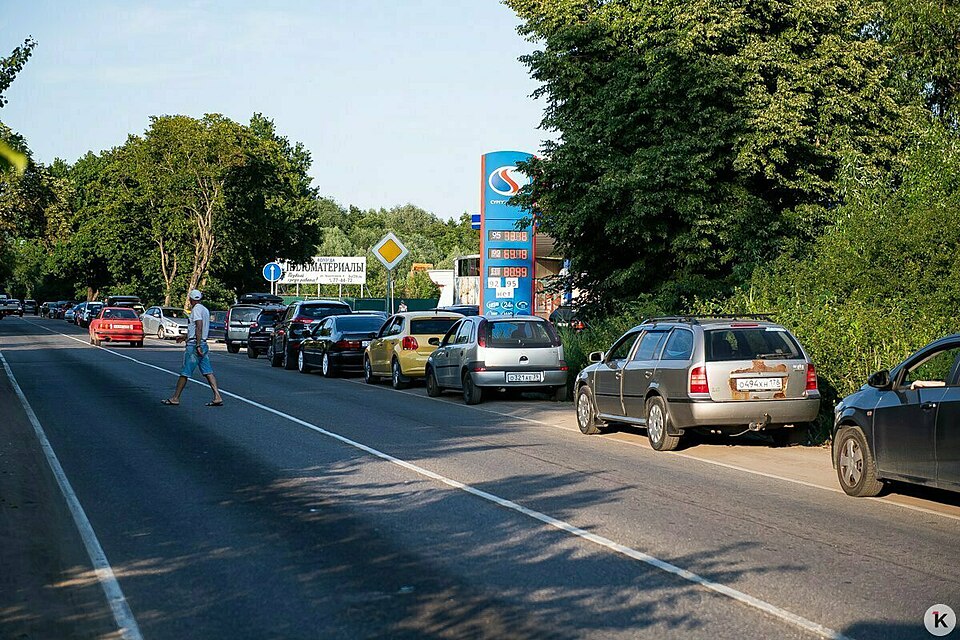
Domestic Pressures Mount as War Demands Reshape Supply Chains
The shortages are not yet catastrophic, but they are spreading. The trend follows a familiar pattern in conflict economies: when a nation redirects resources toward war, civilian supply chains inevitably give way. In Russia’s case, the reliable flow of fuel to ordinary citizens and non-military industries has been disrupted. Refineries have been hit by drone strikes, some deep inside Russian territory, reducing domestic output. At the same time, Western sanctions have limited the hard currency available to import refined products, tightening supply further. The military’s own fuel consumption has surged with expanded ground operations in Ukraine, placing additional strain on available reserves.
For now, the Kremlin appears to calculate that the political risk of these shortages remains manageable. The population has been conditioned to expect hardship, and dissent is effectively criminalized. Yet even in a tightly controlled information environment, long queues at petrol stations and rising prices have a way of seeping into public consciousness. Putin’s public posture remains one of steely resolve; he has offered no acknowledgment of the problem, instead directing all attention to the war front. The question is whether this calculus remains sustainable as winter approaches and domestic demand for heating fuel rises.
Cracks in the War Machine: The Military Logistics Dilemma
What to watch next is whether the shortages begin to affect Russia’s own military logistics. If the army cannot fuel its tanks and trucks, the offensive in Ukraine will stall regardless of the orders that come from the Kremlin. That is the irony of wartime resource allocation: starving the civilian economy to feed the war machine can eventually starve the war machine itself. The expanded ground operations in Ukraine require a steady and substantial flow of fuel. Any interruption in that flow, whether from reduced refinery output, constrained imports, or diversion to civilian sectors, could have immediate tactical consequences.
The Russian leadership appears confident that short-term sacrifices by the civilian population will not translate into broader instability. But the risk is real. Even a small disruption to military logistics could compound over time, especially as Ukraine’s forces continue to target supply lines and infrastructure within Russian territory. The current trajectory suggests that Moscow is betting it can endure the domestic fallout long enough to achieve its objectives on the battlefield. That bet becomes riskier with each passing month.
Ukraine’s Historical Struggle and the Stakes of the Conflict
The country at the center of this conflict is Ukraine, the second largest nation on the European continent. Its history is one of contested sovereignty. The region was once the heart of East Slavic culture under the state of Kievan Rus’ during the 9th century. For centuries, external powers vied for control. The Russian Empire gradually absorbed much of the territory during the 18th century. After the 1917 Russian Revolution, a brief period of independence ended when the Bolsheviks established the Ukrainian Soviet Socialist Republic, which became part of the Soviet Union in 1922. The 1930s saw a human-made famine that killed millions. During World War II, German occupation caused massive civilian losses.
Ukraine declared independence in 1991 following the dissolution of the Soviet Union and transitioned toward a liberal democracy and free-market economy. Political unrest led to the Orange Revolution in 2004 and the Euromaidan demonstrations in 2014, which preceded the unilateral Russian annexation of Crimea. The current conflict represents a fundamental struggle over national identity and sovereignty. Because of Ukraine’s size and strategic location, its stability directly affects the security of neighboring European states. The outcome of this war will determine whether Ukraine remains a neutral democracy or falls under foreign control. As Russia confronts its own domestic fuel constraints, the ability to sustain the offensive may prove to be the decisive factor.




