
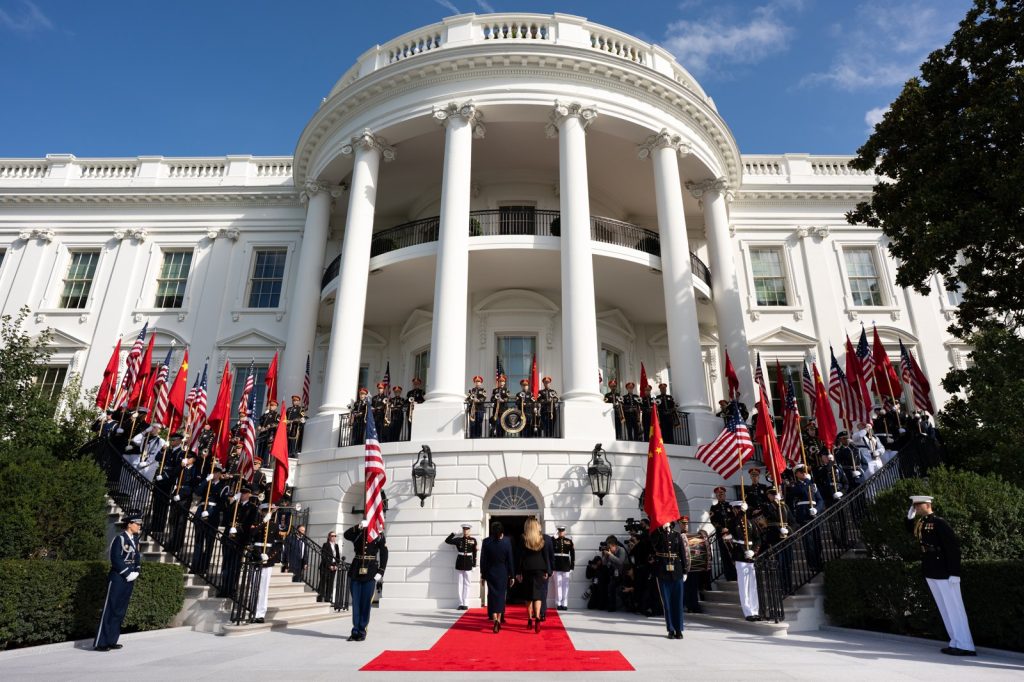
Chinese President Xi Jinping sat down with President Donald Trump on Thursday, May 14, for their first round of talks, and used them to deliver a blunt message. Mishandle Taiwan, Xi said, and relations could land in an “extremely dangerous place,” according to Chinese state media.
Xinhua quoted him telling Trump that the Taiwan question is “the most important issue in China-US relations.” Handled properly, he said, the relationship will enjoy overall stability. “Otherwise, the two countries will have clashes and even conflicts, putting the entire relationship in great jeopardy.” Xi also described “Taiwan independence” and peace across the Strait as irreconcilable as fire and water.
Taipei answered after the remarks. AFP reported that Taiwan called China the “sole risk” to regional peace and insisted “the US side has repeatedly reaffirmed its clear and firm support.”
Why Taiwan is the sticking point
Beijing says the island is part of its territory and that there is only one China. It has vowed to “unify” Taiwan with the mainland, preferably by peaceful means but by force if necessary, and it opposes independence. The Chinese Communist Party has never governed the island. Taiwan has its own constitution and elects its own president, and it rejects Beijing’s claim.
Chen Binhua, spokesman for the State Council Taiwan Affairs Office, put the position this way at a February 5, 2026 press conference: “Taiwan is China’s territory. China must safeguard its own sovereignty and territorial integrity and will never allow Taiwan to be separated from the motherland.” Over the past few years China has held large-scale war games around Taiwan and sent fighter jets and warships into the Taiwan Strait on a regular basis.
Where Washington stands
The United States acknowledges Beijing’s position that there is one China and that Taiwan is part of it. It does not support Taiwan’s independence, but it does not endorse Beijing’s claim either, and it keeps what its government calls a robust unofficial relationship with Taipei. The 1979 US-PRC Joint Communique moved diplomatic recognition from Taipei to Beijing.
The Taiwan Center for Security Studies draws a line between the two phrases that often get mixed up. The One China Principle holds that Taiwan belongs to China and that the People’s Republic is the sole legitimate government. The One China Policy, by contrast, lets countries acknowledge Beijing’s claim without endorsing it, which allows what the organisation calls strategic ambiguity.
How it got here
The Republic of China was founded in 1912. Under the 1895 Treaty of Shimonoseki, the Qing dynasty had ceded Taiwan to Japan, and after Japan surrendered at the end of World War II it handed Taiwan and Penghu to the ROC. The dispute itself dates to 1949, when the Communists won the civil war, took the mainland and forced the Nationalists to retreat to Taiwan.
The last big shock came in August 2022. Then-House Speaker Nancy Pelosi visited the island, the most senior US official to do so in 25 years, and Beijing condemned it severely. Taiwan’s then-president, Tsai Ing-wen, said the visit sent a message that “democracies stand together.”




