
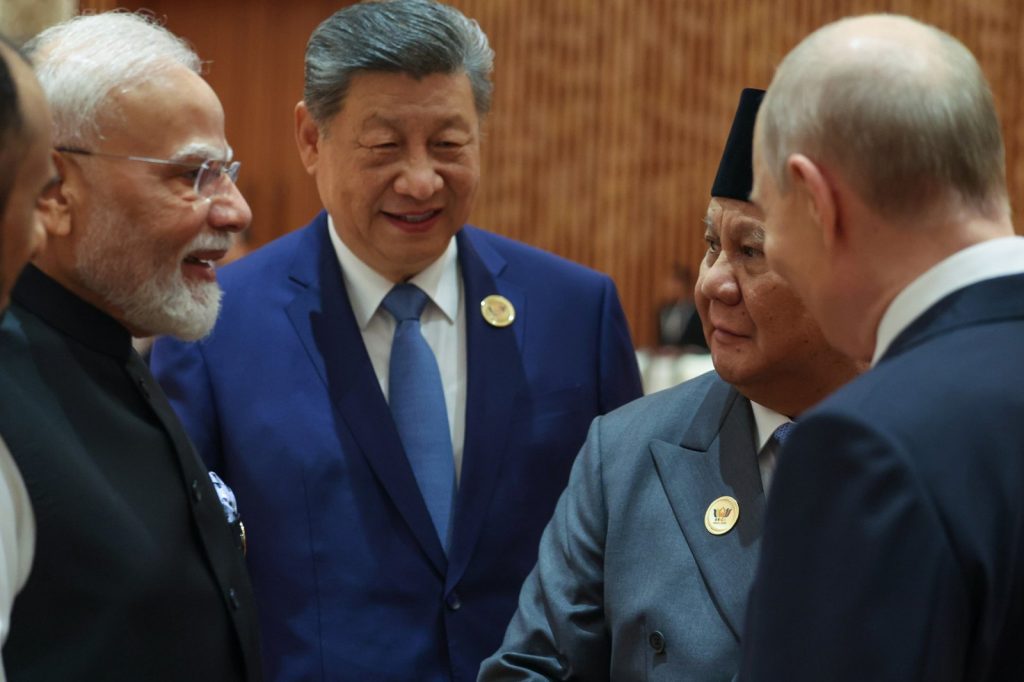
On the Friday before the summit, Narendra Modi sat down with Vladimir Putin and then with Masoud Pezeshkian in New Delhi. Two bilateral meetings, one weekend, one awkward guest list. India is hosting this year’s BRICS gathering on Saturday and Sunday, and Xi Jinping is also expected, according to the published plan.
India’s Foreign Ministry said Modi and Putin talked about political, economic, defense and energy cooperation, and compared notes on the conflicts in the Middle East. Modi repeated that dialogue and diplomacy are the way forward in Ukraine and said India was ready to help with peace efforts. With Pezeshkian, he thanked the Iranian leader for sending a high-level delegation “despite the challenging circumstances” and called for efforts to protect regional stability, maritime trade routes and seafarers.
Eleven members, many agendas
The grouping began with Brazil, Russia, India and China in 2006, and South Africa joined soon after. It now has 11 members, covering about half the world’s population and a large share of global energy supplies, natural resources and output. Growth has added weight and exposed fault lines. India and China are rivals. So are Iran and Saudi Arabia, and Egypt and Ethiopia.
Praveen Donthi, a senior analyst at the International Crisis Group, put it bluntly. “The Global South is not a homogeneous entity,” he said. “Hence, the grouping will find it hard to manage and mediate in these conflicts.” China and Russia have backed Iran in international forums, while India has been more cautious, and Saudi Arabia and the United Arab Emirates have their own tensions with Tehran.
India’s own position is a juggling act. It has bought Russian weapons for years and sharply raised its imports of discounted Russian oil after the invasion of Ukraine. Russian supplies have helped it limit some effects of the energy crisis caused by the Iran war. It has declined to join Western efforts to isolate Moscow, yet it is pursuing major trade and investment deals with the United States and Europe. US sanctions have forced it to end direct imports of Iranian crude.
China, the dollar and the test of relevance
Xi’s trip would be his first to New Delhi in seven years. Relations have improved since border tensions escalated in 2020, though trade and business ties show few signs of a wider recovery. Donthi said India will present its strategic autonomy by belonging to a non-Western grouping while also finding it useful to engage China. New Delhi, he added, wants to keep BRICS from turning into an explicitly anti-Western coalition.
Members are also weighing ways to lean less on the US dollar, through trade in national currencies and payment systems outside Western institutions. Mahesh Sachdev, a retired Indian diplomat, said nobody is planning a frontal assault. “It’s a challenge, but we’re not talking about frontal confrontations. It’s not a binary situation,” he said.
Sachdev warned that “if it remains just a periodic talking shop and photo ops, then its relevance erodes.” Donthi would settle for smaller wins: holding the enlarged membership together, repairing India-China ties, deeper trade and financial cooperation. “BRICS allows for incremental geopolitical gains, if not outright wins,” he said.




