
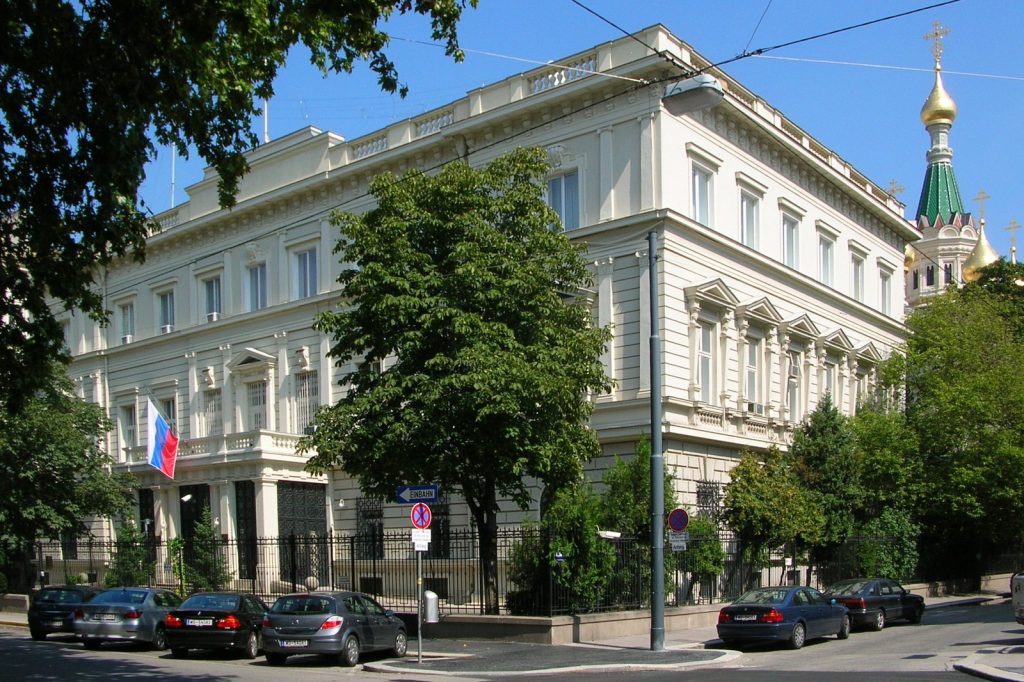
Austria has expelled three Russian diplomats for spying, and the government says the evidence was on the roof.
Foreign Minister Beate Meinl-Reisinger said the three, who have already left the country, used a “forest of antennas” installed on diplomatic buildings to collect information. The Austrian Broadcasting Corporation (ORF) reported, and the foreign ministry confirmed, that the antennas stood on the roof of the Russian embassy in Vienna and at a Russian diplomatic compound.
ORF said the antennas have long irritated Austrian intelligence services. They let Russia intercept data sent over satellite internet by organisations, some of them international.
“Espionage is a security issue for Austria,” Meinl-Reisinger said in a statement sent to the BBC. “We have brought about a change of course in this government and are taking decisive action against it.” She called it “unacceptable for diplomatic immunity to be used to carry out espionage.”
Moscow’s response
The Russian embassy rejected the accusation. “We regard this latest unfriendly move by the Austrian authorities as entirely unjustified, purely politically motivated and categorically unacceptable,” it said in a statement. It added that “Moscow will undoubtedly respond harshly.”
A city with a spying tradition
Vienna has been a centre of espionage for decades. During the Cold War, neutral Austria sat close to the Iron Curtain and made a convenient listening post. Today it hosts a United Nations headquarters and the Organization for Security and Cooperation in Europe (OSCE). Many countries keep up to two diplomatic missions to those bodies on top of an embassy, which brings diplomatic immunity and cover for spies.
The government’s latest Report on the Protection of the Constitution called Vienna “one of the last remaining locations for Russian signals intelligence in Europe”. It said this helps explain “the large number of Russian diplomatic staff” in the capital, and warned that “Austria’s international reputation is being damaged by Russian signals intelligence activities originating in Vienna.”
About 220 people are still accredited to Russian diplomatic missions in Austria. The country has expelled 14 Russian embassy staff since the start of the war in Ukraine.
Other cases
The expulsions follow other spying cases involving Russia in Austria and Germany. In January, Egisto Ott, a former intelligence official, went on trial in Vienna in what was called the country’s biggest spy trial in years. He is charged with passing information to Russian intelligence officers and to Jan Marsalek, the fugitive former Wirecard executive, allegedly for payment. His lawyer, Anna Mair, has rejected the allegations, and the trial is ongoing.
Marsalek, an Austrian citizen, is accused of working as an asset of Russia’s FSB. German police want him for alleged fraud, and he is subject to an Interpol Red Notice. He is thought to be in Moscow after fleeing via Austria in 2020.
Germany announced in January that it had expelled a person accused of spying for Russia and summoned the Russian ambassador.




