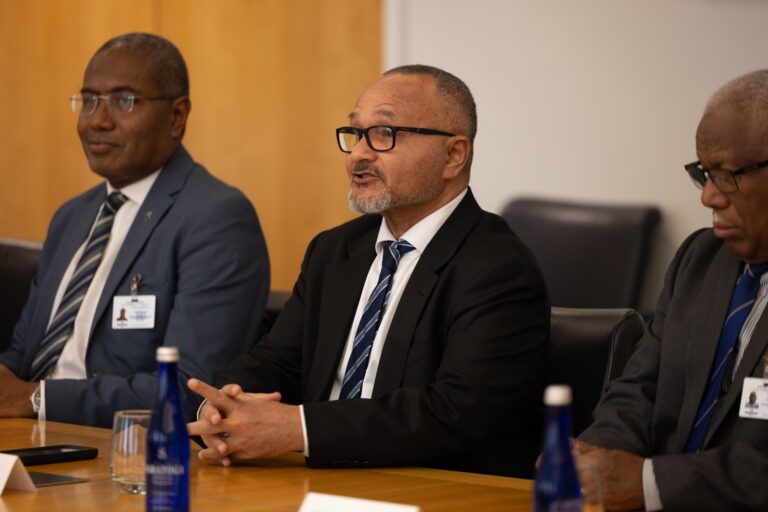
BAGHDAD, November 16, 2026 — Iraqi President Abdul Latif Rashid has urged US President Donald Trump to end the war with Iran and offered Baghdad’s help as a mediator. The appeal comes as Washington tightens an economic blockade that US Treasury Secretary Scott Bessent says is on track to shrink Iran’s currency by 25 percent within a year.
Iraq Caught Between Two Wars
Rashid’s offer places Iraq at the center of a conflict that has already cost the country an estimated $60 billion in lost oil revenue, according to Foreign Minister Fuad Hussein. Since US and Israeli strikes on Iran began in late February, shipping through the Strait of Hormuz — Iraq’s primary export route — has been severely disrupted. Southern oil fields saw output plunge 70 percent to just 1.3 million barrels per day in the war’s early months as storage tanks filled and tankers could not sail.
For families across the region, the war is not an abstract geopolitical event. It means lost government revenue that funds schools, hospitals, and public sector salaries in a country of over 46 million people. Iraq’s position as OPEC’s second-largest exporter makes it uniquely vulnerable; unlike Saudi Arabia, it has almost no alternative export infrastructure.
A New Route Through Oman
Last week, Baghdad struck a deal with Washington to bypass the Strait of Hormuz entirely. Iraqi crude will now move through a corridor along the coast of Oman, Foreign Minister Hussein told Al Jazeera. The arrangement helped push October exports to an estimated 3.4 million barrels per day, nearly matching pre-war levels of 3.3 to 3.5 million bpd.
Total crude production hit 4.6 million bpd in October, the highest since 2019, according to the International Energy Agency. That figure exceeds Iraq’s OPEC+ quota by about 170,000 bpd. Kuwait and Saudi Arabia also raised output in October as smaller shuttle tankers ferry cargoes through Hormuz to supertankers waiting in the Gulf of Oman.
Oil Minister Bassem Mohammed Khudair said Iraq is now exporting through three routes: the Strait of Hormuz, the pipeline to Ceyhan in Turkey, and tanker trucks through Syria. The government is investing in new pipelines and Gulf coast terminals with a goal of reaching 5 million bpd in exports.
Trump’s Ultimatum to Baghdad
Even as oil flows recover, the political pressure on Baghdad has intensified. In early November, President Trump reportedly warned Prime Minister Ali al-Zaidi of financial penalties or direct strikes against Iran-backed armed groups if they do not disarm, according to analysis published by The Conversation.
The warning followed Iraq’s Sovereignty Day on September 30, which marked the departure of US-led coalition forces after a decade-long mission against the Islamic State. The holiday was also meant to celebrate a “state monopoly on arms” — a deadline to bring paramilitary groups under full government control. That deadline was missed and has been pushed to June 2027.
The gap between Washington and Baghdad on what that monopoly means remains wide. For the Iraqi government, it involves integrating some factions deeper into the Popular Mobilization Forces (PMF), a state-sponsored umbrella of 60 to 70 brigades formed in 2014. The US envisions demilitarization and a fundamental restructuring of the PMF itself.
Crackdown in a Militia Stronghold
On November 15, Prime Minister al-Zaidi dismissed nine senior security officials over an alleged oil smuggling network in Jurf al-Nasr, a district in Babil province that serves as a stronghold for Kataib Hezbollah, one of Iraq’s most heavily armed Iran-aligned factions.
The sacked officials included the police chief of Babil province, an Interior Ministry commander, and the director of the Oil Pipelines Company. Military spokesperson Sabah al-Numan said an investigation uncovered illegal refineries and evidence that two strategic pipelines south of Baghdad had been tapped, siphoning crude worth tens of millions of dollars monthly.
“This area had effectively been run as a state within a state until now,” Al Jazeera correspondent Peter Smith reported from Baghdad. Intelligence documents with satellite images confirmed the smuggling operation, al-Numan said. Kataib Hezbollah has since issued sharp statements threatening al-Zaidi’s government and accusing the prime minister of corruption.
Washington’s Economic Vise
Speaking to Fox News on November 16, Treasury Secretary Bessent compared the projected 25 percent collapse of the Iranian rial between March 2026 and March 2027 to the 22 percent contraction of the Russian economy over three years after the Soviet Union fell. “So this is one of the fastest collapses in history,” he said.
Bessent said US restrictions have isolated Iranian officials, preventing them from traveling to London, Paris, or Geneva. “We have them completely isolated. We have an airline quarantined,” he said. He added that public statements from Iranian politicians began showing strain in the summer, and now the Islamic Revolutionary Guard Corps is “getting worried.”
The economic pressure expanded on November 7 when US Central Command announced Task Force Iron Gate, a 20-member team based in Tampa, Florida, designed to disrupt weapons, dual-use technology, and illicit revenue moving across Iran’s land borders and the Caspian Sea. Admiral Brad Cooper said it reinforces a naval blockade that CENTCOM claims has prevented more than $25 billion in Iranian crude exports, a figure that could not be independently verified.
What Mediation Would Require
Rashid’s offer to mediate reflects Iraq’s unique position: it hosts Iranian-backed groups within its security apparatus while relying on US waivers and military cooperation to keep its economy functioning. But the events of the past two weeks illustrate the limits of that leverage.
The prime minister’s crackdown in Jurf al-Nasr shows a willingness to confront smuggling networks tied to powerful factions. Yet the same government has delayed the state monopoly on arms by nine months, and Kataib Hezbollah operates openly enough to issue public threats against the head of government.
For communities in Iraq, the mediation offer is not just diplomacy. It is a bid to stop the cycle of blockade and retaliation that has already cost the country $60 billion — money that, closer to home, pays for the services ordinary Iraqis depend on every day. The next test comes in June 2027, when the postponed deadline for a state monopoly on arms arrives.
Sources
- Iraqi president urges Trump to end Iran war, offers to help mediate
- Iraq
- US demands that Iraq disarms brigades misread the nation’s complicated security landscape
- Iraq PM sacks nine officials over oil smuggling in pro-Iran stronghold
- Iraq Strikes U.S. Deal to Boost Oil Exports Through Hormuz | OilPrice.com
- Iraq's Oil Production "Soars to 2019 High" | Iraq Business News
Photo: Wikimedia Commons (Public domain)