
The Shifting Geography of the Energy Chokepoint
Commercial vessels navigating the waters of the Strait of Hormuz continue to face indiscriminate attacks, according to maritime monitors tracking the escalating dangers in the region. This narrow maritime corridor serves as the primary artery for petroleum exports from the Middle East to global consumers. The geography of the waterway forces tanker traffic through a confined channel bordered by Iran to the north and Oman and the United Arab Emirates to the south. Because alternative pipelines possess limited capacity, any disruption to navigation through this passage immediately ripples across international energy markets.
The strategic value of the strait has defined trade routes for decades as industrial economies expanded their reliance on petroleum imports. Oil extracted across the Persian Gulf must pass through this maritime bottleneck to reach refineries in Asia, Europe, and the Americas. The concentration of global energy transit in such a limited geographical space creates inherent vulnerability to regional conflict. When security breaks down along this route, the logistical impact registers instantly on pricing boards from London to New York.
Escalating Maritime Insecurity and Volume Collapses
Recent military incidents have transformed that structural vulnerability into an active crisis for global shipping companies and energy traders. According to CNN, two cargo ships have sunk near the Strait of Hormuz after being struck by unknown projectiles in separate incidents. The Singapore-registered container ship GFS Pride was struck while passing through the strait, catching fire and later sinking, according to the Maritime and Port Authority of Singapore. Iranian state media Press TV reported that the ship had hit a sea mine on an unauthorized route, while former US Navy officer Charlie Brown argued that a drone attack was more likely. The merchant vessel Cape Dao, registered under Antigua and Barbuda, also sank after being first hit by a projectile on September 23, resulting in the death of one Indian crew member, according to data from the International Maritime Organization.
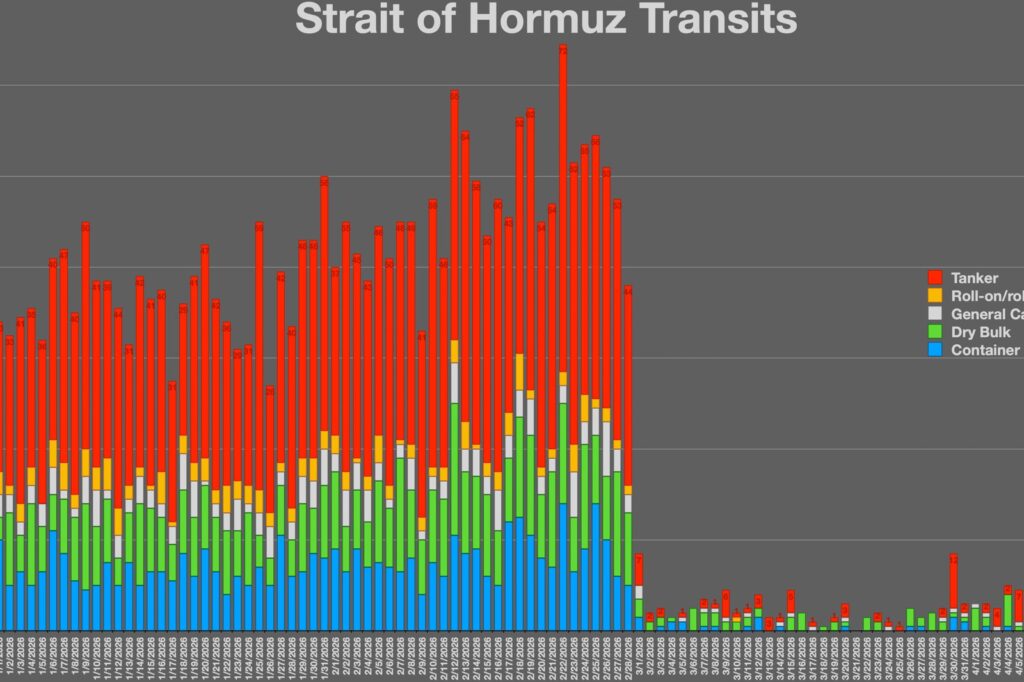
These losses represent a dangerous escalation in near-daily attacks on commercial vessels that have ramped up significantly since the end of September. Data from the United Kingdom Maritime Trade Operations shows that nine attacks in or near the strait have been reported since Monday, including a drone strike on a tanker. The resulting drop in transit volumes has been dramatic. According to maritime data tracking service Kpler, only 4.147 million barrels of oil successfully transited the Strait of Hormuz on Monday, which is less than a quarter of pre-war levels. The seven-day average of oil flow through the passage has dropped sharply since early October, according to Kpler data.
Geopolitical Demands and Political Pressures
Tehran has directly linked the restoration of shipping security to broader geopolitical demands concerning the US military presence in the Middle East. Iranian Army spokesman Mohammad Akraminia issued a warning stating that American forces will be driven out of the region if Washington refuses to withdraw. In a post on X, Akraminia argued that a US withdrawal would allow shipping through the Strait of Hormuz to resume and enable regional countries to take collective responsibility for security. He stated that if America leaves the region, the strait will reopen and collective security will be established with the participation of the region countries, while adding that if Washington does not leave, Iranian forces will expel it. Akraminia also challenged American assessments of Iranian military strength, stating that the country air defence capabilities had improved compared to their condition before and during the war, according to remarks carried by Mehr News Agency.
These developments create severe economic and political complications for the current US administration as domestic electoral contests approach. Rising energy costs resulting from constrained oil transit have become a consistent headache for President Donald Trump as the midterm elections approach, with gas prices and the cost of living remaining top of mind for voters. Trump has portrayed Tehran military as severely weakened, telling a campaign rally in Montana that Iran does not have a navy or an air force, its army is decimated, and its leaders are gone. Meanwhile, reports citing US officials indicate that military planners have prepared options for renewed strikes on Iranian targets, including nuclear sites and energy infrastructure, with operations considered for a period either before or after the November 3 midterm elections. Trump has also ruled out using nuclear weapons in the conflict, discussing the conventional GBU-43/B Massive Ordnance Air Blast bomb in an interview with Newsmax by stating that the weapon is not nuclear and that he would not use nuclear options because the military does not have to.
The Economic Pressure of Blockades and Sanctions
Beyond the direct physical threats to shipping, the broader regional conflict has introduced significant economic friction through military intervention. The United States military continues to enforce a blockade on Iranian ports as a primary method to maintain economic pressure on Tehran. According to reporting from CNN, this strategy has achieved some level of success in impacting the Iranian economy.
The resulting instability has prompted experts to question the long-term viability of current maritime security arrangements. Charlie Brown, a former US Navy officer and senior adviser for the nonprofit United Against Nuclear Iran, has highlighted the growing dilemma facing the international community. Brown noted that while many observers are focused on how the US Navy might respond to the escalating attacks on global shipping, the more pressing concern is the collective response of other nations. He questioned how long the world will continue to tolerate the current threats to seafarers, commercial shipping, and the broader principle of freedom of navigation.
Sources
- Two cargo ships sunk in Strait of Hormuz as Iran ramps up attacks in run-up to midterms | CNN
- Iran threatens to 'expel' US from region as Tehran links Hormuz reopening to troop exit
- Iran threatens to 'expel' US from region as Tehran links Hormuz reopening to troop exit
Photo: Wikideas1 (CC0)




