
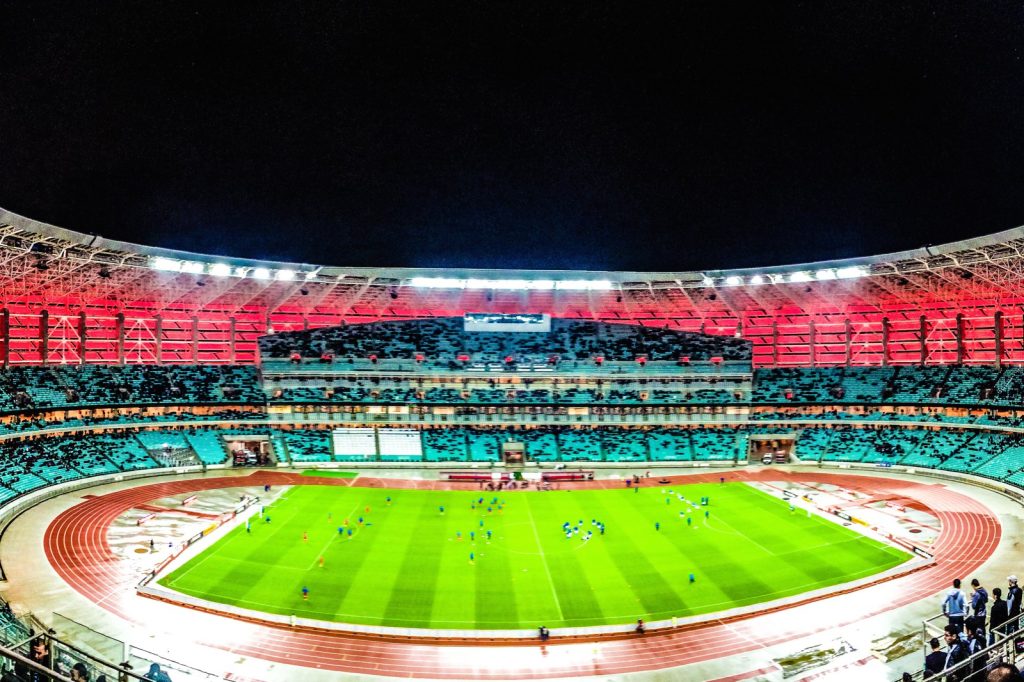
Mukhtar Babayev spent most of his career in oil. On Monday he opened the COP29 climate negotiations in Baku, Azerbaijan, as president of a UN summit that critics were already calling a “greenwash conference.”
Babayev, the country’s ecology minister, is a former executive of the state oil company Socar. His agenda stressed methane from waste and a sixfold increase in battery energy storage, the Financial Times reported. It skipped over a transition away from fossil fuels, even though COP28 adopted that goal last year.
Another petrostate host
This is the third year running that the UN has taken its climate talks to a country that earns most of its export revenue from oil and gas. The United Arab Emirates hosted last year and Egypt in 2022. Brazil, another fossil fuel economy, is next. Climate Action Tracker rates Azerbaijan’s current and target climate policies “critically insufficient.”
The New York Times described the irony as visible in Baku itself, a city on the Caspian Sea built with oil money and ringed by rigs and refineries. Several reports mention the smell of oil in and around the venue.
Babayev’s defenders point to his record at Socar, where, according to Inside Climate News, he tried to cut the company’s environmental damage. A U.S. ambassador to the country recalled that he “said his mission was to ‘change the mentality’ of Azerbaijanis about their responsibilities to preserve the environment.” Climate advocates are less convinced, and warn of industry capture of the COP process. BBC News recently reported that one of Azerbaijan’s senior COP officials used his role to promote fossil fuel deals. He was recorded telling a man posing as an investor, “we have a lot of gas fields that are to be developed.”
How Azerbaijan got the job
A COP host must win approval from every UN member state, and a single “no” can stall the decision. According to the Times, Russia exploited that by blocking any possible Eastern European host that opposed its invasion of Ukraine. That left Azerbaijan and Armenia, who are at war and would each likely vote against the other. Russia broke the deadlock with a deal: Azerbaijan freed Armenian prisoners, and Armenia allowed it to host. Activists have called for the process to be overhauled.
Other criticism
Azerbaijan drew fire early for naming no women to its 28-member climate committee, a choice described as “regressive.” It then added 12 women, bringing the committee to 41 members, the Guardian reported. Deutsche Welle said the country jailed journalists and environmental activists in the months before the summit. Greta Thunberg is among the activists labelling COP29 a greenwash conference.
Delegates arrived with an emphasis on getting wealthy nations to pay for climate mitigation and adaptation in vulnerable countries. Hope is thin in some quarters after decades of missed funding commitments. Papua New Guinea stayed away, citing “empty promises and inaction” and calling the conference “a total waste of time.” PBS pointed to further doubts about the talks, with Donald Trump’s re-election in the U.S. and the recent collapse of the German government.
There was some praise. Azerbaijan plans an energy corridor under the Black Sea, with wind and solar farms in Azerbaijan and neighbouring Georgia feeding a 1,200-kilometre undersea cable to Hungary and Romania, IEEE Spectrum said.




