
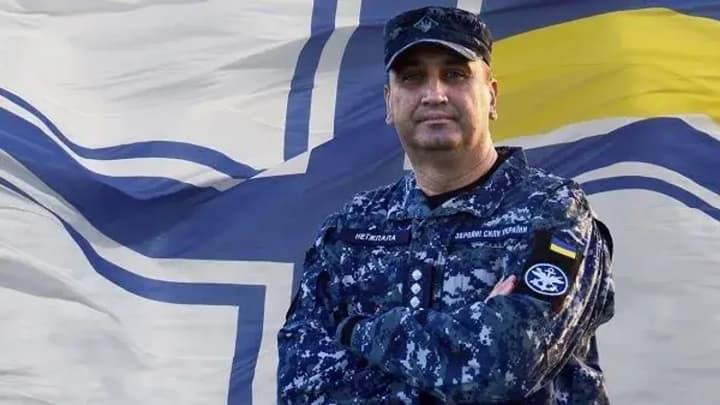
KYIV, July 15 — Vice Admiral Oleksiy Neizhpapa, the Commander of the Ukrainian Navy, has overseen a radical transformation of his force since Russia’s full-scale invasion began in February 2022. Appointed by President Volodymyr Zelenskyy on June 11, 2021, Neizhpapa inherited a conventional fleet that was no match for the Russian Black Sea Fleet on paper. The mechanics here are straightforward: he abandoned the old playbook and pivoted to asymmetric warfare.
The catch is that Ukraine’s navy, stripped of its larger surface combatants early in the war, had little choice. Neizhpapa’s strategy relied on anti-ship missiles and unmanned surface vessels to strike Russian ships at range.
The most dramatic result came in April 2022, when Ukrainian forces sank the Russian cruiser Moskva, the flagship of the Black Sea Fleet. By early 2025, his command had damaged or destroyed over 20 Russian vessels, according to the available record.
From Sevastopol to Command
Neizhpapa was born on December 5, 1975, in Sevastopol, Crimea — a detail that carries a certain irony given that his hometown is now the headquarters of the Russian Black Sea Fleet he has been fighting. He graduated from the Sevastopol Naval Institute in 1998 and later from the National Defense University of Ukraine. His career path included command of the frigate Hetman Sahaidachny and a stint as chief of staff of the Ukrainian Navy.
On closer reading, his biography suggests a career officer who understood the limitations of his force long before the 2022 invasion. The shift to unmanned systems and missiles was not improvisation; it was the logical application of limited resources against a larger adversary.
The Grain Corridor
Follow the money, and Neizhpapa’s role in securing a maritime corridor for grain exports from Odesa becomes a central part of the story. Ukraine’s agricultural exports are a critical revenue stream, and the corridor was a lifeline for the economy. The navy’s ability to keep the route open, despite Russian naval dominance in the northwestern Black Sea, has been a key operational success.
Neizhpapa has been decorated with the Order of Bohdan Khmelnytsky and other awards for his service. The recognition is formal, but the strategic impact is measurable.
What to watch next is whether the asymmetric model Neizhpapa has built can be sustained. The drone and missile campaigns have degraded the Russian fleet, but they have not eliminated it. The grain corridor remains vulnerable, and the long-term funding for unmanned systems and missile stocks is an open question.
Neizhpapa’s navy is a case study in adaptation, but the underlying resource imbalance has not changed.




