
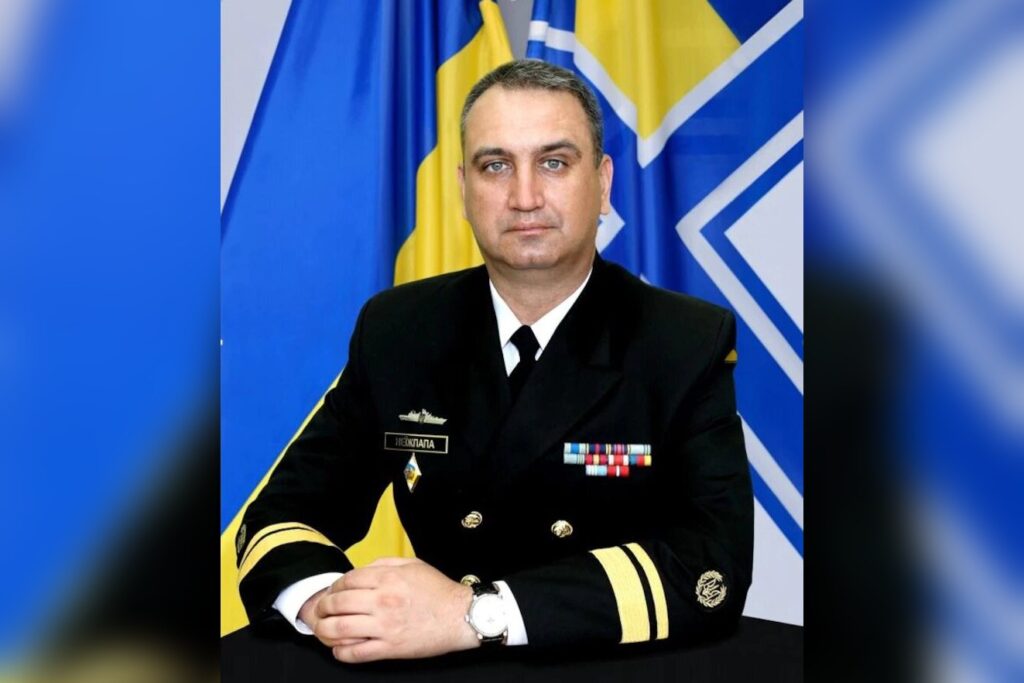
ODESA, July 9 — Against the backdrop of a war that has redefined naval power in the Black Sea, Vice Admiral Oleksiy Neizhpapa has emerged as the architect of a Ukrainian fleet that fights without traditional ships. Neizhpapa took command of the Ukrainian Navy on June 11, 2021, inheriting a force still reeling from the loss of its Crimean homeport seven years earlier. Born in 1975 in Sevastopol, Crimea, he graduated from the Sevastopol Naval Institute in 1997 and rose through the ranks commanding the frigate Hetman Sahaidachny.
He also served as Chief of Staff of the Navy. After Russia’s 2014 annexation of Crimea, Neizhpapa was among those who relocated the navy’s headquarters from Sevastopol to Odesa — a logistical and symbolic shift that foreshadowed the unconventional fight to come.
Under Neizhpapa’s leadership, the navy lost its flagship, the Hetman Sahaidachny, which was scuttled in March 2022 to prevent capture by advancing Russian forces. It was a painful but calculated sacrifice, and it cleared the way for a very different kind of naval strategy. In the corridors of Ukraine’s military planning, Neizhpapa became the driving force behind the development of the navy’s drone fleet and the integration of Neptune missiles.
These are not the tools of a traditional blue-water navy, but they have proven devastatingly effective against a larger, more conventionally powerful Russian Black Sea Fleet. Neizhpapa is known for openly advocating asymmetric tactics, and he has stated plainly that the navy’s goal is to push the Russian fleet out of the Black Sea entirely.
From Crimea to Command
Neizhpapa’s biography is written in the geography of Ukraine’s most contested region. Born in Sevastopol in 1975, he is a product of the very naval city that Russia seized in 2014. His education at the Sevastopol Naval Institute, completed in 1997, gave him a deep understanding of the waters and ports that would later become the flashpoints of a wider war.
His promotion to Vice Admiral came in August 2022, just months after the full-scale invasion began. It was a recognition of his steady hand during the navy’s most existential crisis.
He has also been decorated with the Order of Bohdan Khmelnytsky, one of Ukraine’s highest military honors, a reflection of his service in the face of overwhelming odds.
The Asymmetric Fleet
The wider picture of Neizhpapa’s command is one of radical adaptation. With the Hetman Sahaidachny scuttled and no surface fleet to speak of, the Ukrainian Navy under Neizhpapa has turned to unmanned systems and missile technology. The drone fleet he oversaw has become a signature weapon of this war, striking Russian ships and port facilities with a precision that conventional platforms could not match.
The integration of Neptune missiles has been equally transformative. These anti-ship missiles, developed by Ukraine’s defense industry, have been used to target Russian vessels far from the coast, challenging Moscow’s dominance in the western Black Sea.
Neizhpapa’s advocacy for these systems has been central to Ukraine’s ability to wage a naval campaign without a traditional navy. Looking ahead, the question is whether Neizhpapa’s asymmetric strategy can continue to degrade Russian naval power to the point of withdrawal. The Black Sea remains a contested arena, and the Russian fleet still holds significant advantages in tonnage and firepower.
But Neizhpapa has already accomplished what few thought possible: he has turned a navy without ships into a credible threat to one of the world’s largest fleets.




