The record shows a recurring pattern from the years of the Trump administration’s “maximum pressure” campaign against Iran: American airstrikes on Iraqi militia targets, an Iraqi government protest about sovereignty, and a region stepping carefully away from another open war. Two episodes from that period, in late 2019 and early 2020, map the dispute with unusual clarity.
The first came at the end of December 2019, when US aircraft struck multiple targets across Iraq and Syria, leaving at least 25 fighters dead and dozens more injured. The Pentagon presented the raids, approved by President Donald Trump late on a Saturday, as a “defensive” answer to a rocket strike days earlier on a base hosting Iraqi forces, in which an American contractor died. Washington blamed the Kataib Hezbollah militia and pointed to Iran, which officials said funds and arms the group. Iraq’s prime minister at the time, Adel Abdul-Mahdi, saw it differently. “We have previously confirmed our rejection of any unilateral action by the coalition forces or any other forces inside Iraq, and we consider it as a violation of Iraqi sovereignty and a dangerous escalation that threatens the security of Iraq and the region,” he said the day after the strikes. Secretary of State Mike Pompeo stood by the opposite framing: “We will not stand for the Islamic Republic of Iran to take actions that put American men and women in jeopardy,”
The militias answered in kind, officials and international reports indicated at the time. Kataib Hezbollah said the strikes left it with “no choice but confrontation.” and warned that “Trump should know that he will pay a heavy price in Iraq and the countries where his criminal forces are present,”. Its ally Asa’ib Ahl al-Haq declared “it is our duty to put an end to the U.S. military presence in Iraq through every legitimate method” and urged “political forces to stand against this cowardly aggression.” Some Iraqi voices added context: the struck base, in their account, had served as a frontline against ISIS cells crossing from Syria, and the Popular Mobilization Units trace their origin to a 2014 fatwa by Grand Ayatollah Ali al-Sistani calling Iraqis to arms against the group.
The second episode followed the March 2020 rocket attack on Camp Taji, which killed two American service members: Army Spc. Juan Miguel Mendez Covarrubias, then 27. Air Force Staff Sgt. Marshal D. Roberts, then 28, was also killed, alongside one British service member. The Defense Department again labeled its retaliation, this time on five Kataib Hezbollah sites, as defensive — using the word twice in a single news release. “These strikes were defensive, proportional, and in direct response to the threat posed by Iranian-backed Shia militia groups (SMG) who continue to attack bases hosting OIR [Operation Inherent Resolve] coalition forces,” the release said. The militia’s then-leader, Abu Mahdi al-Muhandis, had already been killed in the January 3 US airstrike that also killed Qasem Soleimani, head of the Revolutionary Guards’ Quds Force — a decision that set the stage for everything after.
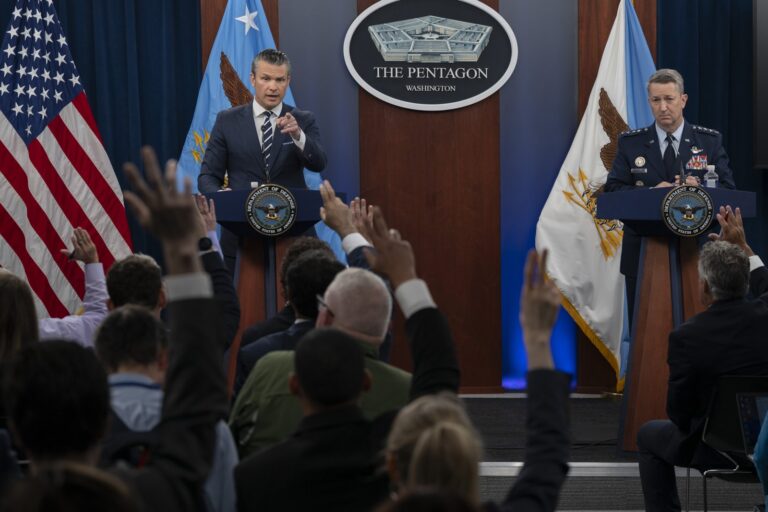
Marine Gen. Kenneth McKenzie Jr., who headed US Central Command, defended the wording at a Pentagon briefing. “I think these attacks are designed to prevent future attacks on us, which would be the definition of a defensive action.” The military, he said, counted 12 rocket attacks against coalition personnel in Iraq across the prior six months, all attributed to Kataib Hezbollah — though he did not elaborate on the evidence behind that tally. He confirmed Washington had told Baghdad after the Taji attack that “a response was coming,” without saying whether Iraqis got advance word of the specific strikes. Iraq’s own military counted the cost differently: according to Al Jazeera, it reported five security personnel killed. McKenzie’s response to that was blunt: positioning yourself next to Kataib Hezbollah after an attack that killed Americans, he suggested, was “probably not a good idea”.
The account indicates the deeper argument was never really about any single strike. Sina Toossi, then a senior analyst at the National Iranian American Council, tied the violence to the administration’s abandonment of the 2015 nuclear accord, arguing that “The dangerous escalation in Iraq occurs in the context of the Trump administration’s reckless and needless ‘maximum pressure’ campaign that threatens to make Iraq an all-out battlefield between the U.S. and Iran,” and that in its push to isolate Tehran the administration risked “yet again plunging Iraq into total chaos.” For Baghdad, squeezed between a superpower and its regional rival, each “defensive” strike raised the same sovereignty question — and each answer arrived from the air.
Sources
- Iraqi Prime Minister Condemns US Airstrikes and Threats to Iran | Truthout
- US airstrikes on Iraqi militia were purely ‘defensive,’ commander says