
For millions of Europeans who use online services daily, the legal uncertainty over where their personal data ends up has been a persistent worry. That cloud began to lift this week as the European Union and the United States reached a preliminary agreement on data flows across the Atlantic, a breakthrough that directly affects how companies handle everything from employee records to online shopping habits.
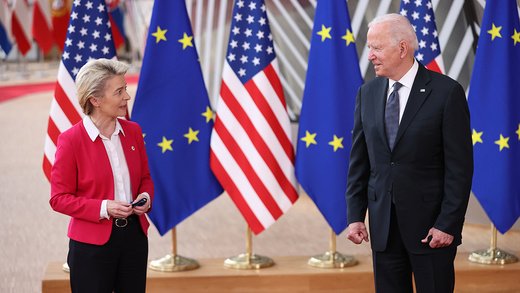
The deal, announced by President Joe Biden and European Commission President Ursula von der Leyen during Biden’s stop in Brussels on a European tour amid Russia’s war in Ukraine, paves the way for Europeans’ personal information to be stored in the U.S. Business groups hailed the announcement, saying it will provide relief to thousands of companies, including tech giants like Google and Facebook, which faced uncertainty over their ability to send data between the U.S. and Europe. Europe has much stricter regulations on data privacy than the United States.
The data in question touches nearly every aspect of modern life. It includes “any information that we voluntarily provide or generate when using services and products online,” said Alexandre Roure, an official with the tech trade group CCIA. That includes names, ID numbers, and geolocation data, along with online identifiers like IP addresses and emails, and other information that tech companies use to target ads.
Companies use this data for all types of online advertising, purchases, and communications, and it may relate to employees, customers, or users.
New Protections for Citizens
President Biden framed the agreement as a significant step for individual rights. “Today we’ve agreed to unprecedented protections for data privacy and security for our citizens,” Biden said.
“This new arrangement will enhance the Privacy Shield framework, promote growth and innovation in Europe and the United States, and help companies — both small and large — to compete in the digital economy.” Von der Leyen echoed that sentiment, stating that the agreement “will enable predictable and trustworthy data flows between the EU and the U.S., safeguarding the privacy and civil liberties.” The deal came hours after EU officials agreed on sweeping new digital rules to rein in the power of big tech companies such as Facebook and Google.
Legal Challenges Loom
The agreement stems from a complaint filed a decade ago by Austrian lawyer and privacy activist Max Schrems, who was concerned about how Facebook handled data. While business groups and companies expressed optimism — Google said it commended the work by the EU and U.S. to “safeguard transatlantic data transfers” — Schrems warned the latest deal could get tied up in the courts. His Vienna-based group NOYB would analyze it in-depth and challenge anything that’s not in line with EU law.
“Customers and businesses face more years of legal uncertainty,” Schrems said. Looking ahead, the key question is whether this framework will survive legal scrutiny.
With Schrems and NOYB preparing to examine the agreement’s details, the coming months will determine if Europeans can finally trust that their personal information is protected when it crosses the Atlantic, or if the battle over data privacy will continue in courtrooms for years to come.




