
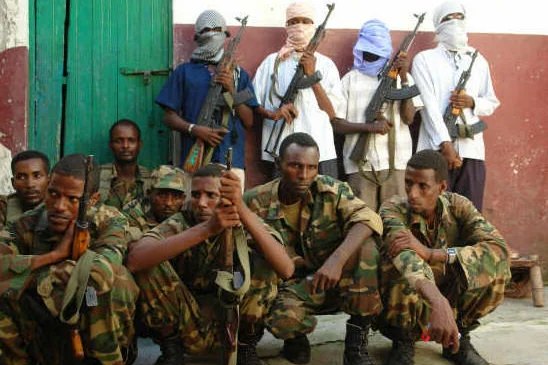
“We won the fight against the enemy of Islam, Mogadishu is under control of its people.” Sheik Sharif Sheik Ahmed, chairperson of the Islamic Courts Union, said it on the radio on Monday, 5 June 2006. For the first time since 1991, one force held every neighborhood of the Somali capital.
The wire report that day came with a warning. The militia’s ideology was described as similar to the Taliban’s, and its victory posed a direct challenge to the UN-backed interim government, which was stuck in Baidoa, 250km away, and had not even managed to enter Mogadishu.
From neighborhood courts to a militia
The Union did not appear overnight. Stanford’s Mapping Militants Project traces it to the early 1990s, when Somalis facing the chaos after dictator Siad Barre’s fall in 1991 turned to Islamic courts for crime control. Sheikh Ali Dheere set up the first in Mogadishu in 1993. Around 2000, several courts merged and pooled their militias, creating the first significant Somali militant force not run by warlords or tied to a single clan.
It ran schools and hospitals in the capital, and areas under its control gained a reputation for being much safer than warlord territory. By 2005 Mogadishu had eleven courts. Sheikh Sharif Sheikh Ahmed, a teacher, had been elected chairman of the city’s courts in 2004. Hassan Dahir Aweys, a former member of the militant group Al Ittihad Al Islamiya, was among the more hardline figures.
The warlords and Washington
The trigger came in early 2006. The United States, worried that Somalia was becoming a haven for Al Qaeda-linked individuals, backed a coalition of Mogadishu warlords called the Alliance for the Restoration of Peace and Counter-Terrorism. It backfired. Backing locally infamous warlords to hunt people inside Somalia was unpopular, and resentment pushed support toward the courts, according to the Mapping Militants profile. A Somali commentator writing for Hiiraan Online in January 2007 made the same point: the warlords misjudged a public tired of their rule.
Washington never confirmed the arrangement. The AP wire said officials declined to comment, and that the United States had taken no direct action in Somalia since 18 servicemen died in a 1993 battle. US officials did say, anonymously, that three al-Qaeda leaders indicted over the 1998 embassy bombings in Kenya and Tanzania were being sheltered by Islamic leaders in Mogadishu.
The fighting was brutal. More than 300 people were killed and 1,700 wounded in recent months, many of them civilians caught in grenade, machine-gun and mortar fire. Warlord Mohamed Dheere was believed to have fled to Ethiopia to seek reinforcements. Weapons prices soared in Baidoa amid fears the militia would head there next.
Relief, then collapse
Residents of the capital welcomed the quiet but were divided about the new rulers. Omar Jamal of the Somali Justice Advocacy Centre in St. Paul, Minnesota, called the victory a major turning point and compared it with the Taliban’s rise, saying the extremists were exploiting people’s weariness of violence, rape and civil war.
The Union later brought Shariah law to the territories it held. Its rule lasted only months. In December 2006, troops of Somalia’s Transitional Federal Government and Ethiopia defeated it. On 31 December its fighters lost the Battle of Jilib and abandoned the port city of Kismayo, retreating toward Kenya, and the group was disbanded. One militia in its ranks went on to become known as Al Shabaab.
Sources
- Islamic militia takes control of Mogadishu
- Islamic Courts Union | Mapping Militants Project (Stanford)
- The Rise and fall of Union of Islamic Courts (Hiiraan Online)




