
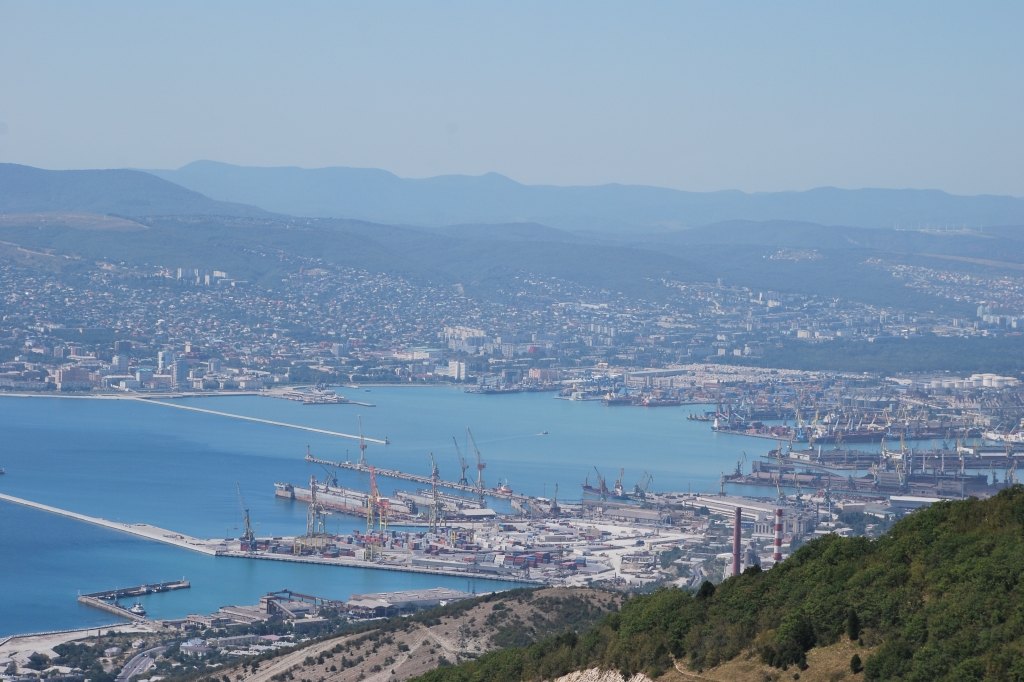
On August 12, Ukrainian drones hit the bow of two Russian frigates tied up in Novorossiysk, in the zone where their Kalibr missile launchers sit. Satellite images show soot around the launchers on the Admiral Makarov and the Admiral Essen.
The Ukrainian OSINT channel Exilenova, after studying the imagery, claims both ships were damaged enough that they cannot fire Kalibrs. The Russian channel Voenny Osvedomitel put the worst case this way: extensive dry-dock repairs, and the loss for an indefinite period of two modern frigates, “each capable of firing 16 cruise missiles in a single salvo.” The photo makes it hard to judge how bad the damage really is.
President Volodymyr Zelenskyy said the strike combined cruise missiles, drones and unmanned boats. Reaching the ships was one thing. Hitting the hatch covers of the launchers, charter97 noted in a report drawing on the BBC Russian Service, shows Ukraine can plan a complex operation against what is the most heavily defended base on the Black Sea.
A refuge that stopped working
Russia once ran two main Black Sea bases: Sevastopol, the primary one, and Novorossiysk. Moscow leased Sevastopol from Ukraine after the Soviet collapse and annexed it in 2014. The base spreads over several bays and includes repair facilities, warehouses and port infrastructure, and Crimea also holds airfields, air defense positions, radar stations and shipyards.
The fleet left in the fall of 2023. Sevastopol sat too close to mainland Ukraine. Ukraine had acquired high-precision cruise missiles able to destroy ships trapped in narrow bays and docks, ships that went to sea faced unmanned boats, and drone capabilities had grown. Russia has not found a reliable defense.
Novorossiysk looked sensible. Distance gave a chance to spot incoming drones and boats. But as Ukraine’s strike range grows, Tsemesskaya Bay is becoming as much a trap as Sevastopol’s harbors: ships at berth are easy targets for air attack, and ships sent out to sea can be hit by drones there.
Nowhere else to go
Alternatives are thin. Russia is building a maintenance base in Ochamchira, Abkhazia, and has ports at Temryuk and Taganrog on the Sea of Azov. None has infrastructure for a fleet like the one in Crimea or Novorossiysk, and creating it would take a long time and a lot of money.
An anonymous Russian military expert told the BBC that preparing ships to face unmanned boats is possible in theory, but every vessel would need a shipyard dry dock. The shipbuilding at Kerch and Feodosia is under drone attack, he said, and so is the Sevastopol yard. Turkey’s closure of the straits blocks ships from leaving for modernization elsewhere, and from arriving as reinforcements. Then comes the human factor. “Who is willing to take on the risk of handling this matter, since a strike and casualties are inevitable one way or another?” he asked. “No one wants to put themselves in that line of fire.”
Killing a frigate is not easy either. Andriy Ryzhenko, a reserve captain first rank in the Ukrainian Navy, told the BBC it takes two or three anti-ship cruise missiles, and Ukraine has few. The first attack on the Makarov used a Magura boat with a 70-kilogram warhead. Destroying it would take two or three Maguras with 300 to 400 kilograms. Mid-range drones can damage parts of a ship, he said, but only a cruise or ballistic missile such as the ATACMS can destroy one.
Still a threat
The fleet is far from beaten. Ryzhenko said its two frigates, submarines and Karakurt and Buyan corvettes together hold around 100 Kalibr missiles, and that upgrading the carriers to Zircon would make things worse for Ukraine. Coastal Bastion systems and strike drones are a second danger, and control of shipping toward Odesa is a third.
Replacement is hard. With the straits shut and few large shipyards in the region, Russia can neither build large ships for the fleet nor bring them in from elsewhere. It is building Karakurt light missile corvettes armed with Kalibrs.




