
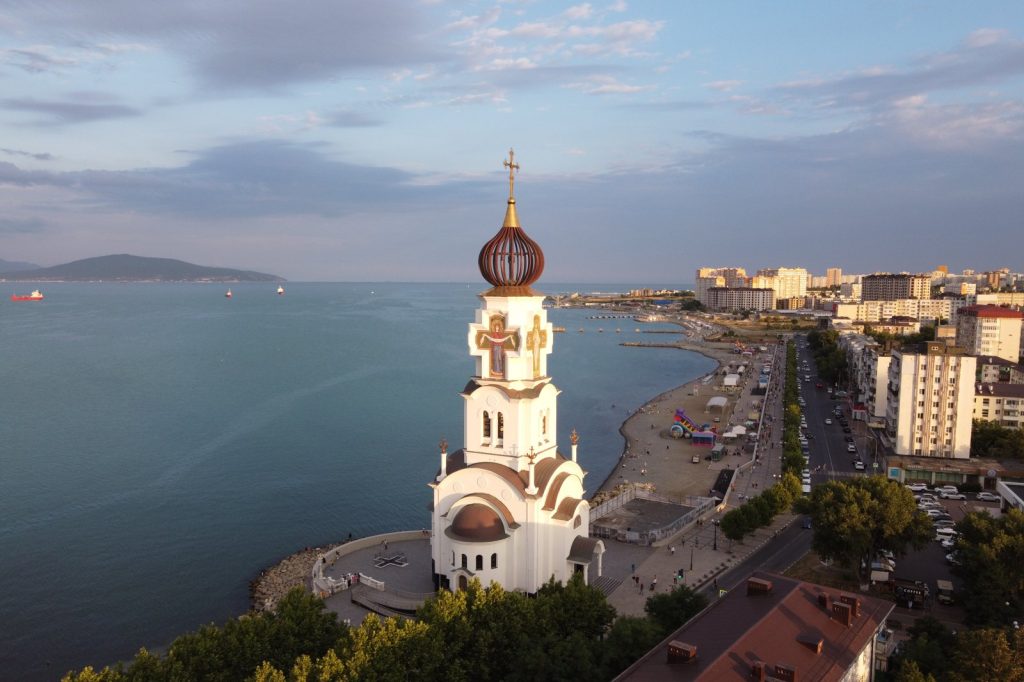
NOVOROSSIYSK, July 9 — The shift is quietly reshaping the Black Sea’s strategic map. Russia’s largest commercial port, Novorossiysk, handles 30% of the country’s total sea trade, including oil exports from the Caspian Pipeline Consortium. It also serves as a key naval base for the Black Sea Fleet, a role that grew after the 2014 annexation of Crimea.
But the city of 262,000 residents, nestled on the northeastern coast of the Black Sea in Krasnodar Krai, is now a proving ground for a new kind of naval warfare. The trend underneath is the rise of unmanned surface vehicles, or USVs, as a credible threat to major port infrastructure.
In August 2024, Ukrainian USVs struck vessels anchored near Novorossiysk’s naval pier. The attack damaged at least two landing ships and one patrol boat. It also forced the temporary closure of the port’s commercial shipping channel, disrupting oil tanker traffic.
Watch this space: the vulnerability exposed here is not just about one attack but a pattern that could redefine how ports defend themselves.
A fortress with a flaw
Novorossiysk is not undefended. The naval base hosts Kilo-class submarines, Ropucha-class landing ships, and Buyan-class corvettes. The port is protected by anti-submarine nets, acoustic sensors, and a fleet of patrol boats.
Yet the shallow waters and heavy commercial traffic create a persistent vulnerability to drone attacks. The August 2024 strikes proved that even layered defenses can be bypassed by small, agile, and relatively cheap unmanned craft.
What’s changing is the calculus for naval planners. Traditional anti-submarine and anti-ship defenses are designed for larger, slower threats. USVs operate differently — they are fast, low-profile, and can swarm.
The damage to the landing ships and patrol boat was not catastrophic in terms of tonnage lost, but the operational impact was immediate. The port’s commercial channel shut down, sending ripples through global oil supply chains that depend on the Caspian Pipeline Consortium’s throughput.
Since March 2022, the city has been under a heightened security alert. That status has not prevented the emergence of this new threat vector. The question now is whether the existing defensive architecture — nets, sensors, patrol boats — can adapt quickly enough.
The commercial-military knot
Novorossiysk’s dual role as both Russia’s largest commercial port and a major naval base creates a unique set of problems. The commercial traffic that makes the port economically vital also provides cover and complexity for attackers. Tankers, cargo ships, and naval vessels share the same waters.
Distinguishing between a legitimate commercial vessel and a disguised USV is a challenge that acoustic sensors and patrol boats alone may not solve. The August 2024 strikes targeted vessels anchored near the naval pier specifically.
That suggests the attackers had precise intelligence and the ability to navigate through busy shipping lanes. The damage to the landing ships and patrol boat was a direct hit on naval capability. But the temporary closure of the commercial channel hit Russia’s economy and its energy exports.
The trend underneath is that the line between military and economic targets is blurring in real time. For the Black Sea Fleet, the loss of its Crimean basing options after 2014 made Novorossiysk even more critical.
The port now hosts the fleet’s most modern submarines and surface combatants. A successful attack on that infrastructure would have outsized consequences. The August strikes did not achieve that level of damage, but they demonstrated the feasibility of the approach.
What to watch next
The defense of Novorossiysk will likely evolve. Expect to see more layered drone detection systems, possibly including electronic warfare countermeasures designed specifically for USVs. The shallow waters and commercial traffic are not going away, so the defense will have to become smarter, not just harder.
Acoustic sensors can hear a submarine, but can they distinguish a small USV from a fishing boat? That is the engineering challenge now facing Russian naval planners.
For Ukraine, the success of the August 2024 strikes provides a template. USVs are relatively cheap to produce and can be deployed in numbers that overwhelm point defenses. If the pattern holds, Novorossiysk will remain a high-value target.
The port handles 30% of Russia’s sea trade. Disrupting that flow, even temporarily, has economic and strategic effects that extend far beyond the Black Sea.
Watch this space for the next evolution. The trend underneath is that unmanned systems are not just a battlefield novelty — they are reshaping the fundamentals of naval power projection and port security. Novorossiysk is the laboratory, and the experiment is ongoing.




