
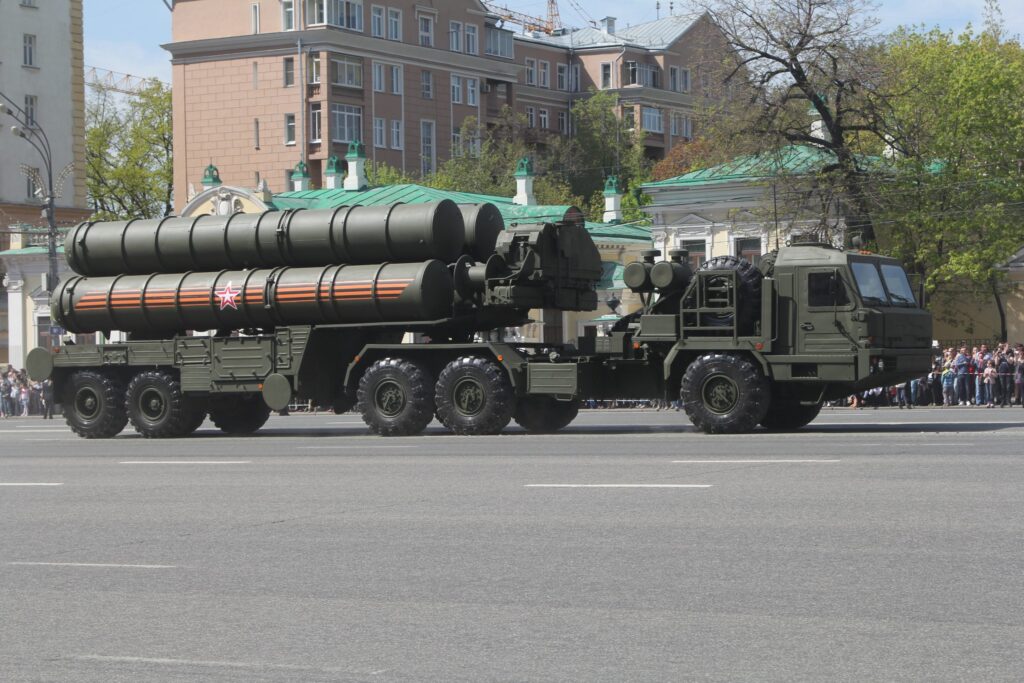
ROME, July 15 — The redeployment of Russia’s most advanced air defense systems from the Arctic to the Ukrainian front tells a story the Kremlin would rather not broadcast. Satellite imagery from August 2024, analyzed by open-source intelligence groups, captured the removal of S-400 Triumf launchers from Nagurskoye airfield in the Franz Josef Land archipelago. At roughly the same time, Pantsir-S1 systems were withdrawn from Temp airfield on Kotelny Island.
The mechanics here are straightforward: Russia is stripping its strategic periphery to patch holes closer to home. The S-400 Triumf, developed by Russia’s Almaz-Antey and first deployed in 2007, is a long-range surface-to-air missile system capable of engaging targets at ranges up to 400 kilometers and altitudes up to 30 kilometers.
It is widely considered one of the most advanced air defense systems in the world. The Pantsir-S1, introduced in 2012, is a shorter-range system that combines radar, surface-to-air missiles, and anti-aircraft cannons. Both systems have seen extensive use in the Ukraine war.
Their original job in the Arctic was to protect Russian strategic assets, including nuclear submarines and bomber bases. Moving them signals a shift in priorities.
The catch is that these systems are not easily replaced. The Arctic bases they left behind are now more vulnerable. Russia has invested heavily in its northern military infrastructure, and the S-400s and Pantsirs were a central part of that posture.
Pulling them out suggests that the threat from Ukrainian drone and missile attacks, which have increasingly targeted Russian air bases and oil refineries, has become the more immediate concern. Follow the logic: if Moscow were winning the air war, it would not be relocating its premier defensive systems from the High North.
What Ukraine is throwing at them
Ukraine has not been fighting this war with Soviet-era equipment alone. Western air defense systems, including Patriot batteries from the United States and IRIS-T from Germany, have been delivered to Kyiv. These systems have forced Russian aviation to operate more cautiously and have raised the cost of each missile strike.
On closer reading, the Russian redeployment is a defensive adjustment to a Ukrainian capability that did not exist in the early phases of the war. The Patriot system, in particular, has demonstrated the ability to engage ballistic missiles, which has complicated Russian targeting calculations.
The S-400 and Pantsir systems are not just any hardware. They are the backbone of Russia’s layered air defense doctrine. The S-400 handles the high-altitude, long-range threat; the Pantsir covers the low-altitude, short-range gaps.
Removing them from the Arctic and sending them to Ukraine means Russia is betting that the immediate threat from Ukrainian strikes outweighs the long-term risk of leaving northern bases exposed. That is a bet on the current operational tempo holding, rather than on strategic depth.
What the imagery shows
The satellite imagery from August 2024, analyzed by open-source intelligence groups, provides a rare unclassified look at Russian military logistics. The Nagurskoye airfield is located in the Franz Josef Land archipelago, a remote set of islands in the high Arctic. Temp airfield sits on Kotelny Island, part of the New Siberian Islands.
These are not minor outposts; they are forward operating bases for Russia’s Northern Fleet and its strategic bomber force. The decision to remove air defense systems from these locations was not taken lightly.
The imagery confirms the movement, but it cannot show the debate inside the Russian General Staff that preceded it. Both the S-400 and the Pantsir-S1 have been used extensively in the Ukraine war. That experience has likely revealed weaknesses and maintenance demands that were not apparent during peacetime deployments.
The systems pulled from the Arctic may be headed for repairs, or they may be going directly to the front. Either way, the Arctic is now less defended than it was a year ago.
That has implications for NATO’s northern flank and for the security of the undersea cables and energy infrastructure in the region. What to watch next is whether Russia attempts to backfill these Arctic positions with older systems, such as the S-300, or whether it simply accepts the reduced coverage. The answer will tell us how stretched Russian military logistics have become.
For now, the satellite photos offer a rare, verifiable glimpse of a strategic shift driven by the grinding demands of a war that shows no signs of ending.




