
“There is to be no hesitation.” With that line in a social media post on Thursday, President Donald Trump said he had ordered the US Navy to “shoot and kill” any Iranian boat laying mines in the Strait of Hormuz. Al Jazeera reported that the order could put the fragile ceasefire between the two countries at risk.
Trump’s post took a dig at Iran’s fleet, saying its naval ships are “ALL, 159 of them, at the bottom of the sea!” He added that mine sweepers are clearing the strait right now, and that he was ordering the work to continue “at a tripled-up level!”
Defense Secretary Pete Hegseth repeated the order at a Pentagon briefing on Friday. Trump, he said, has authorized the Navy to destroy any Iranian fast boats that try to mine the water or disrupt passage. “This is a real full blockade,” Hegseth said. “We’ll use up to and including lethal force if necessary.”
A blockade with no end date
The mining order sits alongside a US blockade of Iranian ports, which Hegseth said will run “for as long as it takes.” The war was in its 55th day, and he said the US was “not anxious for a deal.” Since the blockade began last week, he said, the Navy has turned around 34 ships and interdicted at least three.
Gen. Dan Caine, the Joint Chiefs chairman, described the boardings. On Sunday, Marines boarded the Touska, a 965-foot Iranian container ship, after its crew ignored warning shots. A destroyer had fired nine rounds into the engine room. The next day, a Navy team took over the tanker Tifani in the Indian Ocean at the Justice Department’s request. Caine said it carried sanctioned Iranian oil. The very large crude carrier Majestic X was interdicted on Wednesday. All three ships and their crews are in US custody.
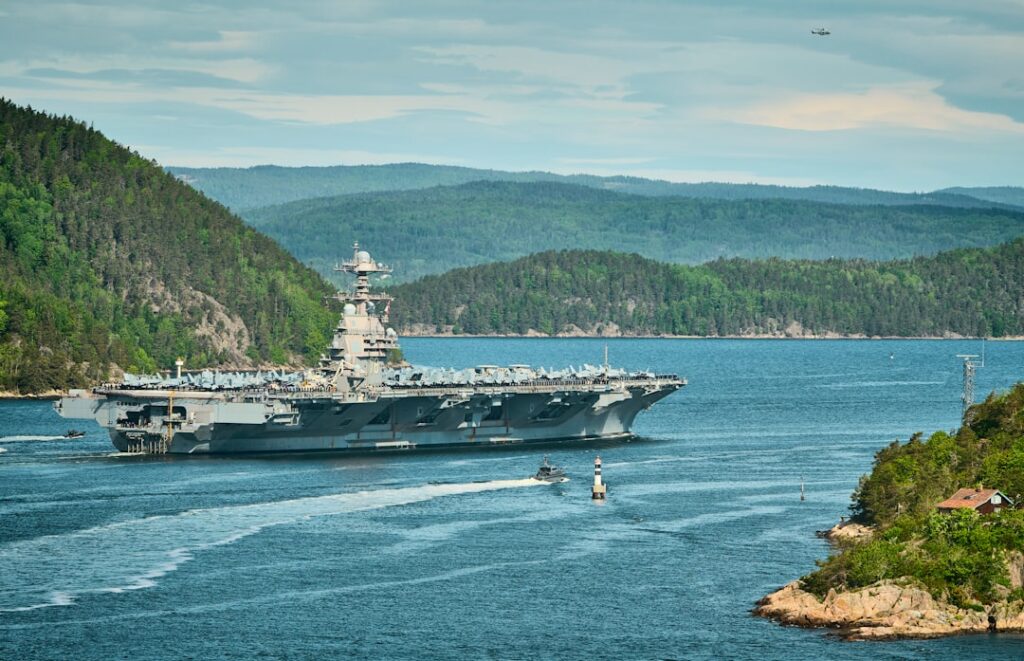
US Central Command said the carriers Abraham Lincoln, Gerald R. Ford and George H.W. Bush are all in the Middle East, the first time in decades that three have operated there at once.
Iran’s response
Iranian officials have promised repeatedly to defend the country and answer any US attack. Iran closed the strait in response to the US-Israeli military campaign and now claims rights to the passage, parts of which run through Iranian waters. Before the war, about 20 percent of the world’s oil and natural gas moved through it. Petrol in the US has passed $4 a gallon, up from $3 before the conflict.
Iran has made lifting the blockade a precondition for resuming talks. Trump extended the ceasefire when it was due to expire on Wednesday, with no deadline set. He also claimed the US has “total control over the Strait of Hormuz” and that it is “sealed up tight”, though Iran has all but halted vessel traffic there.
Trump also asserted that Iran’s leadership is split between hardliners and moderates. Al Jazeera noted there is no evidence of a rift. President Masoud Pezeshkian replied on X that there are “no radicals or moderates” in the country, and that “we are all ‘Iranian’ and ‘revolutionary’.”
Doubts about the strategy
Jennifer Kavanagh of Defense Priorities rejected Hegseth’s claim that time favors Washington. “The costs for the United States and its allies (and the global economy) are higher than they are for Iran,” she said. “The only exit strategy is through political compromise.”
Sources
- US to ‘shoot and kill’ Iranian boats laying mines in Hormuz, Trump says
- US Navy ordered to ‘shoot and kill’ alleged Iranian mine-laying boats amid ceasefire
- 2026 Strait of Hormuz campaign




