
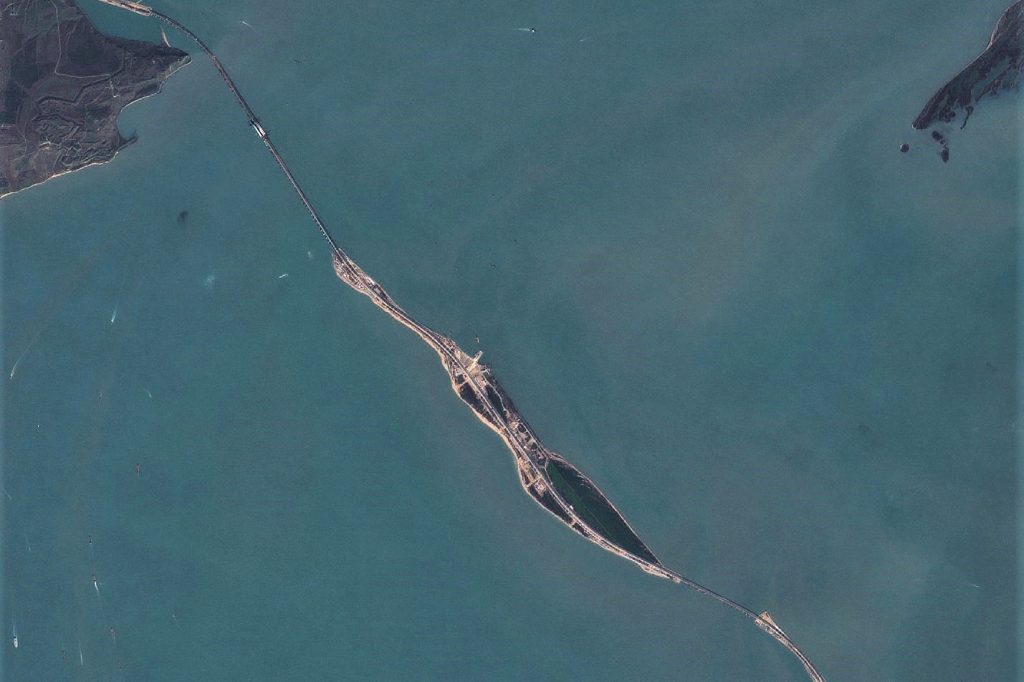
At 6:10 p.m. local time on July 10, 2026, Russia’s FSB Border Guard Service told shipping companies it would no longer accept applications to pass through the Kerch Strait. The order took effect immediately. No date was given for lifting it.
Russia also suspended navigation on the Don-Azov Canal, the waterway between the Don River and the Sea of Azov, according to Reuters, which cited three sources in Russia’s grain export industry. The cause was eight days of Ukrainian drone strikes. By Tech Times’ count, loitering munitions had hit more than 100 vessels in the Sea of Azov in that time, and 15 more were struck overnight into Monday, July 13, when the restrictions were still in force.
Why the strait matters
The Kerch Strait is the only maritime gateway between the Sea of Azov and the Black Sea. After annexing Crimea in 2014, Russia took authority over both sides of it. The sea behind it is shallow, with a maximum depth of only 14 meters, and covers roughly 37,600 square kilometers. Its ports include Taganrog, Yeysk, Mariupol and Berdyansk. Fed by the Don and Kuban rivers, it has low salinity.
The closure stops more than local traffic. Market analysts cited by Reuters estimate that up to a quarter of Russia’s wheat exports, from the Rostov and Krasnodar regions, move through the Azov. Euronext wheat futures rose as much as 4% on July 10 to a six-week high. Sources in the grain industry described long lines of trucks forming near the entrances to the ports of Rostov and Taganrog, which stopped accepting grain.
The sea also supplies fuel to occupied Crimea.
Operation Crimean Switch Off
Ukraine’s 414th Separate Unmanned Strike Aviation System Brigade, known as “Magyar’s Birds” after Unmanned Systems Forces commander Robert “Magyar” Brovdi, launched what it called “Operation Crimean Switch Off” on July 6. On the night of July 11 alone, Ukrainian drone units struck 28 Russian ships: 21 tankers, four tugboats, two cargo vessels and a dredger. They also hit 53 military targets across occupied Crimea and southern occupied territories.
Brovdi said the aim is not necessarily to sink ships. It is to put them into long repairs so they cannot do their logistical work. Some, he said, have been struck more than once.
The Institute for the Study of War, citing Starboard Maritime Intelligence data, reported a roughly 55% fall in vessels sending active AIS transponder signals in the Azov between June 30 and July 11. Shadow fleet ships often switch the transponders off, so the real drop may be larger.
Defense analyst Roy Gardiner estimated that Ukrainian drones had struck about 175,000 tons of shipping in a few days. “These are World War II numbers,” he wrote.
The weapon
Much of the damage appears to come from the Fire Point FP-2, a one-way attack drone. Fire Point co-owner Denis Shtilerman told the TSN outlet that the warhead was raised to 200 kilograms, and a redesigned wing extended its range to about 370 kilometers with that payload. The Azov is roughly 340 kilometers across at its widest, north to south, so a single launch site in Ukrainian-controlled territory can reach any vessel on it.
The War Zone reported that operators watch the target through the drone’s camera over satellite data links and confirm the strike before impact.
Fuel crisis on land
The shipping campaign lands on a country already short of fuel. Novaya Gazeta Europe estimated on July 2 that the crisis had spread to at least 78 of Russia’s 83 regions. Kpler put Russian gasoline production at roughly 20% below domestic demand. Moscow drivers reported waits of two hours or more to fill up. Putin acknowledged the impact for the first time but called the refinery strikes “not critical.”
Sources
- Sea of Azov: Geography, Ecology and Strategic Chokepoints
- Ukraine Drones Seal Azov Sea: Russia Suspends Kerch Strait, Wheat Prices Jump
- Kerch Strait: the strategic gateway Putin cannot afford to lose at any cost




