
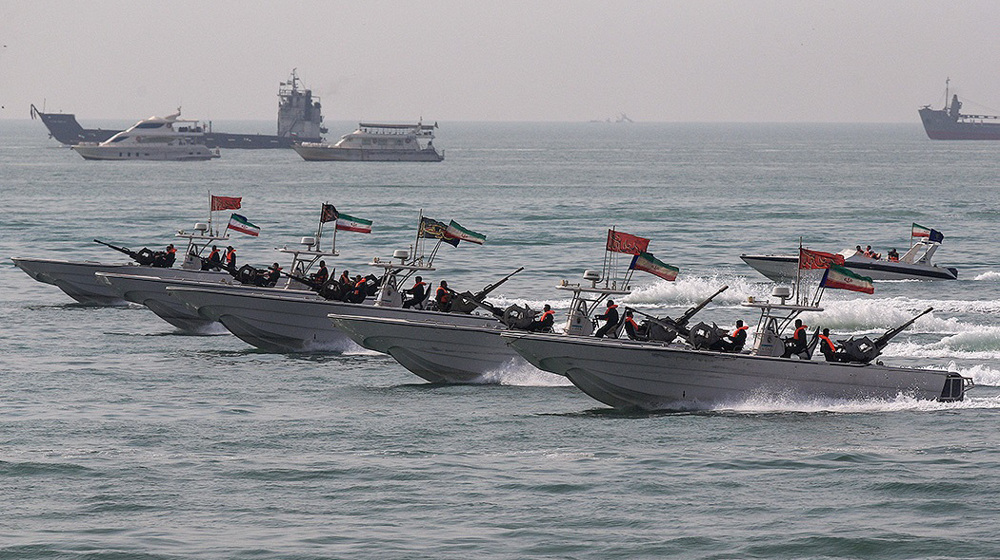
Nobody outside Iran’s Revolutionary Guard knows how many small attack boats it owns. The Australian Broadcasting Corporation reported in May 2026 that analysts put the figure anywhere from hundreds to thousands, and that many sit in “cavernous bunkers under the mountains.” Iran’s judiciary chief has said they “lie in wait from the sea caves of Faror Island” for American warships.
That secrecy is part of the design. The Islamic Revolutionary Guard Corps Navy is built for a different kind of fight than the regular navy it operates beside.
A parallel force with its own sailors
The Guard Corps took shape right after the shah fell in 1979, as a counterweight to conventional armed forces that Iran’s clerical leaders distrusted. The Council on Foreign Relations says its chain of command runs to the supreme leader and “bypasses the elected president.” The whole IRGC counts approximately 190,000 troops, and the naval branch accounts for twenty thousand sailors. They patrol the waters around the Strait of Hormuz, where about one-third of the world’s seaborne crude oil passes each year, by the council’s estimate.
The mosquito fleet
The navy’s signature weapon dates to the 1980s: fast boats carrying rocket-propelled grenades, machine guns and, more and more, missiles. They attack in swarms from several directions at once, aiming to swamp the defenses of a merchant ship before it can react. Alex Plitsas, a former Pentagon official, explained the logic to the ABC bluntly: “they’re small and annoying, and they hit.” Jennifer Parker, a maritime security expert at The Australian National University, said the boats “traditionally come out and harass vessels and merchant ships.”
Tankers and cargo ships have little answer. They cannot use defensive weapons effectively and move too slowly to run. Hundreds of ordinary speedboats work the same waters every day, so the attackers can blend in. Before the current conflict, approximately 20 percent of the world’s oil flowed through the strait, according to the ABC. The United States sent Seahawk helicopters against the boats, and Admiral Brad Cooper reported six destroyed.
Losing its commander
Iran has lost much of its traditional navy, the ABC noted, yet the small boats remain a threat to global shipping. The force’s commander, Alireza Tangsiri, did not survive the war. The Jerusalem Post reported that Israel killed him on March 26, 2026. Per the paper, Israeli officials saw Tangsiri as “a highly creative and resourceful commander” and feared he might go on to lead the entire IRGC. Cooper, it said, had telephoned Israeli chief of staff Lt.-Gen. Eyal Zamir on March 19 and asked for Tangsiri’s elimination. Zamir approved it.
Sources
- The Islamic Revolutionary Guard Corps (IRGC)
- Iran's Mosquito Fleet: a strategic disruption in the Strait of Hormuz
- Israel assassinated Iran's navy chief over fears he could lead a more dangerous IRGC




