
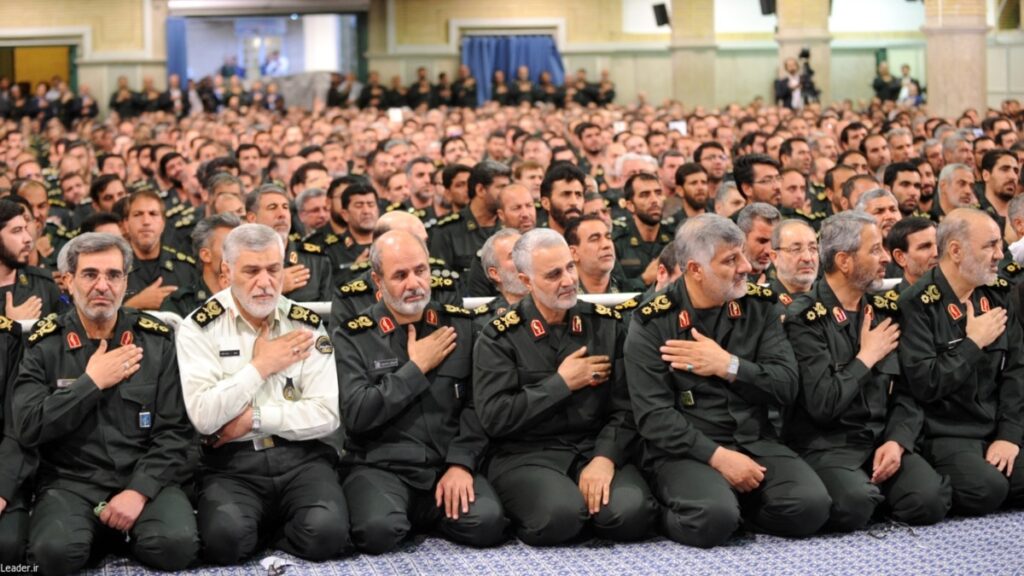
Estimates put the Quds Force at roughly 17,000 to 21,000 soldiers, according to Business Insider. That is a small number for a unit with a footprint from Lebanon to Yemen. The explanation lies in what it does: the Quds Force mostly does not fight directly, it equips and trains others to.
The unit is the external arm of Iran’s Revolutionary Guards. The Council on Foreign Relations calls it the Guards’ external affairs branch in all but name, and says it emerged out of the IRGC’s sponsorship of armed groups beyond Iran’s borders, which began in the 1980s during the Iran-Iraq War. Business Insider traces the group to the aftermath of the 1979 revolution and adds that the name is the Arabic term for Jerusalem.
Command runs straight to the top. The Quds Force reports directly to Supreme Leader Ali Khamenei. The Guards as a whole answer to him too, and their command structure bypasses the elected president.
An “axis” built on supply
By the CFR’s account, Tehran’s aim is twofold: export its revolution and deter Western countries and Israel. The group’s partners in this effort include Hamas, Hezbollah and the Houthis, and Iran treats the arrangement as an anti-Western “axis of resistance.” The Quds Force supplies weapons, money, training and advice.
One man shaped much of that web. Qasem Soleimani, the Quds Force commander, cultivated Iran’s partnerships with regional armed groups, the CFR says. A US drone strike killed him in January 2020, together with Abu Mahdi al-Muhandis, an Iraqi-Iranian dual citizen who had been a Quds Force officer himself and who led the mobilization of Shiite militias against the Islamic State. Business Insider places the strike in Baghdad. Iran answered with missiles fired at American forces in Iraq.
What Washington accuses it of
In 2007, President George W. Bush charged that the unit was handing Shiite militants roadside bombs for use against American troops. The CFR flags a caveat: experts in and out of the US government questioned whether those orders really came from Tehran. The Trump administration later blamed the IRGC for 608 American troop deaths in Iraq, a tally covering 2003 to 2011. Business Insider adds that the unit helped arm Iraqi militias with improvised explosive devices, blamed for hundreds of American military deaths.
Older cases are murkier. Western and regional intelligence officials link the IRGC with a 1994 attack in Buenos Aires on a Jewish center, a charge Tehran denies. The 1983 bombings in Beirut have been laid at the door of Iran and Hezbollah.
Syria, Yemen and the money
After the Arab uprisings of 2011 the Quds Force went into Syria. Iran first described its people as guardians of Shiite shrines, then acknowledged that they were helping Bashar al-Assad suppress unrest. They worked as advisers and also fought on the front lines beside Hezbollah militants and Afghan refugees. In Yemen, the Houthi rebels received intelligence, training and weapons from the Guards.
The CFR says the Guards have smuggled oil, mostly to China, raising millions that flow to the Quds Force and to Hezbollah.
The unit has also been a target. In June 2025, during Israel’s “Operation Rising Lion,” the Israel Defense Forces said they hit Quds Force command sites in the Iranian capital, killing the head of its intelligence department and his deputy. The IDF said the sites were “completely destroyed.”
Sources
- The Islamic Revolutionary Guard Corps (IRGC) – Council on Foreign Relations
- What is the Quds Force, the elite Iranian unit Israel has been targeting in airstrikes? – Business Insider




