
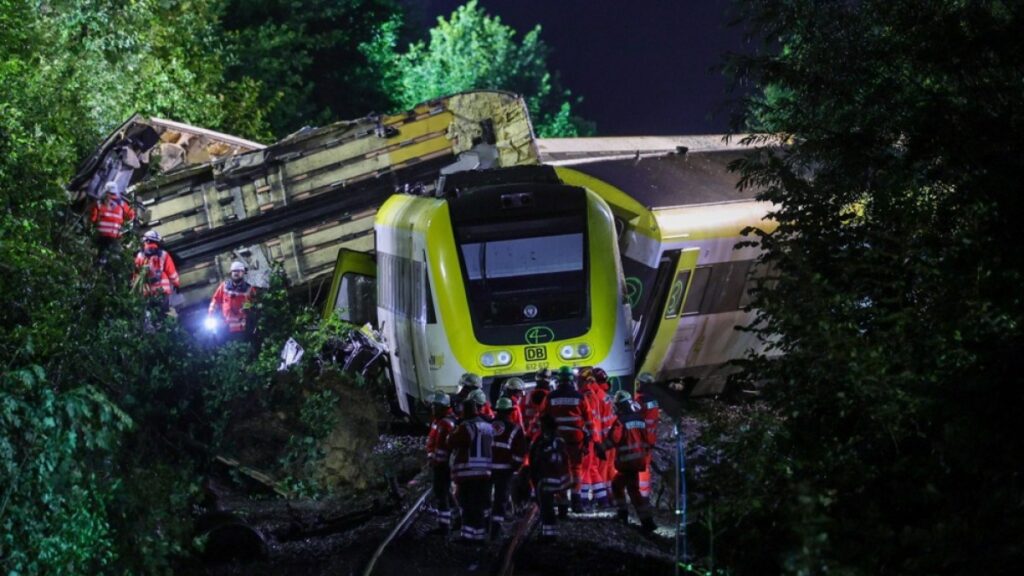
A catastrophic train derailment in Baden-Württemberg on July 27, 2025, has left three people dead and approximately 50 injured, thrusting Germany’s state-owned railway operator into a renewed spotlight over infrastructure and safety. The Regional-Express train, operated by Deutsche Bahn AG, was carrying roughly 100 passengers when it left the tracks.
Among the deceased are a railway employee and the train driver, while 25 of the injured remain in serious condition. Deutsche Bahn, formed in 1994 through the merger of West Germany’s Deutsche Bundesbahn and East Germany’s Deutsche Reichsbahn, is a product of national unification. Headquartered in Berlin’s Bahntower, the company serves 132 million long-distance passengers and 1.6 billion regional passengers annually.
These figures underscore the immense scale of operations—and the potential for harm when failures occur. This derailment is not an isolated incident but rather a symptom of longstanding strain on Germany’s rail network.
For years, investment has failed to keep pace with rising demand, leading to aging tracks, signals, and rolling stock. Deutsche Bahn has faced persistent criticism over delays, cancellations, and maintenance backlogs. While the company maintains that safety is its top priority, a derailment of this severity demands scrutiny into possible causes: track defects, signal errors, mechanical faults, or human error. The violent nature of the crash is evident in the high number of serious injuries.
The driver’s death is particularly significant, as drivers serve as the last line of defense, identifying hazards and applying brakes. The loss of both the driver and a railway employee represents a direct depletion of institutional knowledge and experience within the system.
Deutsche Bahn will cooperate with regulators, but the outcome of such investigations often follows a predictable pattern: reports leading to recommendations, which may or may not receive funding. Funding, however, requires political will. Germany, as a wealthy nation, has the resources to maintain its railways.
The question is whether it will prioritize doing so. This incident will intensify pressure on the federal government, which owns Deutsche Bahn.
Ministers will face inquiries in the Bundestag, opposition parties will seek accountability, and the public will demand reassurance. The company’s reputation, already weakened by chronic delays, is likely to suffer further. The regional network, carrying 1.6 billion passengers each year, is a backbone of daily life for millions—commuters, students, workers, and families.
A derailment of this magnitude erodes trust, prompting passengers to question the safety of their next journey. Calls for increased investment, independent safety reviews, and faster infrastructure upgrades are expected.
These measures are reasonable but require significant time and funding, competing with other national priorities such as the energy transition, defense spending, and social programs. The facts remain: three dead, approximately 50 injured, and about 100 passengers aboard. The investigation will determine the cause; the aftermath will determine the response.
Deutsche Bahn faces substantial questions, the government faces difficult decisions, and passengers face lingering uncertainty.




